
- News
- Posted
Fosi Audio S3, ZD3, ZH3 & PSU20
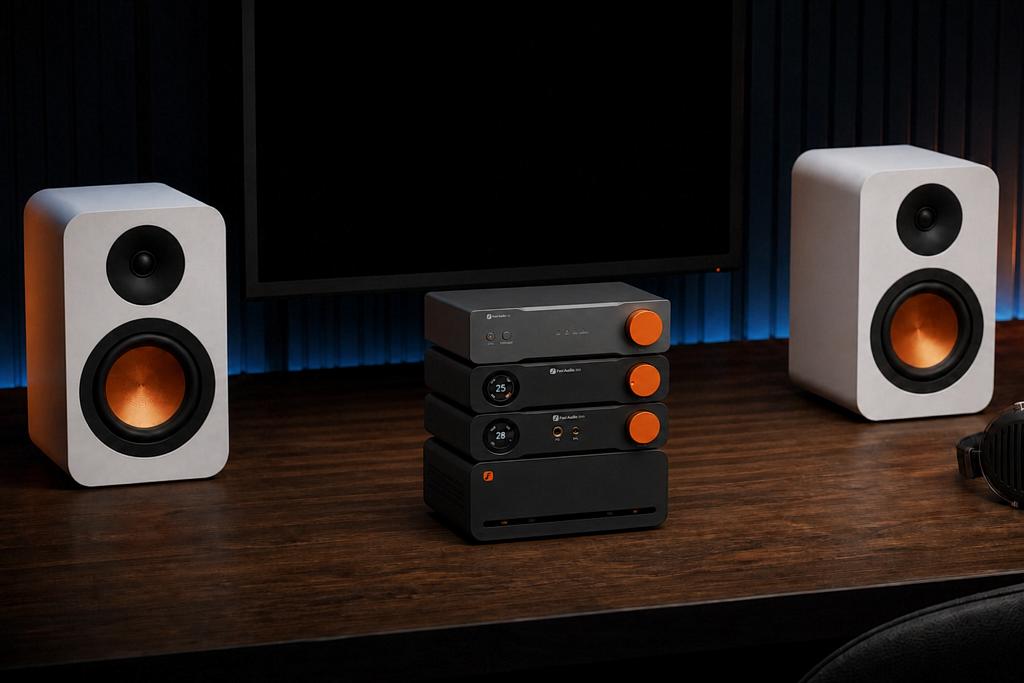
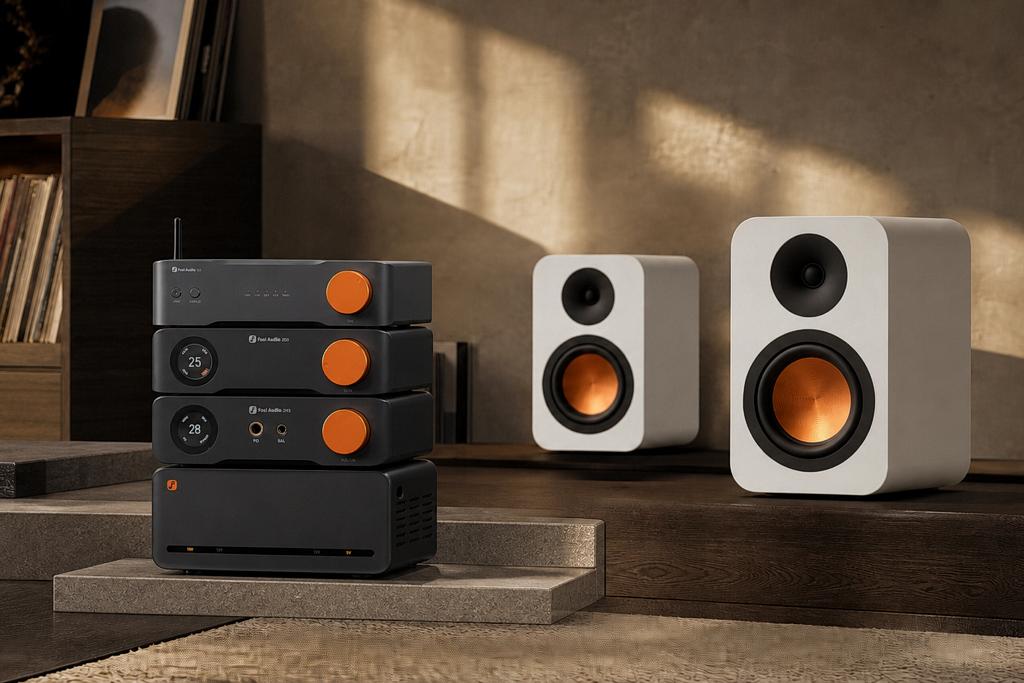
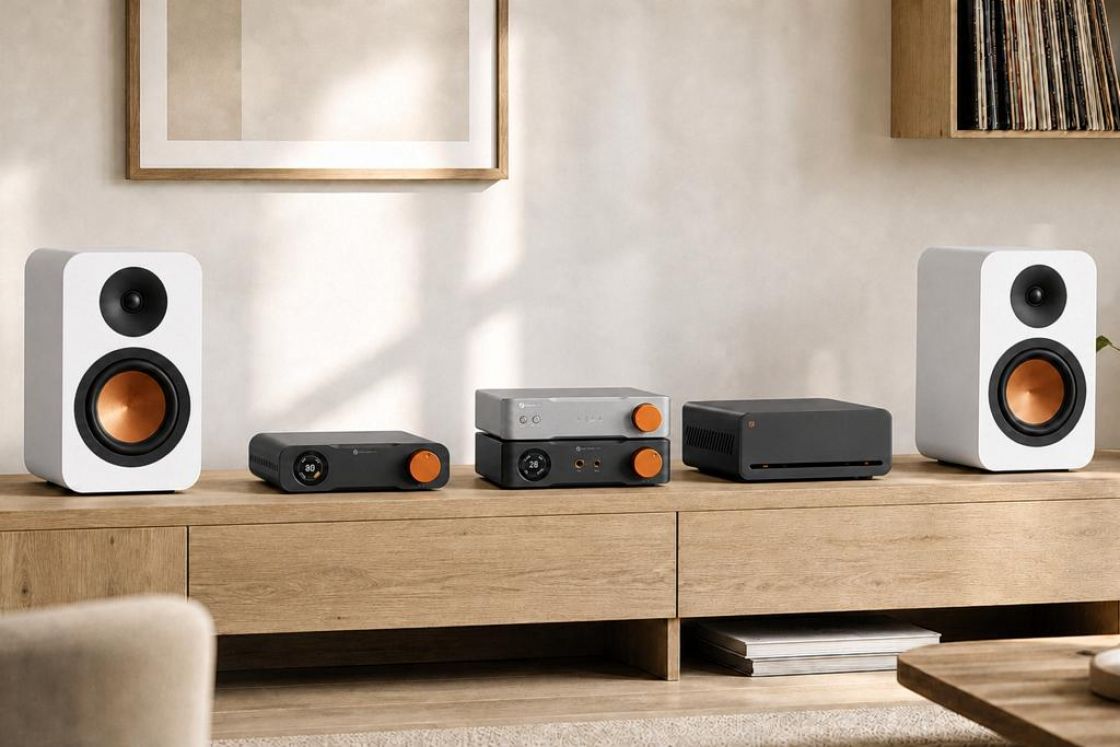
Fosi Audio started out making small, affordable amplifiers designed to deliver as much performance as possible for relatively little money, while occupying considerably less space on a desk or shelf than conventional hi-fi equipment. Over time, however, the Chinese company's portfolio has expanded well beyond that original concept. DACs, preamplifiers, monoblocks, headphone amplifiers, and, more recently, loudspeakers and a dedicated music streamer have all joined the lineup. Now, Fosi Audio is attempting to bring these developments together into something that can reasonably be described as a complete audio ecosystem. At its core are four components with similar dimensions and a consistent visual identity: the S3 network streamer, ZD3 digital-to-analog converter, ZH3 headphone amplifier, and PSU20 linear power supply. Each can operate independently, but all four have been designed with the idea that users can gradually assemble a more sophisticated system as their requirements evolve.
This approach is particularly interesting because Fosi Audio is not trying to squeeze every conceivable feature into a single enclosure. Modularity should be understood here in a functional rather than a literal sense. Instead of replacing internal circuit boards or expansion cards, users simply add another compact component when they actually need its capabilities. Someone who already owns an amplifier and a pair of speakers can start with the streamer. A listener who primarily uses a computer and headphones might choose the headphone amplifier with its integrated DAC. A separate converter can come later, as can a dedicated linear power supply. Importantly, these four components do not represent the limits of the system. Fosi Audio also expects them to work alongside its stereo amplifiers, power amplifiers, monoblocks, loudspeakers, and subwoofers. The idea is to offer a flexible collection of components that can be combined in different ways, rather than forcing customers into a single predefined configuration.
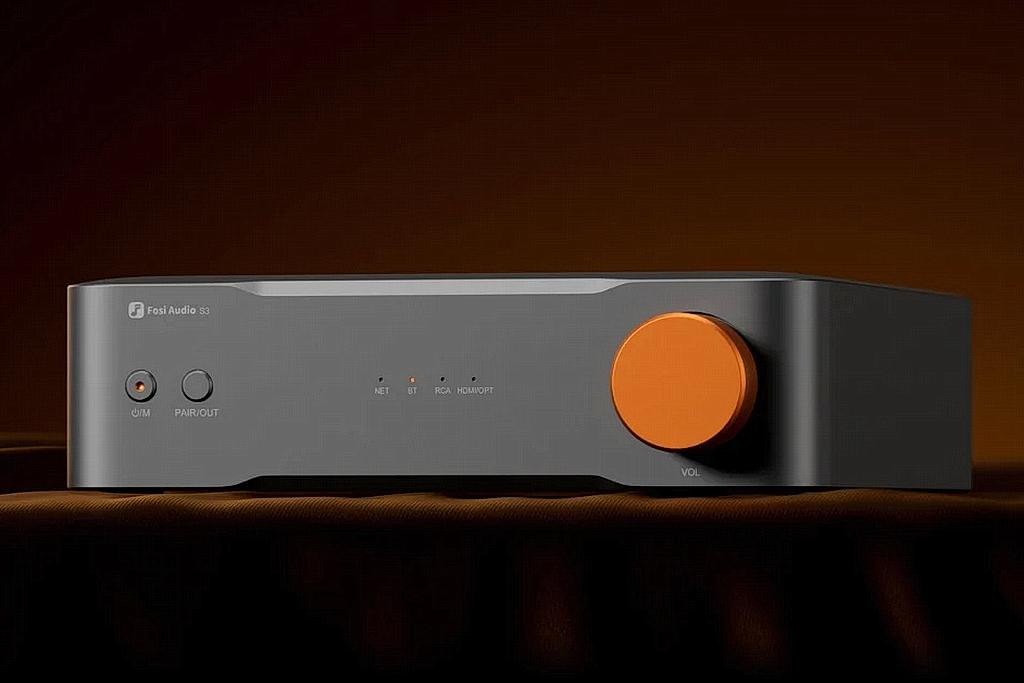
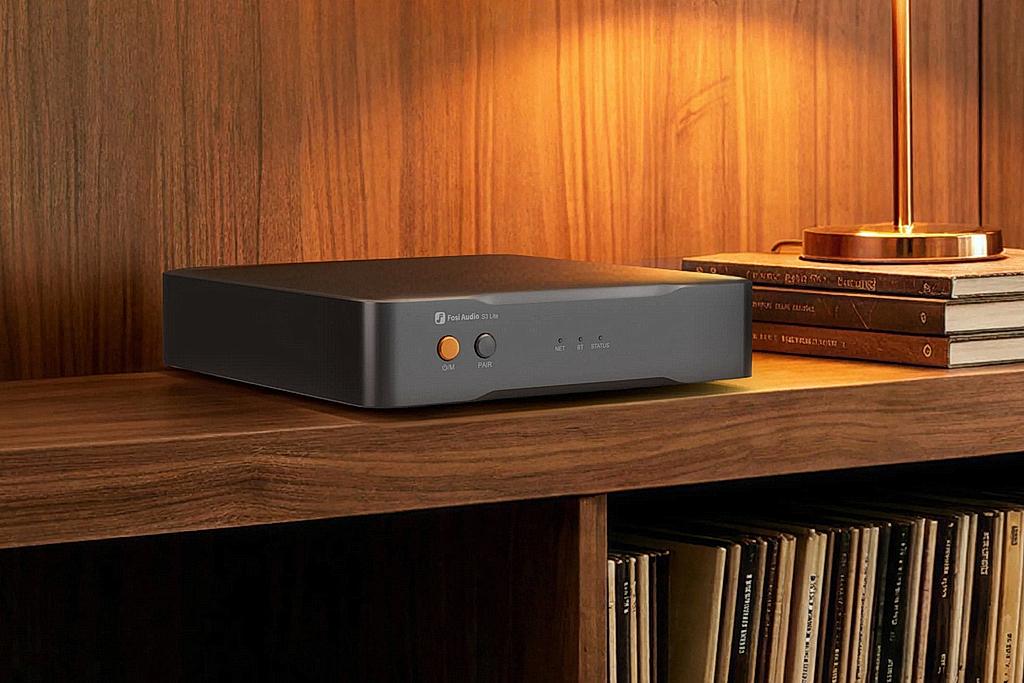
The most versatile member of this quartet is the S3, the first dedicated network streamer in Fosi Audio's history. It can perform three functions simultaneously, serving as a network music player, digital-to-analog converter, and preamplifier. Its conversion stage is built around the AKM AK4493SEQ DAC chip, supported by OPA1612 operational amplifiers and ELNA capacitors, while the digital and analog sections are kept separate to minimize interference. The S3 supports AirPlay 2, Google Cast, Spotify Connect, TIDAL Connect, and DLNA/UPnP, with Roon Ready certification still in progress. Network connectivity is provided by dual-band Wi-Fi 6 and Ethernet, while the manufacturer also specifies support for PCM material with sampling rates reaching 768 kHz through compatible wired connections. Bluetooth 5.3 is included as well, and users can control the streamer through the Fosi Audio app or the supplied Bluetooth remote. In other words, despite its modest dimensions, the S3 has been designed to accommodate virtually every popular way of listening to digital music, from conventional streaming services to files stored on a home network.
The S3 is not intended exclusively for streaming music from the internet. Its rear panel also provides USB, optical, and coaxial digital inputs, along with an HDMI eARC connection that allows the component to be integrated into a system with a television. On the analog side, both single-ended RCA and balanced XLR outputs are available, while a dedicated subwoofer output makes it relatively easy to build a compact 2.1 system. In practice, the S3 can therefore serve as the central component of a setup using powered speakers or a separate power amplifier, without requiring an additional preamplifier or DAC. It is only when the owner decides to delegate digital-to-analog conversion to a separate device that another member of the Fosi Audio family becomes particularly relevant.
That component is the ZD3, a fully balanced DAC equipped with its own volume control and capable of operating as a preamplifier. This time, Fosi Audio has chosen the ESS ES9039Q2M conversion chip and an XMOS XU316 USB receiver. Through USB, the DAC supports PCM signals at sampling rates up to 768 kHz and DSD512, while the manufacturer's specifications quote total harmonic distortion plus noise below 0.00008% and a signal-to-noise ratio of 126 dB. The ZD3 features USB, optical, and coaxial inputs, but also includes HDMI ARC and Bluetooth connectivity with support for aptX and aptX HD. Consequently, it can handle audio from a computer, television, smartphone, or a conventional digital transport with equal ease. Analog output is available through RCA and balanced XLR connections. One particularly useful feature is bypass mode, which disables the internal volume control and turns the ZD3 into a conventional DAC with a fixed output level. This allows another component, such as the S3, to handle volume adjustment instead.
Fosi Audio has also retained a feature familiar from some of its earlier products: replaceable operational amplifiers. The ZD3's op-amp is installed in a DIP8 socket, allowing more technically adventurous users to experiment with compatible alternatives without touching a soldering iron. The manufacturer lists devices such as the MUSES02, OPA2134PA, and discrete Sparkos Labs SS3602 among the possible replacements. Whether changing an operational amplifier produces an audible improvement will naturally depend on the circuit and the component being substituted, but the ability to experiment is undoubtedly appealing to enthusiasts who enjoy modifying and fine-tuning their equipment. It also fits neatly into Fosi Audio's broader philosophy of allowing owners to customize their systems instead of treating every internal component as something that must remain permanently untouched.
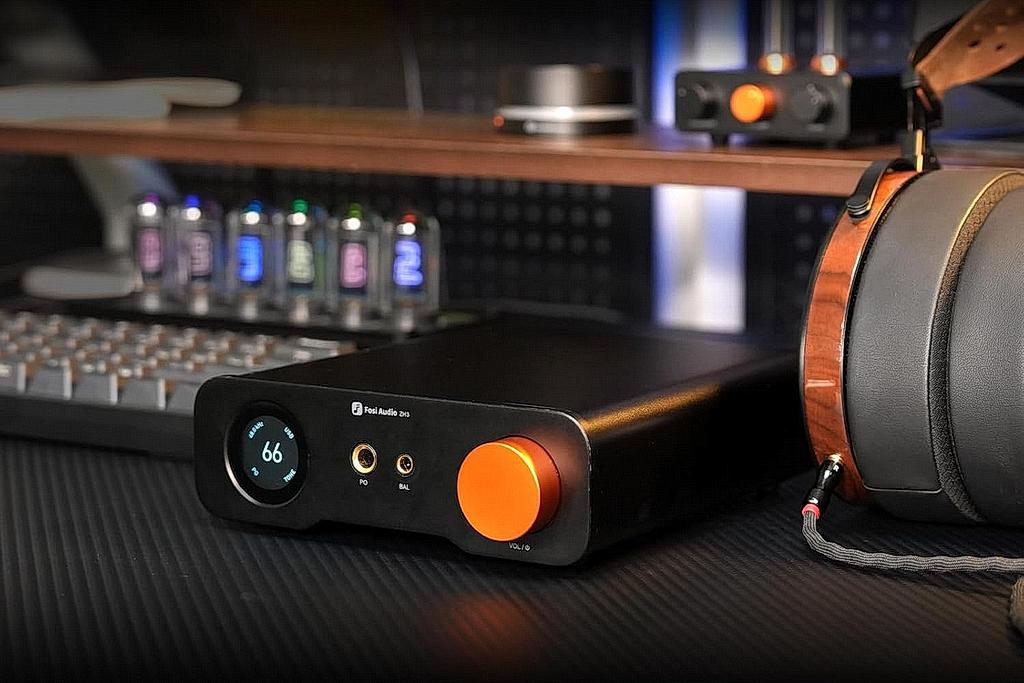
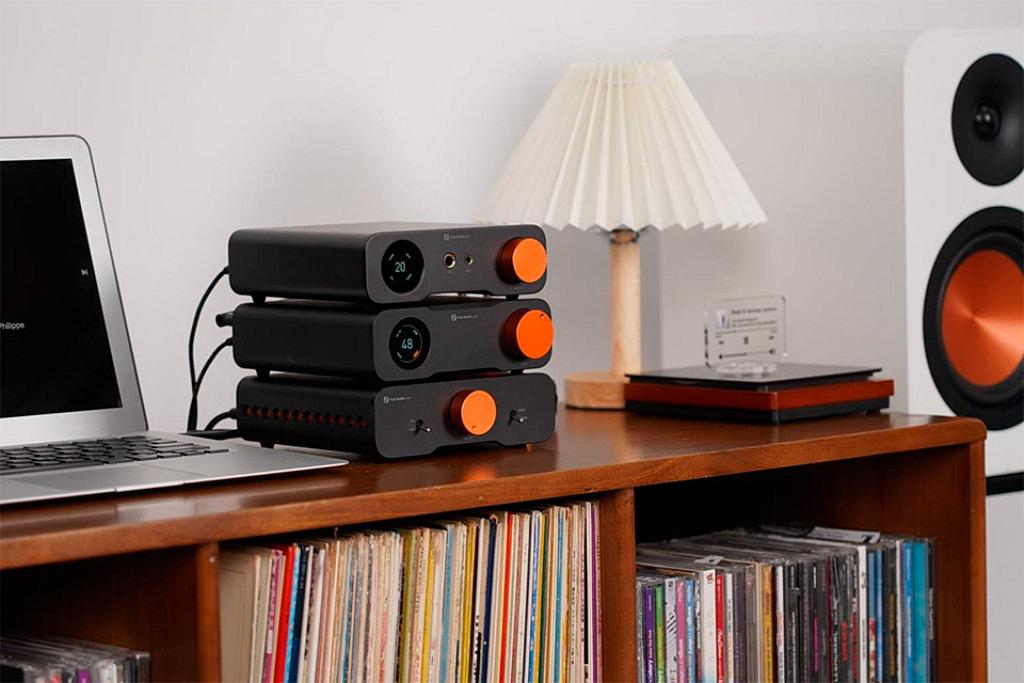
The third member of the family is the ZH3, a component aimed primarily at headphone listeners, although describing it simply as a headphone amplifier would hardly do it justice. Its compact enclosure contains a DAC, preamplifier, and balanced headphone amplification stage. Digital-to-analog conversion is once again handled by an AKM AK4493SEQ, while an XMOS XU316 interface enables PCM playback up to 768 kHz and DSD512. The analog circuitry incorporates four replaceable OPA1612 operational amplifiers. The most impressive specifications, however, concern the headphone outputs. Through its balanced 4.4 mm connection, the ZH3 can deliver up to 2,570 mW per channel into 32 ohms, while the single-ended 6.35 mm output provides 640 mW per channel into the same load. Three selectable gain settings are intended to accommodate both sensitive headphones and more demanding models with impedances reaching 300 ohms. This combination should give the ZH3 considerable flexibility, allowing it to work with everything from relatively efficient everyday headphones to full-size designs that require substantially more power.
The ZH3 does not have to be the final destination of the audio signal, either. RCA and XLR line outputs allow it to function as a preamplifier for active studio monitors or a separate power amplifier, while an analog RCA input provides a connection for an additional source. Users also get bass and treble controls, six selectable digital filters, volume memory, automatic shutdown, and a remote control. Support for USB Audio Class 1.0 and 2.0 extends compatibility to certain gaming consoles as well. Fosi Audio is therefore attempting to bring conventional hi-fi functionality into the increasingly popular world of desktop audio, where the same system may be used for work in the morning, music in the evening, and gaming or movies later at night. Rather than requiring a dedicated component for every activity, the ZH3 combines several useful functions in a single compact device, without abandoning the kind of connection options and adjustment facilities associated with more traditional hi-fi equipment.
The fourth component may appear the least exciting at first glance, but it plays an important role in the overall system concept. The PSU20 is a dedicated linear power supply capable of powering up to three devices simultaneously. Inside its enclosure is an 80-watt toroidal transformer, Nippon Chemi-Con capacitors, and circuitry responsible for voltage regulation and stabilization. Two DC outputs and a USB-A connection are electrically isolated from one another, with each channel featuring its own rectification, filtering, regulation, and protection circuitry. The first DC output can be configured for 12 or 15 V and supplies up to 20 W, while the second offers 12 or 5 V with a maximum output of 15 W. The USB-A port provides 5 V at 1 A. According to the manufacturer, the power supply achieves a ripple level as low as 0.1 mV, while the input can be switched between 115 and 230 V mains operation. Protection against overheating, overvoltage, and overcurrent is also included.
The reasoning behind the PSU20 is relatively straightforward. Many compact audio components rely on external switching power supplies, which are inexpensive, efficient, and practical, but can also introduce electrical noise depending on their design and implementation. A properly engineered linear supply can provide clean, stable power while allowing several compatible devices to share a single power connection. Of course, this does not automatically mean that replacing a switching adapter with a linear supply will transform the sound of every DAC, streamer, or amplifier. The actual benefit depends on the quality of the original power supply and the power regulation already implemented inside the connected equipment. Nevertheless, the PSU20 offers an attractive combination of low-noise power delivery, flexible output voltages, and simplified cable management. It also provides a way of upgrading the supporting electronics without replacing the audio components themselves, provided their voltage and current requirements are compatible with its outputs.
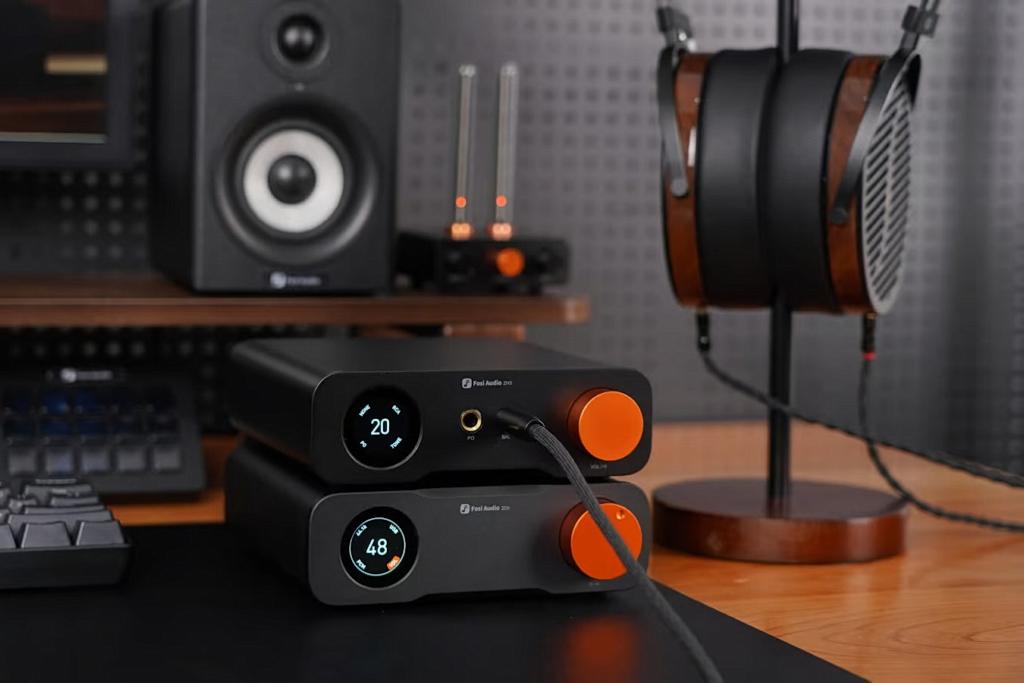
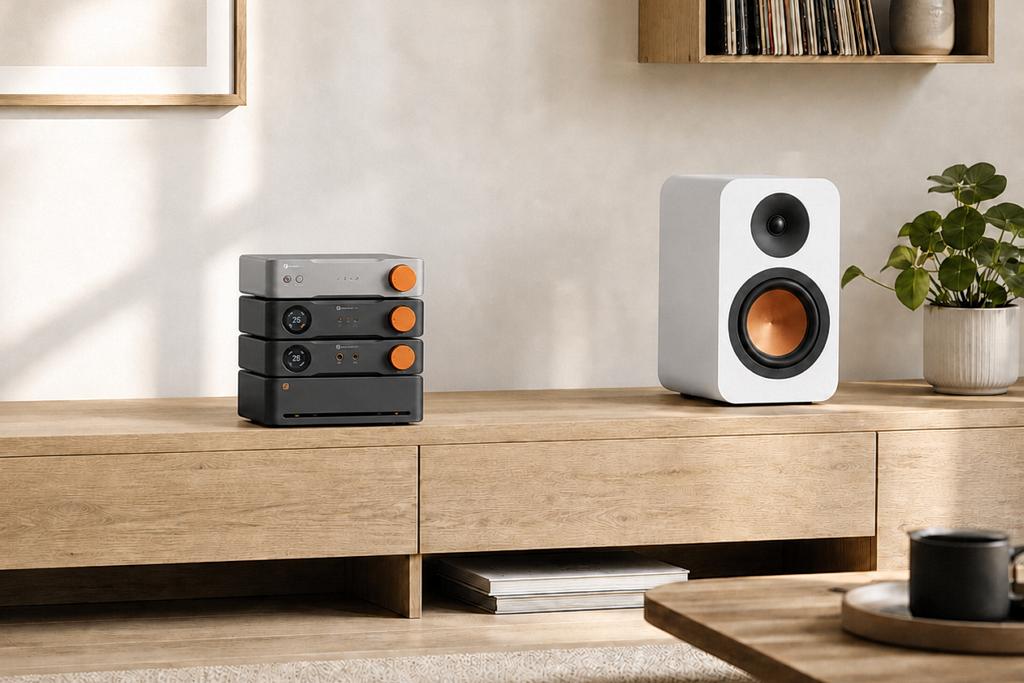
It is only when these four devices are considered together that Fosi Audio's idea of a modular system becomes fully apparent. In the simplest configuration, the S3 can be connected to an existing amplifier, immediately adding modern streaming capabilities to an older stereo system. The ZH3 can form the basis of a sophisticated headphone setup connected to a computer, while the ZD3 can handle audio from a television, computer, or other digital source before feeding the signal directly to powered speakers or an amplifier. In a more elaborate configuration, the S3 can act as the digital transport and central control component, the ZD3 can take responsibility for digital-to-analog conversion, the ZH3 can provide a dedicated headphone listening solution, and the PSU20 can replace several separate switching adapters with a single source of power. Each component brings its own capabilities to the system, and the owner can decide which of them are actually necessary.
It is also worth emphasizing that this is not a closed ecosystem. The S3 can be connected to an entirely different DAC, the ZD3 can work with a streamer from another manufacturer, and the ZH3 is perfectly capable of operating independently on a desk. The PSU20, meanwhile, can power other compatible devices as long as their electrical requirements are met. This is arguably the most appealing aspect of the entire concept. The shared visual design and technical compatibility encourage customers to build a complete Fosi Audio system, but the manufacturer does not make the operation of individual components dependent on the presence of the others. For listeners, this means that a system can evolve gradually, without replacing perfectly functional equipment simply because another feature has become desirable. It is a welcome alternative to the all-in-one approach, where gaining one additional capability sometimes means replacing the entire device.
Taken together, the S3, ZD3, ZH3, and PSU20 illustrate how far Fosi Audio has progressed from its original focus on inexpensive miniature amplifiers. The company is no longer simply competing on price and compact dimensions, but attempting to offer a coherent family of components with modern connectivity, ambitious specifications, and considerable freedom of configuration. The individual devices remain relatively affordable, which makes the idea of gradually assembling a more complete system especially appealing. The Fosi Audio S3 is priced at $259 in the United States and €279 in Europe, while the ZD3 costs $179 and €189, respectively. The ZH3 is available from $189 or €199, and the PSU20 linear power supply costs $199 or €239. Official UK pricing for all four components has not been consistently confirmed. Info and photos by Fosi Audio.