
- Reviews
- Posted
Pylon Audio Jade 10
Poland means different things to different people. For some, it brings to mind mountains, lakes, forests, turbulent history, beautiful cities, pierogi, kielbasa and stuffed cabbage. For others, it is a modern, entrepreneurial country - energetic, ambitious and full of people who, after decades of catching up, no longer feel the need to prove anything to anyone. They simply get on with it. They build companies, invest, design, manufacture and enter markets that, not all that long ago, seemed completely out of reach. You can see it in technology, industry, services and design, but also in far more specialized fields, including audio. Surprising as it may sound, Poland is home to well over a hundred manufacturers of audio devices, accessories and components - from large, increasingly recognizable brands to tiny, highly specialized, sometimes almost one-person workshops making unusual loudspeakers, amplifiers, cables, power distributors, isolation platforms, feet, supports and objects whose purpose sometimes has to be explained even to people who have followed this hobby for years. Some of these companies have long since stopped being curiosities for local patriots and have become serious players on the international stage. Fezz Audio tube amplifiers, J.Sikora and Muarah turntables, Mytek converters and digital devices, Lampizator's eccentric creations, Albedo and Audiomica Laboratory cables, JCAT network accessories, Enerra and Gigawatt power strips and conditioners - these are only the most obvious examples. When it comes to loudspeakers, however, the undisputed leader is Pylon Audio.
Apart from their country of origin, these companies share another important trait - in every case, we are talking about very recent history. At best, their beginnings reach back to the early 1990s. More often, they started even later, once Poland's economic transformation had finally created the conditions needed to run a business, import components, attend international shows, build distribution networks and compete with brands that had enjoyed decades of uninterrupted development. Of course, audio did not simply appear in Poland after 1989. The country had large factories producing loudspeakers, electronics and consumer audio equipment, including Tonsil, Radmor, Unitra and Diora. The problem is that this world was, in a way, sealed off from the present by the thick curtain of communism. In 1989, the old system collapsed, and the new one emerged slowly, under difficult conditions, with almost everything having to be built from scratch. This is why today's Polish audio manufacturers, even the most successful ones, do not have the kind of heritage British, American, Japanese or Scandinavian companies can draw upon. At least not in the sense of an unbroken line of iconic models, technologies born in the 1970s, old catalogs full of charmingly dated photographs, and products that can now be revived almost unchanged.
That does not mean Polish companies have to sit on the sidelines while the rest of the hi-fi world rediscovers turntables, tube amplifiers, horn-loaded loudspeakers, the ritual of listening and the pleasure of living with objects that seem to have a soul. A fascination with the past does not have to belong only to those who were actually there. No sensible person would tell a 20-year-old that they have no right to listen to Nirvana's "Nevermind" on vinyl because they were not yet born when the album was released. In the same way, a company that was not making studio monitors in the 1970s can still try to understand what was valuable about that aesthetic and translate it into a contemporary language. Pylon Audio has not only the expertise to do that, but also the technical and financial resources. The company operates a large factory with its own anechoic chamber, has distributors in more than 30 countries, opens showrooms in China and manufactures cabinets for many other brands, including names associated with high-end audio. In other words, the manufacturer based in Jarocin - a town known in Poland for its rock festival - is a genuine heavyweight, and the loudspeakers sold under its own name are only the visible part of a much larger operation.
Ironically, the lack of a long-standing legend may actually work in Pylon's favor. When older brands bring back former classics, they have to tread carefully. Any change in proportions, drivers, crossover, materials or sound can be seen as a betrayal of the original. They have to satisfy both those who remember the old models and those who expect modern build quality and a recognizable but updated sound. Pylon had no such burden. Its designers could not pull a 50-year-old monitor from their own archives because no such product existed. Instead, they could ask a different, and perhaps more interesting, question - what would the ideal retro loudspeaker look like if it were designed today from the ground up, with no obligation to reconstruct anything, but with a clear understanding of what we still value in classic designs? Big sound, ease, tone, dynamics, natural veneer, a paper cone, a horn tweeter, a strong personality and the ability to make music enjoyable even at moderate volume - all of this could become the foundation for a thoroughly modern loudspeaker.
The idea came about almost by accident. If you assumed that the first technical assumptions and sketches were created in the office of a company president watching the vintage-audio trend gather momentum, or in a design department where engineers indulged a fantasy of traveling back in time, you would be wrong. The first version of these old-school speakers was created by the graphic designer responsible for Pylon's renders and advertising materials. Those photorealistic images of loudspeakers placed in beautiful, extravagant interiors are built from three-dimensional models of every object in the scene - furniture, acoustic panels, records and even cables hanging naturally behind the rack - all of it is his work. One day, while preparing another set of renders for Pylon, he began wondering what the company's loudspeakers might have looked like if the brand had existed half a century earlier. For fun, he created such a model - large two-way monitors with a big woofer, a horn-loaded tweeter, a wide front-firing bass-reflex port and a cabinet tilted slightly backward. At first, the whole thing was treated as an internal joke. Nobody seriously considered turning it into a product, but as more people saw it, their reactions gave Pylon's management something to think about. There were doubts, of course. These vintage-style boxes looked nothing like the slim, modern and rather minimalist speakers from the Pearl, Opal, Sapphire, Ruby, Diamond, Zirkon or Jasper lines. There was also no historical anchor for a company whose story began only in 2011. But what, exactly, stood in the way of making this vision real? Nobody outside the company knew about it. No promises had been made to fans. Distributors had not been given an expected delivery date. The Jade series could quietly develop behind the scenes. Cabinets, drivers, crossovers, grilles - every decision took time, but apparently there was plenty of fun in the process as well.
At the end of 2022, the Jade 20 was introduced - a large two-way monitor with a 12-inch paper woofer, a compression tweeter loaded by a Tractrix horn, a wide front baffle, a generous bass-reflex port and a cabinet finished in natural veneer. The market's reaction was clear. Fans of the Polish brand appreciated its courage, retro-audio enthusiasts fell for the design immediately, and reviewers praised the speaker for its build quality and full, coherent, carefully tuned presentation. Interest in Pylon's vintage-inspired loudspeakers was strong enough that more models were only a matter of time. In 2025, the company expanded the concept dramatically with the Jade 30. This time, the Polish manufacturer offered customers a real beast - a three-way loudspeaker with a 15-inch woofer, a paper-cone midrange driver with an aluminum phase plug and a BMS tweeter driver working in a short horn. Pylon was now talking not only about tone, freedom and vintage styling, but also about a truly concert-like experience and full-scale sound. A few months later, the catalog gained a smaller counterpart to the "twenties" - the Jade 10. This is an attempt to condense the entire Jade philosophy into its most manageable form. The Jade 10 keeps the key ingredients - rounded cabinets, black front baffle, natural veneer, paper cone, horn tweeter and wide bass-reflex port - but packages them in a speaker intended for much smaller rooms. When I first saw them, I smiled instinctively. Compared with the larger Jade 20 and Jade 30, they look almost cute. But does scaling down a loudspeaker of this type make sense? Can it still deliver a sound that brings to mind the golden age of stereo? And can a young Polish company create its own take on a classic monitor without pretending it has 50 years of history behind it?
Design and functionality
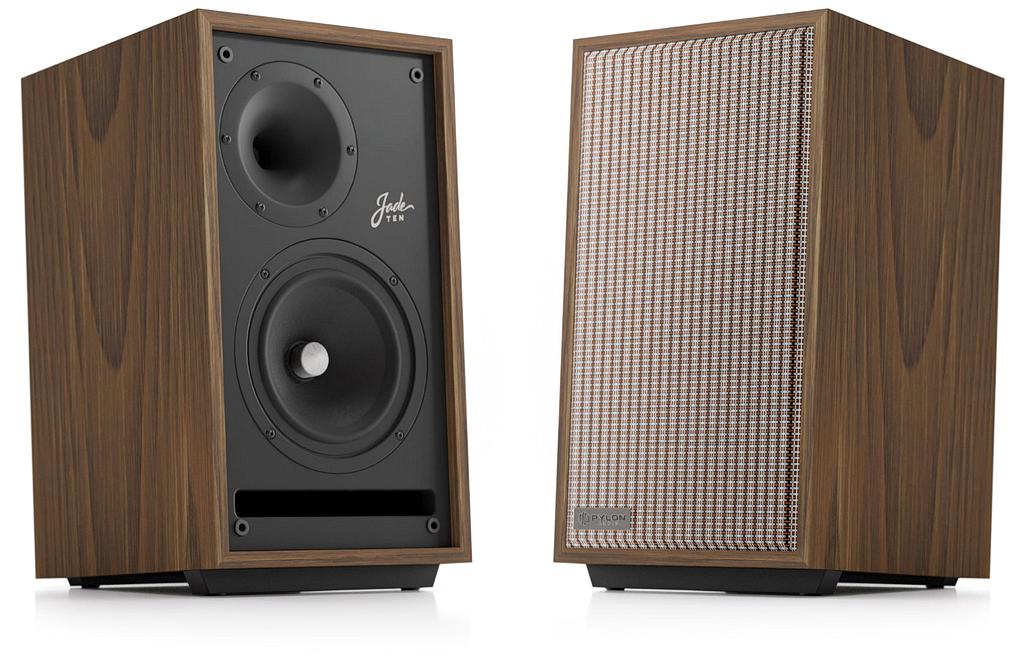
The Jade 10 is the smallest model in this family, but "smallest" is a relative term. In today's monitor market, where the norm is a narrow box with a 13-18 cm woofer and a 25-mm dome tweeter, the Jade 10 looks like a visitor from another era. It stands 52 cm tall, 30 cm wide and 35 cm deep, and each cabinet weighs 20 kg. Since this is still featherweight territory compared with the "twenties" and "thirties", Pylon offers optional stands for the "tens", bringing their total height close to that of small floorstanders. Even without the stands, however, these are not the sort of monitors one casually places on a bookshelf. Their natural habitat is the floor. Purists will probably point out that this violates one of the sacred rules of loudspeaker setup, namely that the tweeters should be at ear level. Fair enough, but come on - one glance is enough to understand that these speakers were not designed for forensic listening sessions. They were designed to be enjoyed. By today's standards, they are fairly large monitors whose cabinet proportions, woofer size and high-frequency dispersion all serve a goal different from that of most contemporary speakers. The point was not to make the speaker vanish visually, to make it as narrow as possible or to keep it politely discreet. The point was to give music the kind of scale and freedom that small monitors often simply cannot produce.
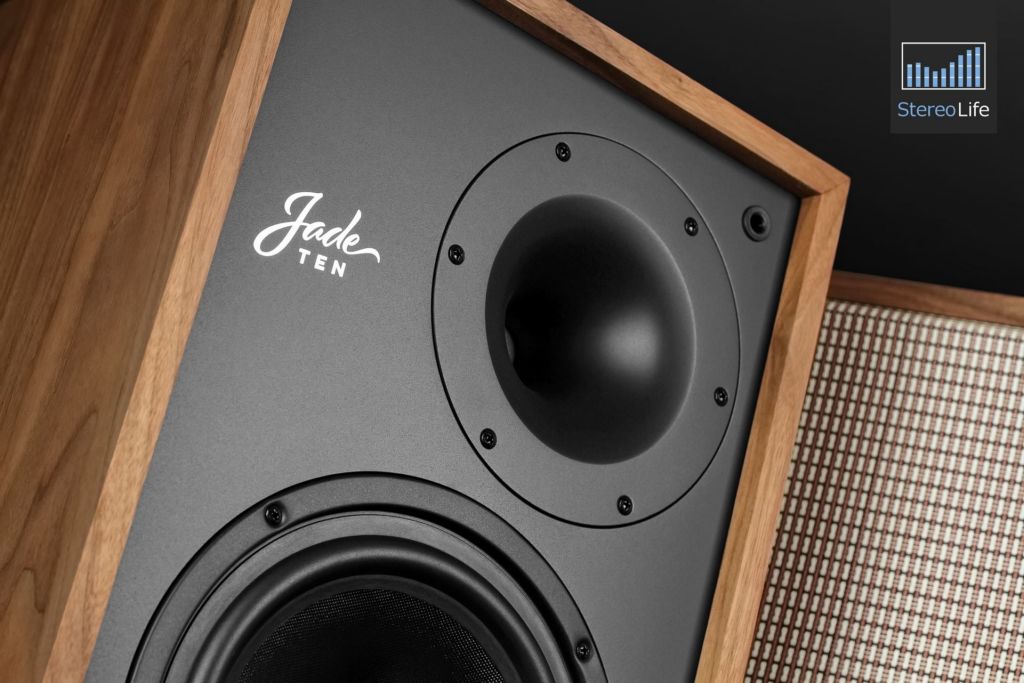
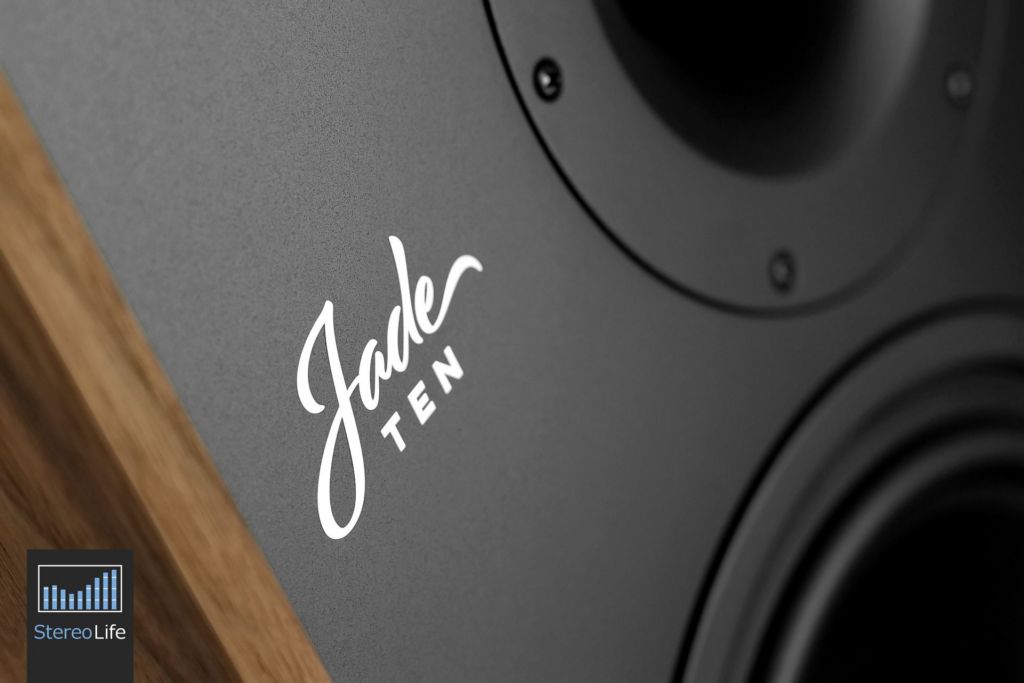
One thing should be made clear right away, because it is central to understanding this project. The Jade 10 is not a speaker for everyone. If you want something visually and sonically neutral, something that will blend into any system, room and taste, you should probably look at the Ruby, Diamond or Jasper lines. Jade is something else - hi-fun, a play on form, a tribute to a time when the world looked different. Pylon has created a loudspeaker with character. Not an aggressive character, not a flashy or provocative one, but an unmistakable one. The Jade 10 carries a clear affection for the 1970s, yet what stands out just as strongly is the absence of exaggeration. For all its originality, this is a surprisingly restrained speaker. Classic, but not silly. In fact, despite its unusual form, it is also remarkably user-friendly, but more on that later. Even small details, such as the typeface used for the model name on the front baffle, make an impression. Inside, this is not a random collection of ideas lifted from old loudspeakers. It's a modern design dressed in a form that evokes the classics. That, I think, is what makes the Jade 10 so compelling. It does not try to imitate one specific model from the past. Nobody is trying to convince us that the material composition of the woofer cone is closest to what BBC monitors used 50 years ago. Its frequency response does not stop at 14 kHz because "that is how the original did it". Pylon simply took from that old aesthetic what still makes sense and added three things for which the brand is known - good components, excellent woodworking and a sensible price.
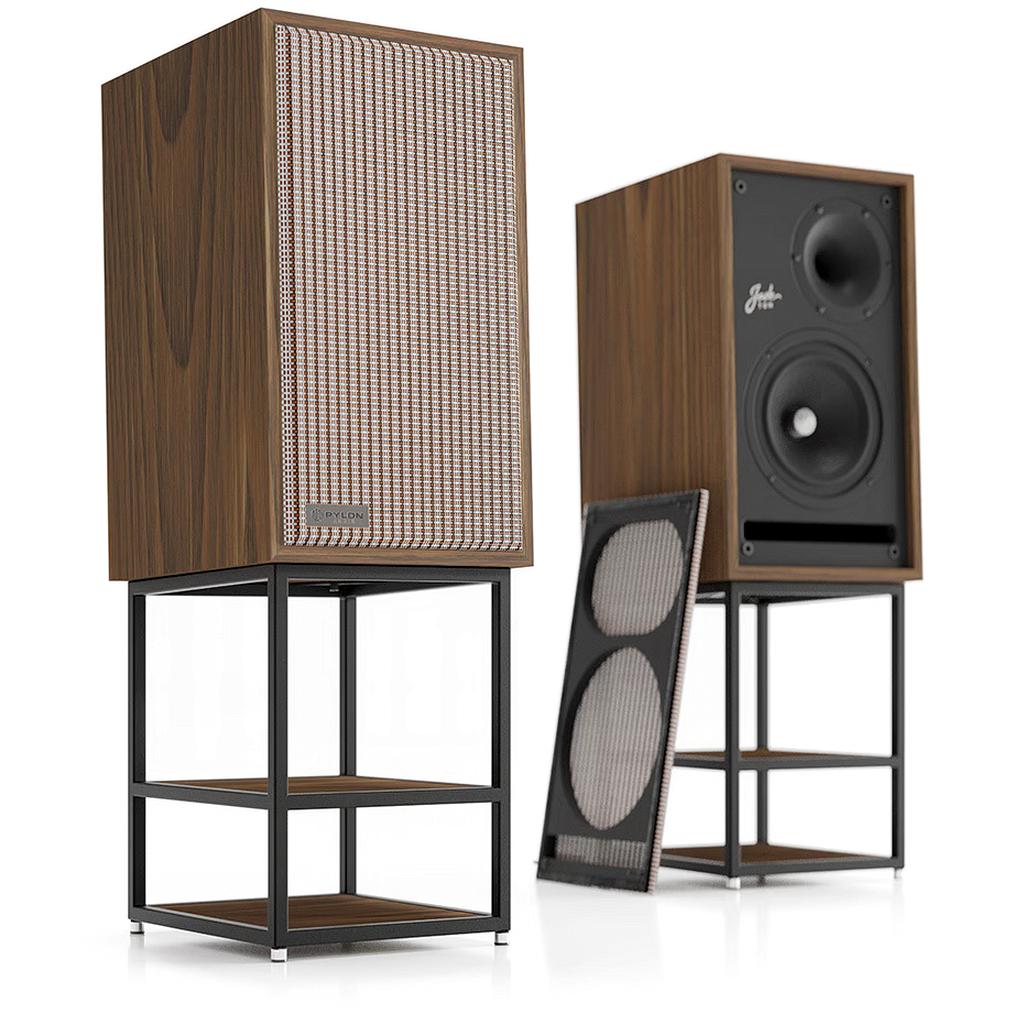
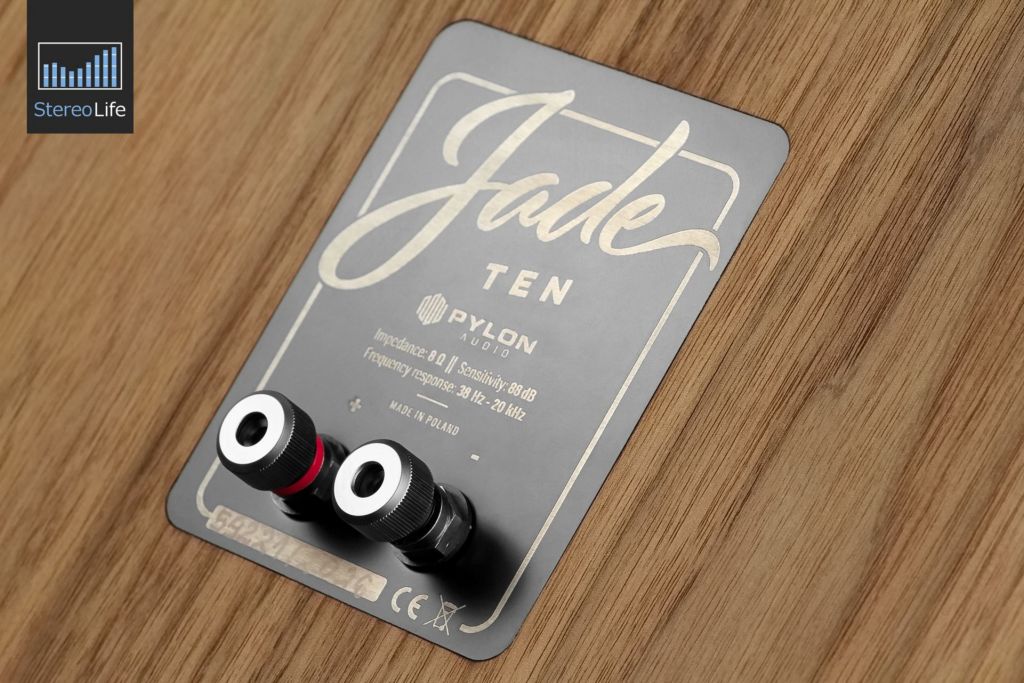
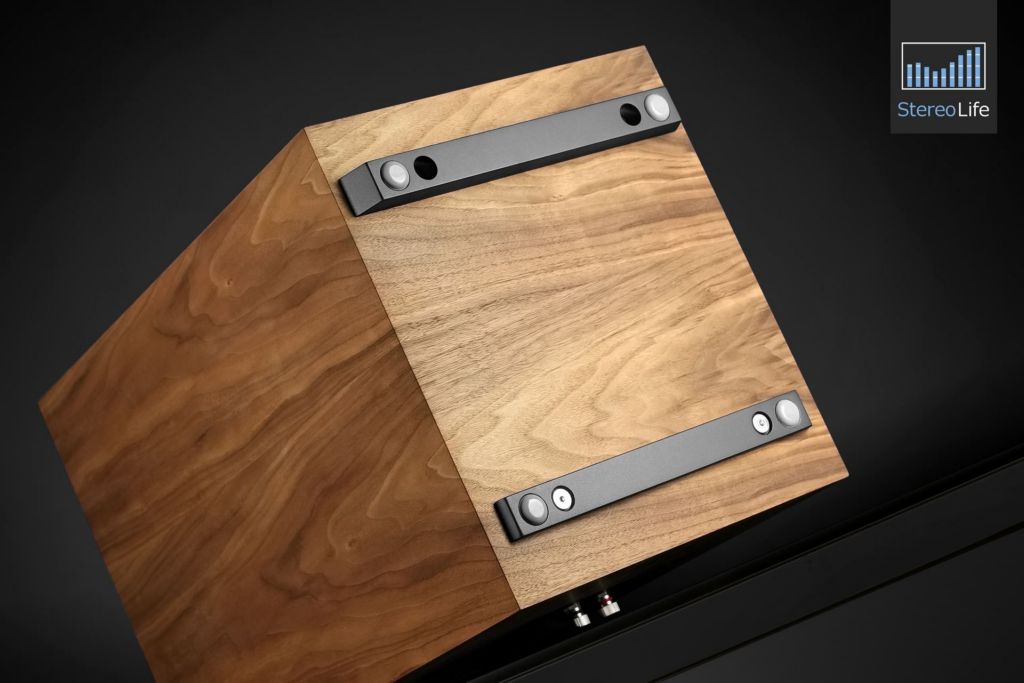
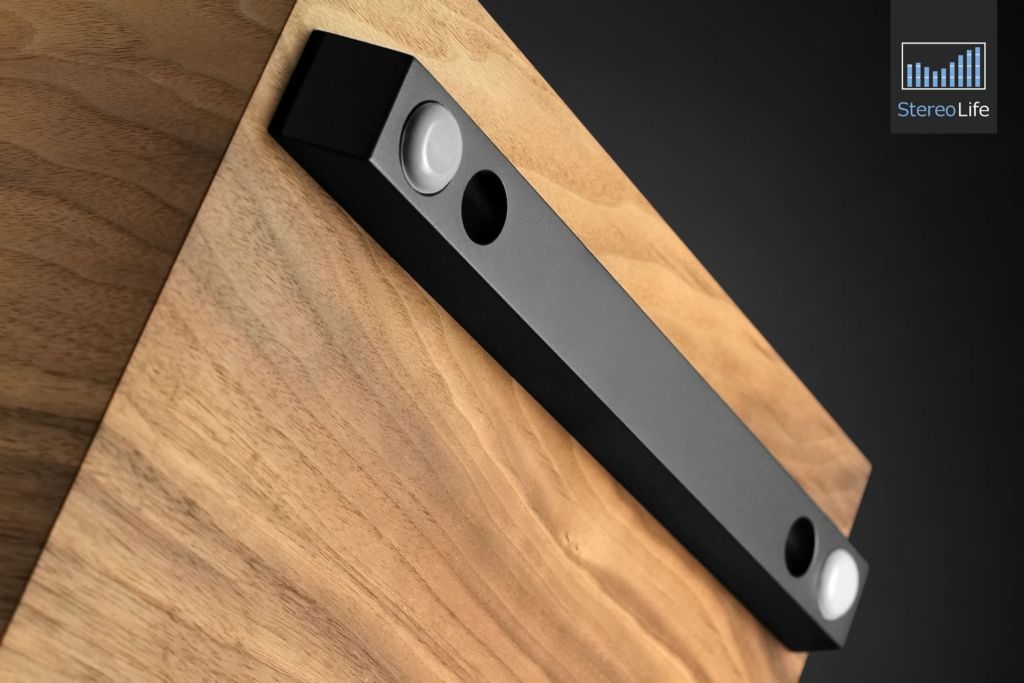
Meeting the "tens" in person is pleasant, but also a little surprising, because photographs do not fully communicate their proportions. On a screen, they can look like attractive vintage-style monitors. The size of the boxes immediately tells a different story. The wide baffle, considerable depth and large low-midrange driver make the Jade 10 look more like compact studio monitors than conventional standmount hi-fi speakers. At the same time, they are not so large that one person cannot manage them. The speakers are packed in two separate cartons, so there is no single 40-plus-kilogram crate to wrestle with. Unpacking is quick and straightforward, with no nasty surprises. Initial setup is just as easy. The speakers come with small plinths designed to direct the sound toward the listener's head. Flattened plastic feet are already installed, allowing the cabinets to stand safely on both carpet and hard floors such as wood or tile. The terminals are single-wired and accept any type of connector. They are also mounted low enough that hiding or at least neatly arranging the cables should not be difficult. If you choose Pylon's dedicated stands, you remove a few screws, take off the plinths and use the threaded inserts in the same locations to attach the speakers to the stands. The metal bases have two shelves finished in veneer, and their height of 37.5 cm raises the whole system to about 90 cm. Incidentally, at High End 2026 in Vienna, Pylon did not use the Jasper 25 mkII, the Zirkon 20 or the high-end Amethyst Gamma in its system. It used the Jade 10 on the company's own stands, paired with tube electronics from Fezz Audio.
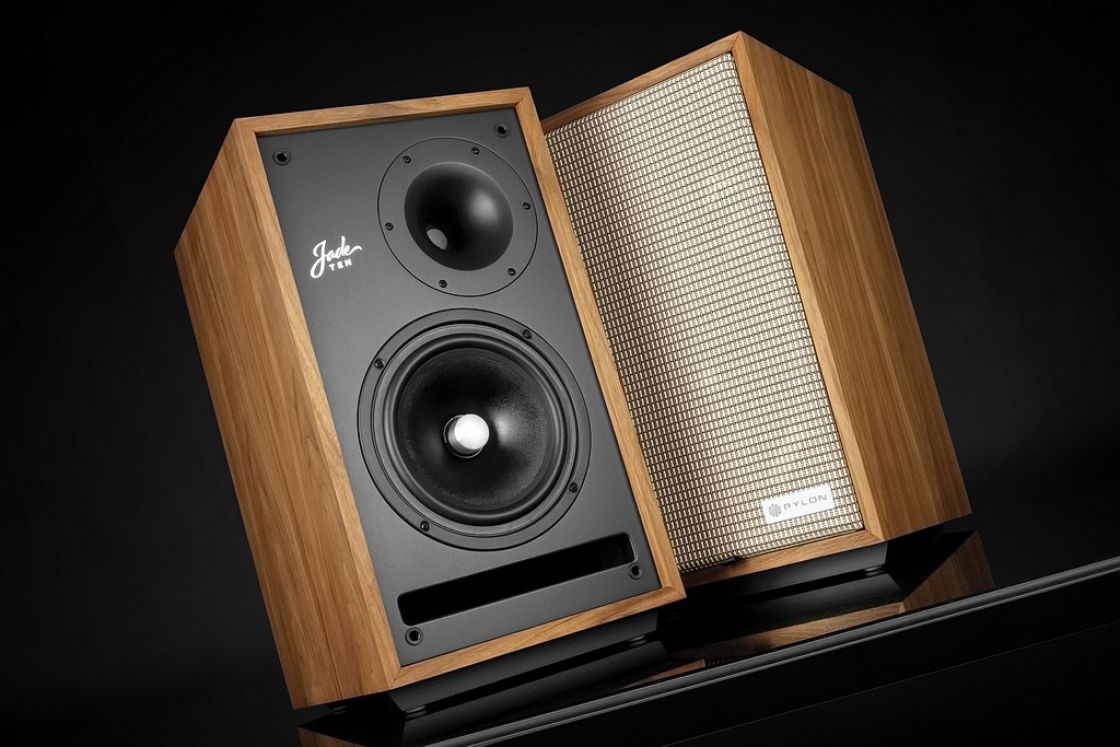
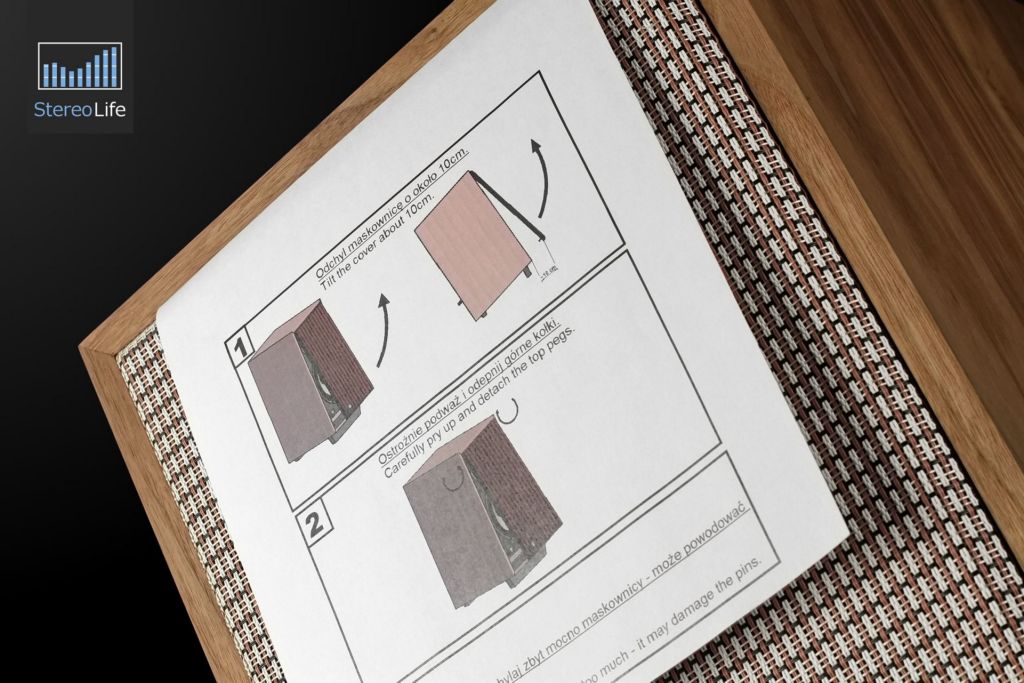
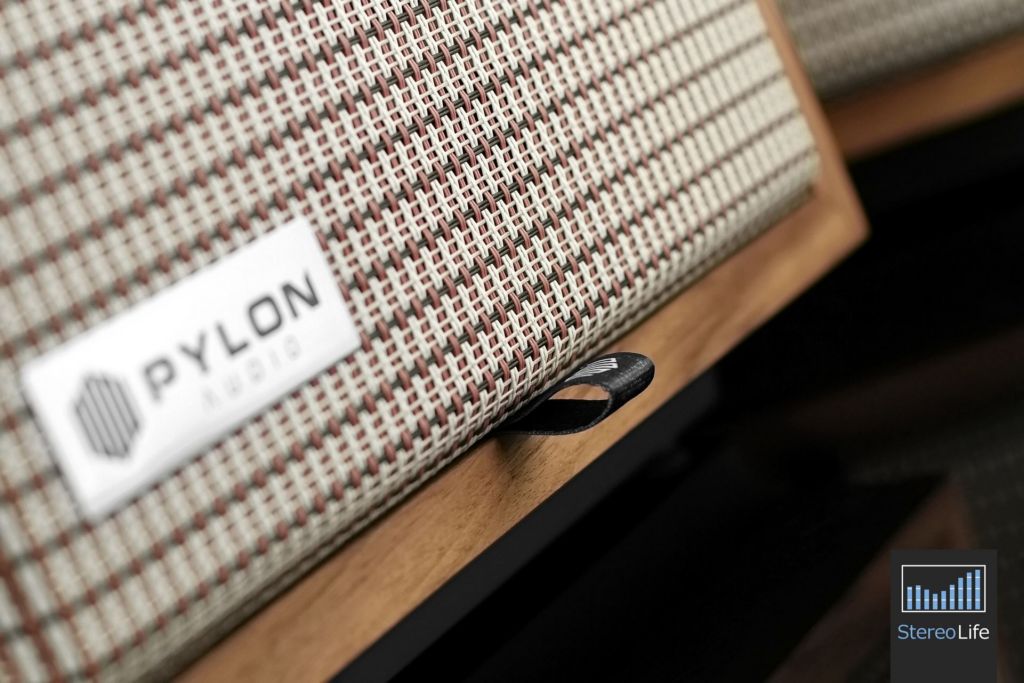
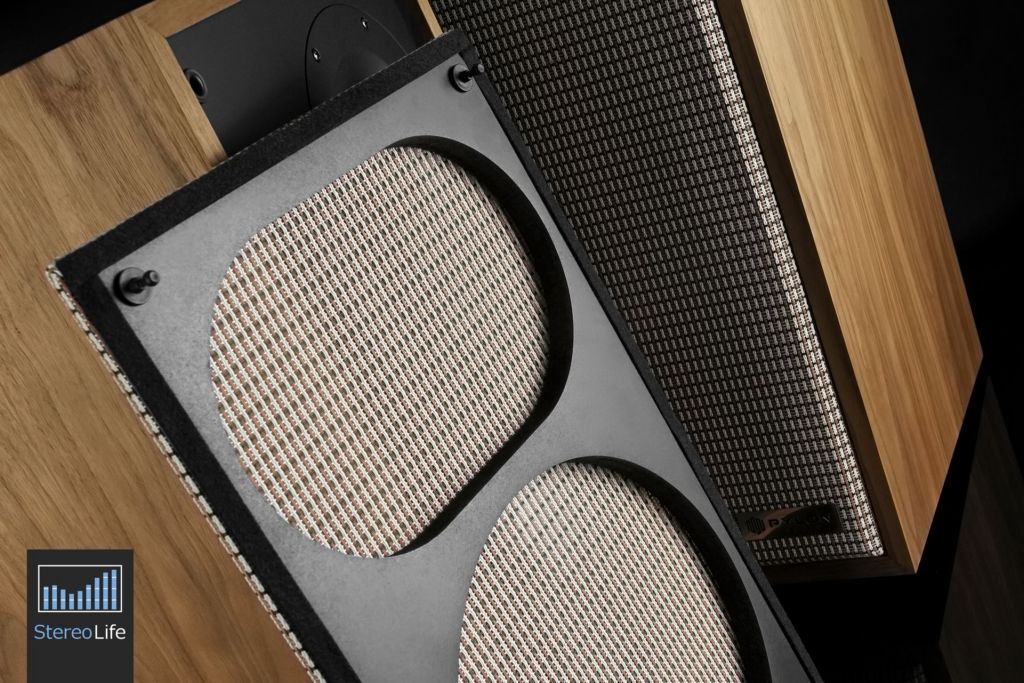
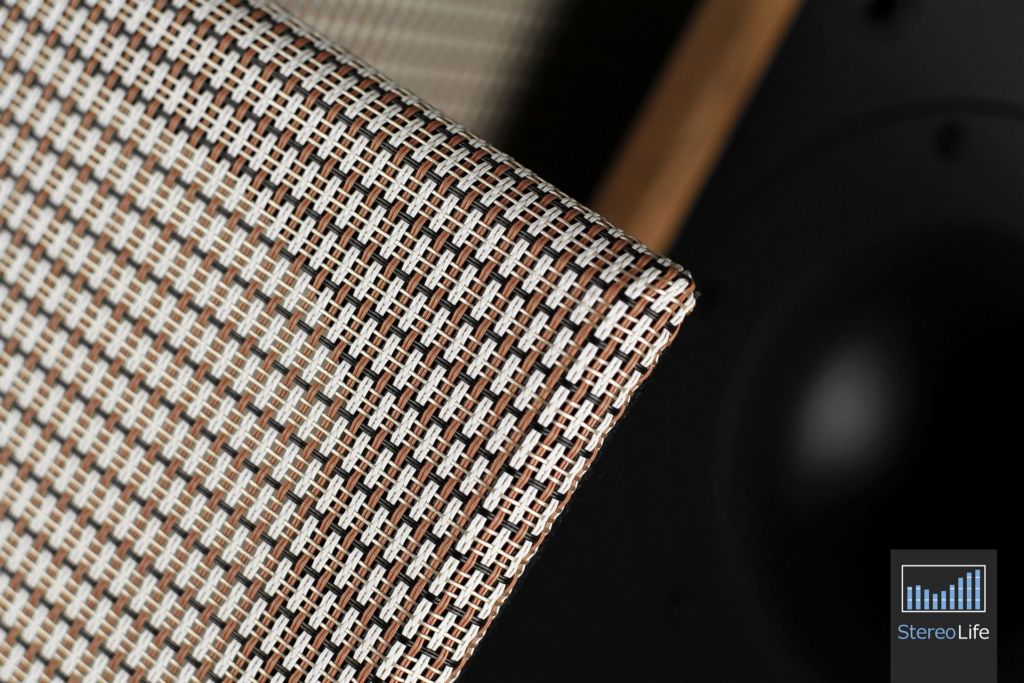
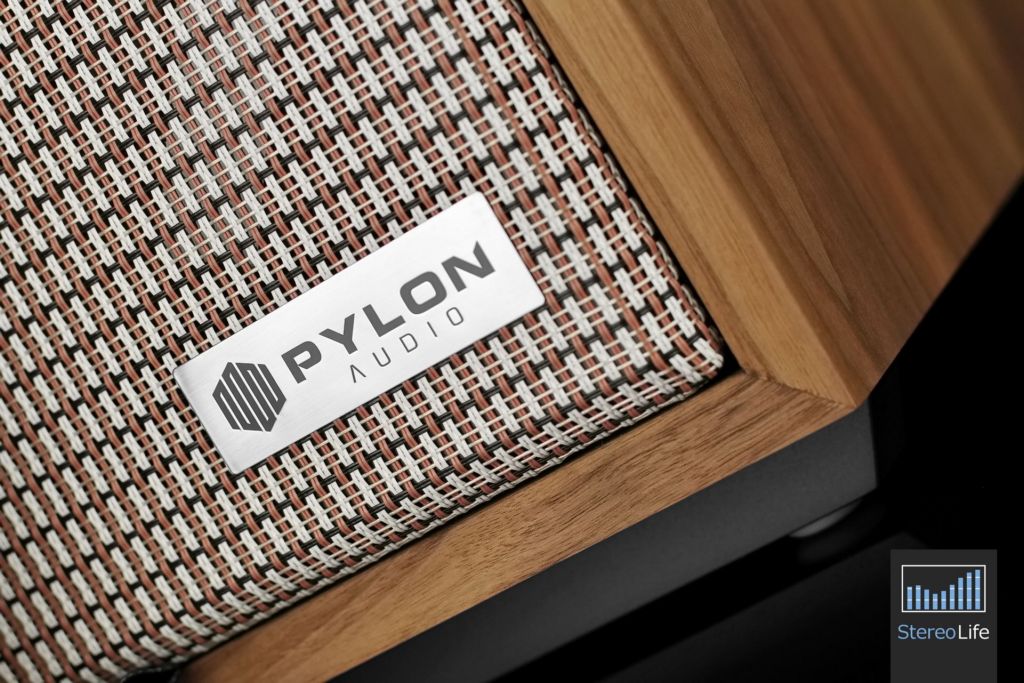
As with the two larger Jade models, the grilles are one of the most charming details of the "tens". Many makers of vintage-style loudspeakers have their own ideas here. We have seen grilles made from colored foam, perforated metal and various takes on thin BBC-style frames pressed into grooves around the front baffle, sometimes called Frameless Frame designs. Pylon has done something related, but in its own way. Here we get thick frames covered with an interesting, very durable fabric that, up close, looks like a weave of multicolored ribbons and fishing line. The grilles attach with pegs. To remove them, you pull a small "tag" with the company logo, although this has to be done properly, as the included warning sheets explain. Once the lower pegs pop out of their holes, you should grab the grille itself and release the upper section. Keep pulling on the tag and you will break the upper pegs. This is basically the only thing Jade 10 owners need to remember. The underside of the grilles is lined with soft felt so they do not scratch the black front baffles. Other than that, the speakers are practically maintenance-free. The front-firing bass-reflex port gives you a lot of freedom in terms of distance from the rear wall. Even if the "tens" are pushed all the way back, the depth of the cabinet means the drivers will still sit 35-40 cm from the wall. If you want to experiment with placement or move the speakers to another room, you will not need to hire movers or call the friend you once went to the gym with ten years ago as part of a New Year's resolution - except he never quit.
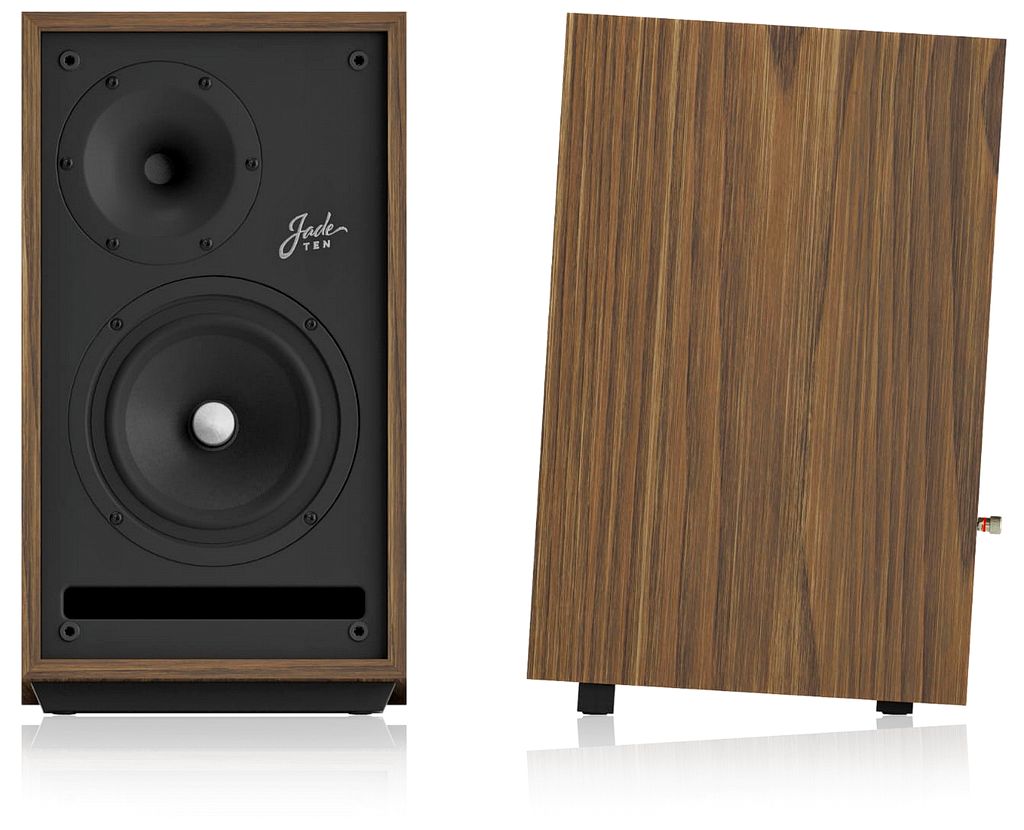
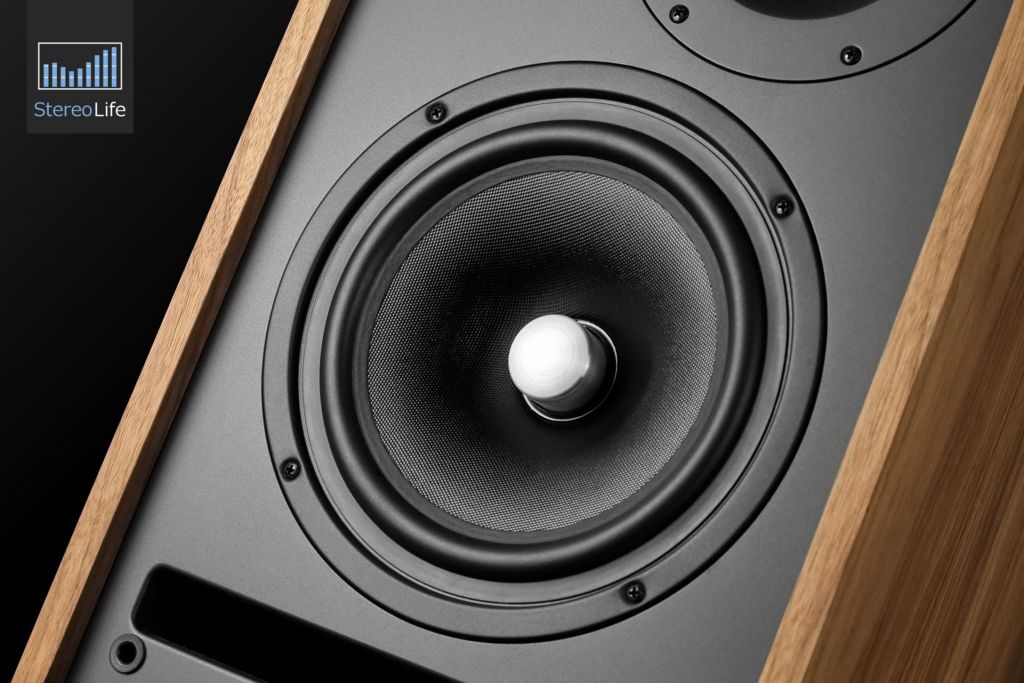
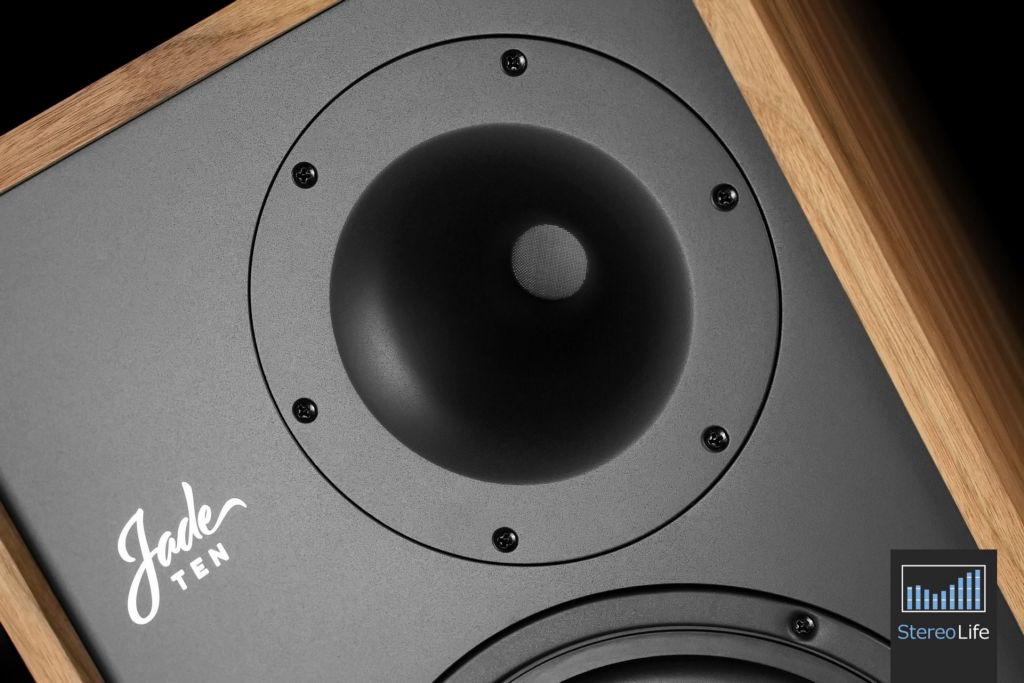
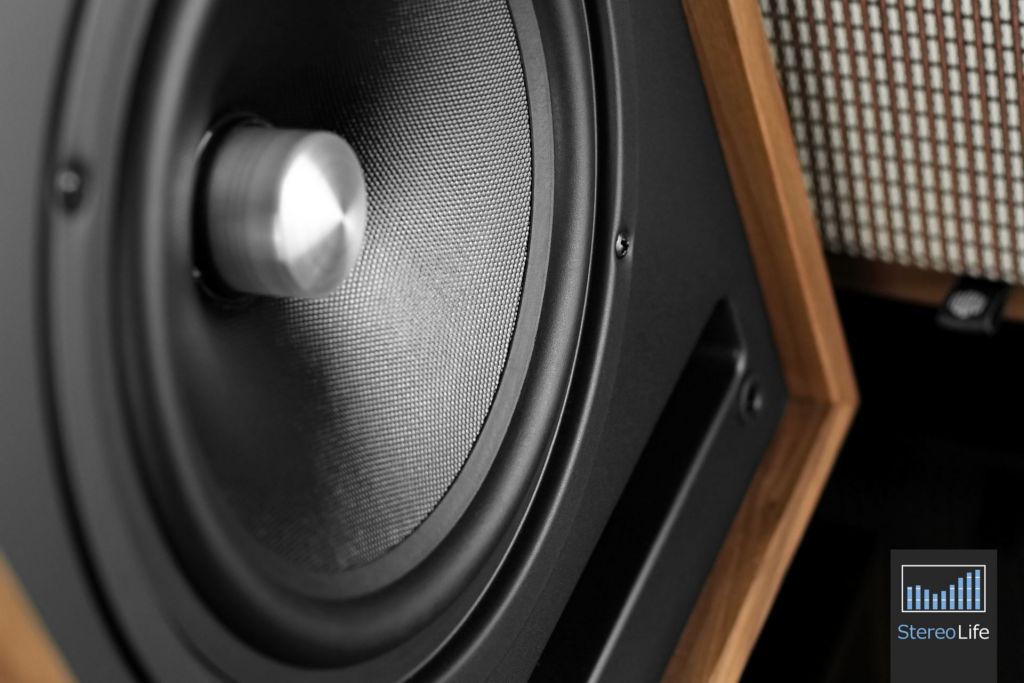
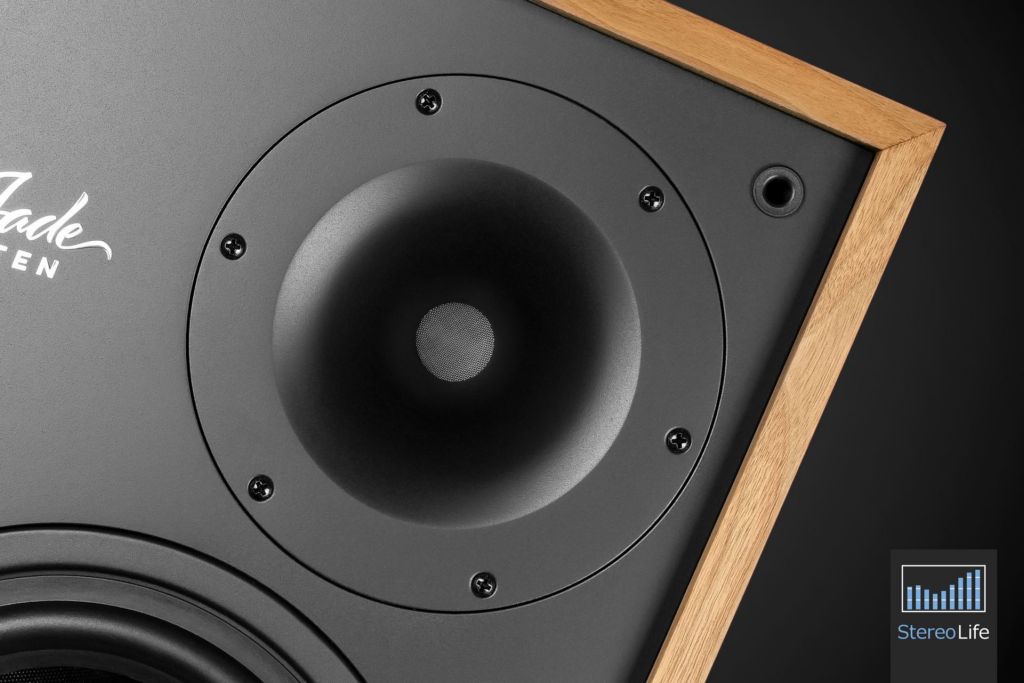
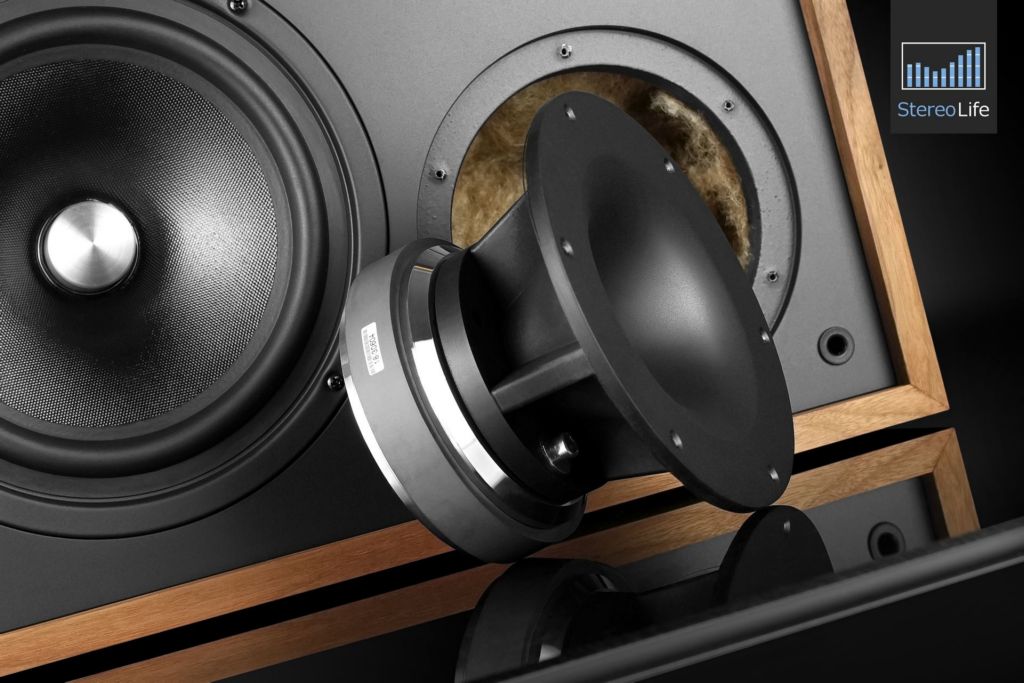
There is quite a lot happening on the front baffle of the Jade 10. The upper section is occupied by a compression driver working in a short horn. Below it sits a 22-cm low-midrange driver, and near the bottom edge there is a wide bass-reflex outlet. This layout not only gives the speakers their distinctive appearance, but also tells us a lot about the design priorities. The large woofer is meant to provide mass, ease and scale. The compression driver is there for speed, microdynamics and controlled directivity. The front port is designed to make placement easier and let the speakers breathe even when they cannot be pulled far into the room. Pylon says the system works optimally both on the floor and on the dedicated stands. That is important, because the Jade 10 is not a small monitor that has to be placed on heavy, tall stands a meter from the wall in a large listening room. Visually, one of the key elements is the American walnut veneer finished with oil-wax. This is not merely about wood visually warming up the design and fitting the retro mood. It is about quality and the feeling of being in contact with something real. More and more customers seem to be looking for exactly that, and Pylon clearly knows how to deliver it. The "tens" do not look as if they have been wrapped in vinyl or some synthetic material pretending to be real wood. The grain is clear, the joints are precise and the surface has a pleasantly tactile texture. The finish originally introduced for the Jade series proved so successful that Diamond and Jasper speakers are now also available in the same veneer and are apparently selling extremely well.
Functionally, the Jade 10 sits somewhere between a monitor and a small freestanding loudspeaker. On paper, it remains a standmount design, but its dimensions, weight and cabinet volume demand a more serious approach than most monitors. Placing it on a TV cabinet is out of the question, but next to one - absolutely. In practice, we are dealing with something that might best be called a floor monitor. Treat it that way and it turns out to be surprisingly easy to live with, because the front port and relatively broad sweet spot make it more forgiving than many speakers with highly directional treble. Another interesting detail is that Pylon recommends the "tens" for rooms between 12 and 32 square meters, which is a very wide range. One can assume that success will depend mainly on placement, not to mention the accompanying equipment and the room's acoustic conditions. Still, these speakers have the potential to produce a full, mature sound in a small room, the kind of sound you are unlikely to get from shoebox-sized monitors. In a larger living room, they should reward the listener with freedom and a broad soundstage, provided you do not expect the acoustic pressure of floorstanders three times their size.
How does this work in practice? I have to admit I had some doubts at first, but after only a few days I concluded that this type of design is exceptionally practical. Contrary to appearances, this is not one of those products that looks cool in photos and then turns out to be impossible to live with. Quite the opposite. The Jade 10 is a genuinely well-thought-out, civilized loudspeaker. It also lets you do things that would not work with typical monitors or floorstanders. Try putting ordinary monitors on the floor. Or try setting up floorstanders so they maintain the right distance from the wall while not blocking a wall-mounted TV, even when you are watching a game from the dining area. I am not saying the floor-monitor concept is better than everything else, or that every loudspeaker manufacturer should now add one to its catalog. It is also worth remembering that Pylon was not the first to think of it. Klipsch Heresy has been around for many, many years. JBL has plenty to say with its Classic series as well. These are legends permanently written into audio history. On the other hand, nobody can forbid others from creating their own versions, such as the Revival Audio Atalante 5. Even so - and despite the ongoing fashion for retro equipment - speakers of this type remain relatively rare. They are treated more like harmless eccentricities than a recognized category. Why? After three weeks with the Jade 10, I still cannot figure it out, because in many living rooms speakers like these will settle in more easily than either classic monitors or floorstanders. Maybe manufacturers are afraid to experiment. Maybe they cannot bring themselves to create something so different from the models that form the backbone of their ranges. Maybe they simply prefer to avoid criticism from people who believe that only companies active 50 years ago have the right to build this kind of loudspeaker.
Drawbacks? The first is that only two finishes are available - walnut and black. In theory, that is enough, but many Pylon models can be ordered in at least a dozen factory finishes, and if someone insists, even in any color from the RAL palette. I do not see that option here, and perhaps red or blue "tens" with black grilles would look spectacular. If you would like to find out, ask whether a special pair can be ordered. True, the Jarocin factory handles so many outside commissions and builds so many of its own speakers in standard versions that finding room in the schedule for custom projects may be difficult. On the other hand, every such order is also an opportunity to show off the company's technological capabilities and, in a way, conduct live market research on its own fans. The second drawback surprised me more. After I unpacked the speakers, a sharp, unpleasant chemical smell spread through the house. Opening the windows for half an hour was not enough. This specific "aroma" lingered for a good week. The grilles turned out to be the culprit. I do not know whether this is the smell of the fabric stretched over them, or whether some adhesive or impregnating agent is involved, but for several days the house had to be aired out. Fortunately, the smell disappears completely afterward, and even up close there is nothing to detect. The Jade 10, then, is one of those speakers that need not only to break in, but also to air out.
What else could I criticize? Probably only small details that are easy to fix. The plastic feet mentioned earlier work reasonably well on both hard floors and carpet, but they are not ideal on either surface. On laminate flooring, the cabinets slide easily, so if you spend an hour finding the perfect toe-in, even a passing cat may introduce its own "correction". Silicone bumpers may solve that problem. On thick carpet, meanwhile, the speakers may feel a little unstable. In that case, you can remove the wooden supports and use the threads underneath to install proper, long spikes. As a bonus, you will gain the ability to adjust the backward tilt of the cabinets. Oh, and one more thing. Speakers that stand 55-56 cm tall, with a top panel measuring 35 x 31 cm - are they not perfect stands for potted plants? If all your windowsills and cabinets are already occupied, I suggest discussing this with the rest of the household in advance, because something may overflow, fertilizer may spill, and it would be a shame to ruin that beautiful walnut veneer.
This brings us to the price. As expected, compared with the most obvious rivals, Pylon wins this round decisively. Take the Klipsch Heresy IV. Granted, they are slightly larger and three-way, but they cost $3,599. Revival Audio Atalante 5 are larger too, but conceptually very similar, and a pair costs $5,495. In JBL's lineup, the closest in size are the L82 Classic at $3,189, but they are noticeably smaller and not really intended for floor placement, which means stands should be added to the bill. It is also hard to ignore speakers such as the Wharfedale Super Linton at $2,699, although again these are large monitors that should ideally be bought with dedicated stands, and the two rear-firing bass-reflex ports add another placement complication. Pylon chose its usual route - aim for the middle of the price range, but push the quality high enough that customers instinctively compare the Jades with more expensive, rather than cheaper, alternatives. The cost to the buyer on the European market is €3,250. In my opinion, the "tens" are 90% of the Heresy IV for 50% of the price. Where does that difference come from? Probably not from the Polish speakers being worse, uglier or less refined. Maybe it is simply that nobody is charging us extra for heritage, something companies with long traditions are always eager to remind us about. Or maybe it comes from the scale of Pylon's operation and the fact that the company does in-house everything it possibly can, so it does not have to pay outsiders for design, measurements or cabinet production. I do not know. But as much as I love hi-fi equipment with history, from iconic turntables to tuners with a "magic eye", the Jade 10 - without that collectible aura - made an excellent impression on me. This is simply European craftsmanship at a very high level.
Sound performance
Some people argue that the fashion for retro equipment exists only because it looks original and unusual, and that lovers of old amplifiers, reel-to-reel tape machines and loudspeakers that have not been manufactured for decades are slightly crazy, because modern devices sound clearly better, not to mention how much better they measure. I have always had great respect for that community, if only because this is an extremely demanding hobby. Nobody would devote serious time and money to it if the only reward were the chance to take a few photos or the satisfaction of owning a unique object that can serve, at most, as decoration. It is not as if you can buy the first system you find in a secondhand shop and suddenly enjoy enchanting sound. You need to know the subject, follow classified ads, hunt for real gems, find a good technician and wait your turn to have the equipment brought back to proper condition - assuming that is possible at all. Of course, the aura of exclusivity, the attractive appearance and the very act of using vintage machinery can bring a lot of joy. But ultimately, it is about the sound - a sound as unique and out of step with today's reality as having to flip a record after a few tracks, or the crackles that accompany the ritual. After all, you could just buy a network speaker, open an app on your phone and listen to the same album a moment later. And yet it is not the same.
Vintage audio equipment has a particular charm, and it is not only about the rituals that come with using it, nor even about whether its sound is brighter, darker, denser, freer, more dynamic, more spacious or more tangible. It is about character. Today, audio designers often seem to work toward a pattern built around neutrality and universality. Headphones, amplifiers and loudspeakers may have slightly elevated bass or a gently warmed midrange, and they must be able to play loud without strain, but beyond that, they are often expected to be neutral almost to the point of anonymity. It is hard to shake the impression that their sound is supposed to be gray, shapeless and inoffensive, because it needs to appeal to the widest possible audience. A product that 80% of listeners say does not bother them is safer than one that 20% of listeners fall in love with. Globalization, political correctness and commercial pragmatism. Where, in all of this, is the space for innovation? For designers who want their equipment to have a point of view? Today a true act of courage may be a return to ideas from several decades ago and the creation of loudspeakers such as the Jade 10.
In theory, such old-fashioned boxes stand apart from today's world of smartphones, robots, autonomous cars, artificial intelligence and disposable products. And you know what? It is wonderful that they do. Even better, they break away from current conventions not only through their shape, appearance and build quality, but also through their sound. True, they do so in a controlled and civilized way, but you do not have to listen for long to understand that they are different. It is also immediately clear that they were designed by someone who understands what makes classic hi-fi special and how to recreate some of that magic. I will not beat around the bush - after a few minutes of listening, a broad smile appeared on my face. I knew immediately how much fun I would have testing these speakers. I was also pleased to hear that Pylon's designers were clearly winking at people who know how old-school monitors of this type are supposed to sound, what their identity should be built around and even what they should ask of the listener. It is almost an inside joke, understood only by a certain kind of listener. If you have never heard speakers like this, you may find the Jade 10 peculiar or even strange. But if you know and like this aesthetic, I am sure you will be smiling after the first few bars too.
The sound of the "tens" is best understood not by starting with the midrange or the treble, but with scale. The smallest loudspeaker in the Jade series does not sound like a classic monitor whose greatest strengths are disappearing from the room, pinpoint imaging and precisely drawn miniature sound sources. Yes, it can build a wide soundstage and fill the room with sound, but its main advantage over compact monitors and slim floorstanders lies elsewhere - the music has physical presence. It is not miniaturized, thinned out or reduced to a neatly organized little model of itself. The Jade 10 tries to produce a sound larger, freer and meatier than its dimensions suggest. This is a completely different presentation from standard loudspeakers with a 15-cm woofer. Those speakers often offer excellent imaging, cleanliness and speed, but the bass and lower midrange are always limited, to some degree, by cabinet size. Many manufacturers have learned to disguise these limitations very cleverly, and in some cases the results are astonishing. Still, some audiophiles believe physics cannot be cheated - if you want truly deep, juicy, fleshed-out bass, you need a woofer with a substantial cone. It is similar to the saying "there's no replacement for displacement", often repeated by fans of large engines. I would not state it quite so absolutely, because the Audiovector QR5 in one of my systems can hit brutally hard and deliver the kind of abdominal massage many subwoofers would envy. There, however, we have not one but three 15-cm drivers, and with plinths and feet those speakers stand almost 110 cm tall. Here, similarly impressive bass comes from cabinets that are much easier to integrate into an existing room and, with a little luck, can even disappear among furniture, decorations and everyday objects.
Since we are already on the subject, let us talk about placement, because the final result depends on it to a large degree. As with standard monitors or floorstanders, the basic task is to find the right balance between tonal balance and spatial presentation. The unusual part is that you are maneuvering backward-tilted cabinets measuring 55 x 30 x 35 cm, so some of the procedures we may be used to do not fully apply. Even more important, the "tens" have wide front-firing ports, which means they really like working close to the wall. One might assume that regardless of port placement, they would need at least 40-50 cm of free space around them. They do not. In two rooms and two different systems, the Pylons clearly lacked low-frequency support when placed half a meter from the wall. They sounded flat and boxy. As the distance decreased, the sound became progressively richer, meatier, fuller and deeper. When I found the optimal position, the tape measure showed... 15 cm. Seriously - these speakers are perfectly happy sitting about a hand's length from the wall. This is important for anyone looking not only for interesting speakers, but also for practical ones - speakers that do not steal valuable living space and do not need to be treated like museum pieces. Move typical rear-ported floorstanders that close to the wall and you will usually be punished with boosted, booming bass. Some people pretend it is fine, others look for help in equalizers and cables, and some simply pull the speakers out for serious listening. With the Jades, none of that gymnastics is necessary. They were designed and tuned in a way that somewhat recalls Lyngdorf's FR-2 - they not only tolerate being placed close to the wall, but can actually reward you for it with a full, deep and relaxed sound.
Even more surprisingly, the stereo image did not suffer much from this setup, because the Jade 10 likes to play wide anyway, aiming for a concert-like effect rather than a studio-like one. Put differently, its specialty is large-scale presentation - building a wall of sound in front of the listener rather than creating a holographic image in which every source can be located with microscopic precision. If that is the effect you want, I would suggest starting with the dedicated stands, because that is probably the configuration in which the "tens" have the best chance of producing the kind of space we associate with "normal" modern loudspeakers. If you have heard large, carefully positioned monitors such as the Graham Audio LS6 10th Anniversary Limited Edition, Spendor Classic 2/3, Graham Audio LS5/9 or Harbeth Super HL5, you know it can be done - despite wide baffles, right-angled edges and all the other obstacles that should theoretically make such imaging impossible. I would not rule anything out. Perhaps one day I will hear the Jade 10 set up so skillfully and paired with such good electronics that I will be pulled into a three-dimensional soundstage and want to recreate that effect at home. To be brutally honest, though, I do not think most people interested in this model will have such expectations. If your top priority is a deep, wide, precisely organized stereo image, you probably will not choose vintage-style boxes designed to sit on the floor, preferably close to the wall. Here, the real point is scale and the ability to fill the room with sound.
The range in which the designers' intentions are clearest is the midrange. A paper cone, a large woofer surface and a fairly classic tuning philosophy should produce a sound that is saturated, natural, free from artificial coolness and perhaps touched with a little warmth. And that is exactly what happens, although one more ingredient appears - coherence. For fans of the Polish brand, this is hardly a surprise, because the ability to blend all parts of the frequency range into a homogeneous whole has long been one of Pylon's trademarks. But how do you do that when you have to stitch together a 22-cm paper woofer and a 25-mm compression tweeter in a wide horn? Somewhere between them, a gap should appear. Even if the frequency balance itself somehow avoids an audible hole, there remains the problem of matching two very different driver personalities. The lower midrange should be dense, soft and pleasant. The upper range should be fast, resolving and perhaps slightly bright. Yet Pylon's engineers have managed, perhaps not to make the "tens" a textbook example of linearity and audiophile purity, but to preserve the culture and musicality for which the brand's speakers are known. Yes, there are some shifts and irregularities in the middle of the band, but this is not a fight between two opposing forces. It is more like a blending of their strengths.
For a long time I wondered why this unusual midrange appealed to me so much, and after several days of listening, it finally clicked. The secret is that the transition from one world to the other does not happen abruptly. What we hear is something like the classic audiophile pairing of a tube preamplifier with a powerful solid-state power amplifier. We know that the character of both elements will be audible at the output. We also know that depending on the music, the proportions may shift slightly - sometimes the warmth and delicacy of the preamp comes forward, and sometimes the brute force of the transistors takes over. In the end, however, the combination remains satisfying and, above all, engaging. This is not boring neutrality achieved by stripping the sound of everything intriguing and atmospheric. It is a mixture of two flavors that contrast beautifully, constantly complementing one another and competing for our attention. And because every listener focuses on something different, do not be surprised if opinions about the Jade 10's midrange turn out to be contradictory. Some will praise it for wonderfully natural, organic and tangible vocals, ideal for jazz, acoustic music, blues, soul and small ensembles where tone color and presence are crucial. Others will note that despite all its fleshiness, the Pylons' midrange is surprisingly clear, precise and fast, at times brushing against a studio-monitor aesthetic. Who will be right? Everyone.
The treble, of course, is the most intriguing subject. A compression tweeter immediately fires up the imagination, but it also raises concerns among those who have had bad experiences with horns. In common hi-fi language, horn speakers can be associated with aggression, shoutiness, excessive attack and a sound tuned more for stage use than domestic listening. Pylon clearly tried to avoid this. The manufacturer emphasizes that the horn profile is intended to deliver detailed yet gentle highs and a wide listening window. Did it work? To an extent, yes, although anyone who has read the midrange description carefully will already suspect that the Jade 10's top end leans toward speed and transparency. Fortunately, the tweeter never crosses the line of good taste. Its character remains another interesting trait that occasionally draws our attention, rather than the element that defines the entire sound or dictates the associated equipment. The highs are pleasantly light and resolving, but free from the insistent quality some horns can have. To put it plainly - under the right conditions, they can sparkle, but they do not hiss.
Treble tuned this way may turn out to be one of the greatest strengths of the smallest Jade, especially at low volume. Where many speakers begin to merely "plink", sounding flat and vague, the compression tweeter in the "tens" continues to work beautifully, preserving clarity, freshness and energy. So if you are looking for speakers that will open up at normal listening levels but also perform in the evening at very low volume, without waking anyone and without forcing you to reach for headphones, you can add this unusual "parameter" to the list of advantages. The same applies to amplification. Seeing 8-ohm impedance and 88-dB sensitivity, some tube-amp enthusiasts may assume that despite the horn tweeter, these speakers are not for them. Not true. The Jades are easier to drive than many modern speakers with lower impedance, so with a little common sense, a tube amplifier is absolutely on the table. Maybe not a 5- or 10-watt one, because the 22-cm woofer needs control if the bass is not to turn into a shapeless jelly spreading across the floor and living its own life, but the Unison Research Triode 25 I used drove the Pylons beautifully. And if you are wondering whether they can play loud, they can. With a 200-watt Hegel H20, the "tens" produced dynamics many large three-way floorstanders would gladly claim as their own.
It has been a long time since I had a product in my system with this much character, and with so little embarrassment about the fact that its designers' concept has both strengths and weaknesses. By definition, it is not universal, yet it is almost perfect at being exactly what it was meant to be. The Jade 10 does not care what you think of it. If you say it is ugly - fine. If you arrange a listening session and decide its sound is not coherent or convincing enough - so be it. Even if you refuse to give it a chance because you believe a company that has existed for only 15 years has no right to create its own interpretation of the loudspeakers that dominated the market 50 years ago, live in peace with that conviction. I am completely won over by these vintage-style Pylons. They are not afraid to present music in a way that is intriguing on the one hand and sufficiently correct on the other, so our favorite recordings do not turn into caricatures of themselves. They are odd in their own way, but also surprisingly practical. They can be placed almost against the wall and used in ways that would end in spectacular failure with most conventional speakers, yet they can reward you beautifully if you pay some attention to electronics and accessories. Speaking of the latter, as the test was nearing its end, I started thinking that the speaker cables I used many years ago might suit the Jade 10 perfectly - Van den Hul CS-122 Hybrid. I ordered a pair with factory-installed banana plugs, and it was a bullseye. The bass gained body, especially at the very bottom. The highs were smoothed and polished without losing sparkle or resolution. The midrange took half a step toward warmth, as if in this friendly rivalry between paper musicality and studio realism, the Dutch cables had chosen the cellulose camp. The CS-122 Hybrid removed my last doubts and sealed the deal. Pure synergy. I rarely recommend such combinations, because every system is different, but if you are considering the Jade 10 or have already bought them, borrow this specific Van den Hul model and listen for yourself. Consider it my little tip for those in the know.
Build quality and technical details
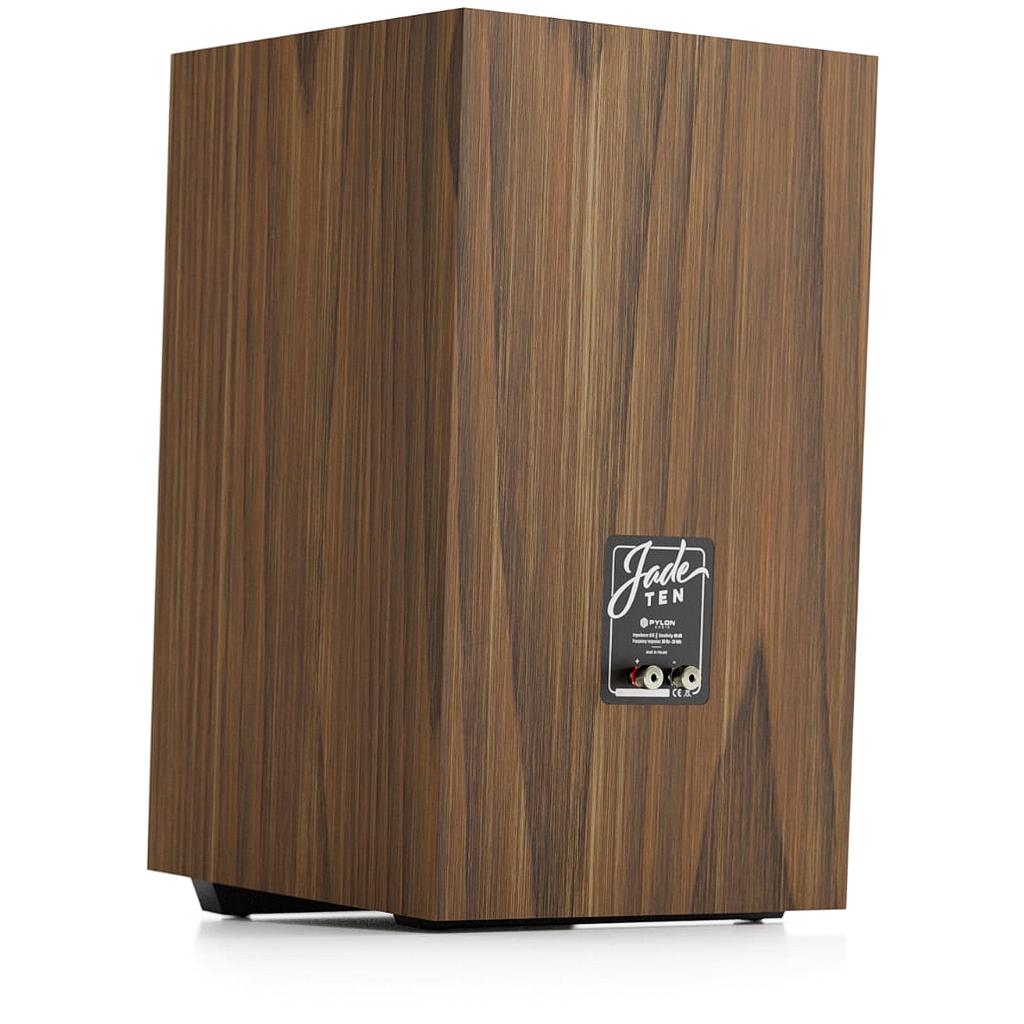
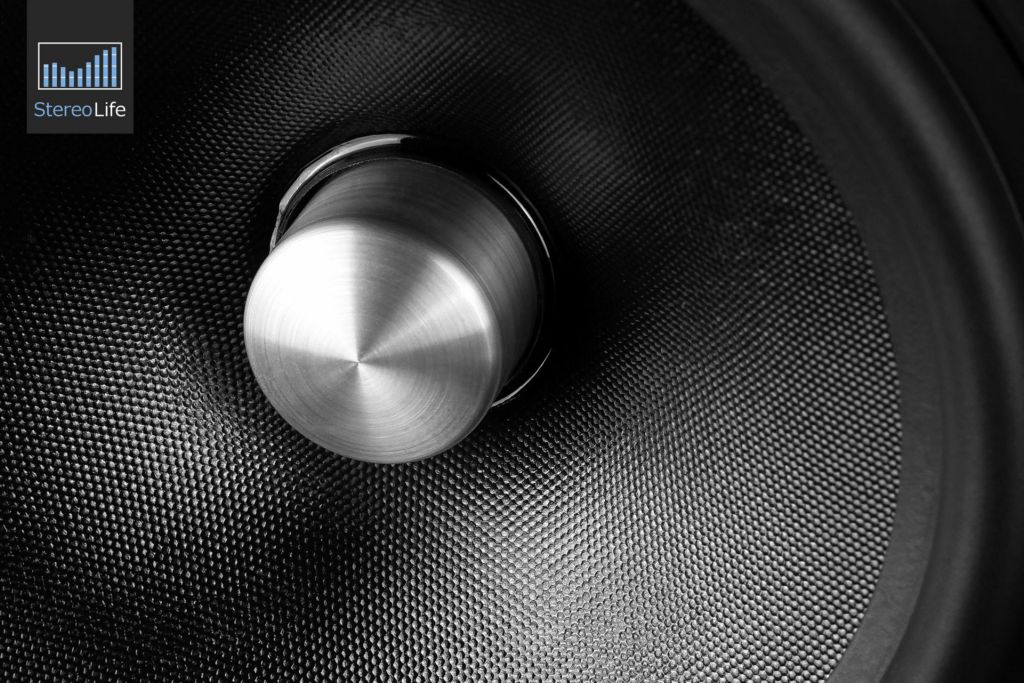
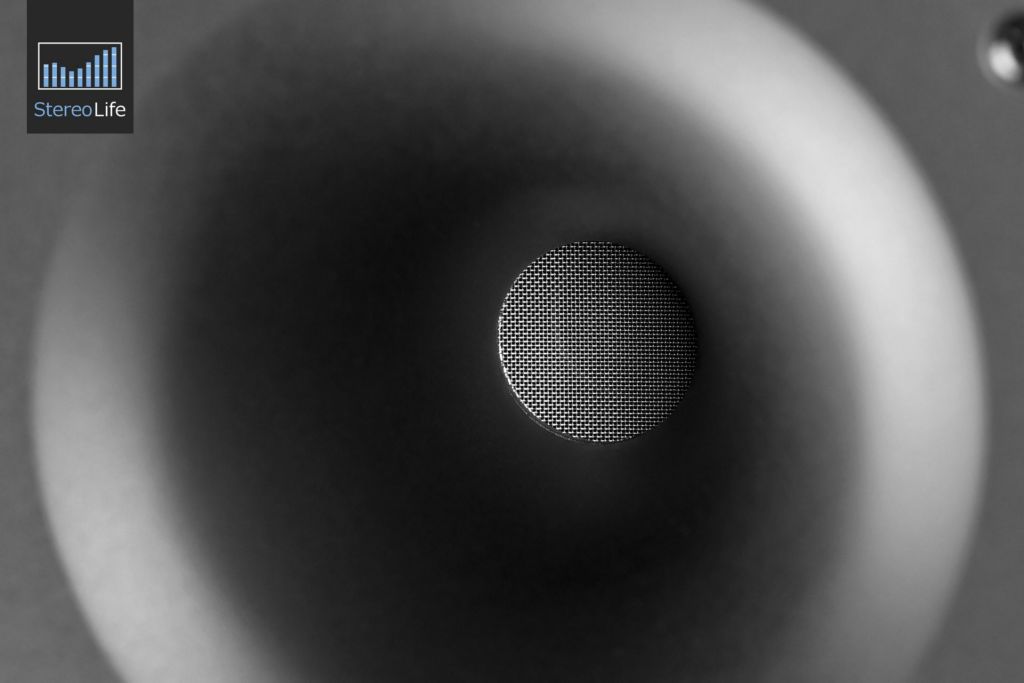
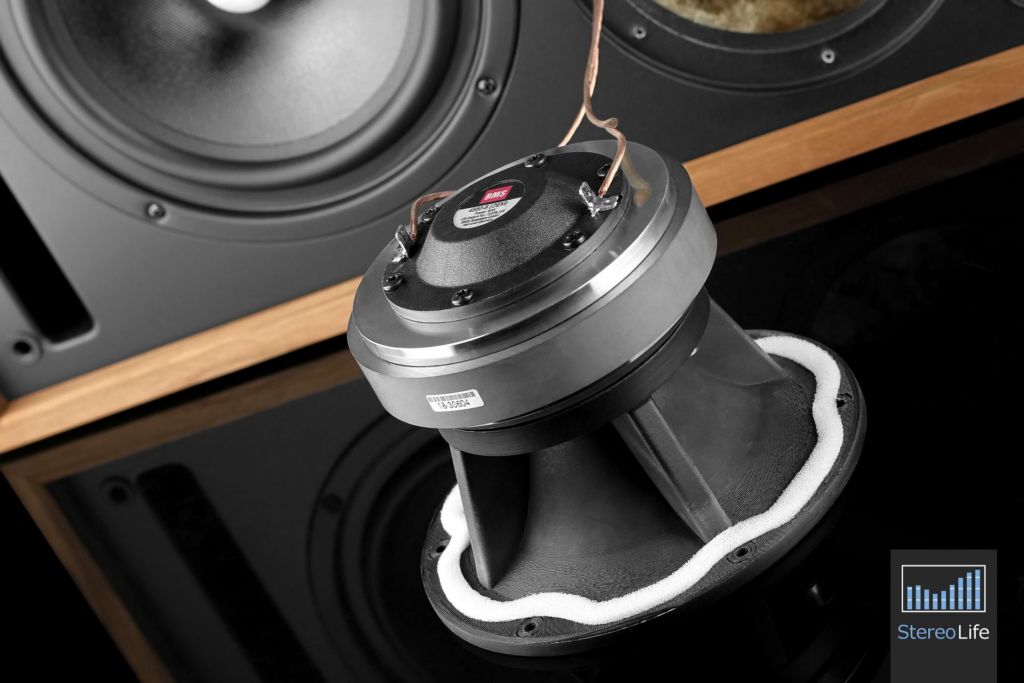
The Pylon Audio Jade 10 is a two-way loudspeaker in a vented enclosure which, as befits a monitor inspired by classic designs, uses drivers that are unusual by today's standards. Bass and midrange are handled by a 22-cm PSW 22.8 CS driver with a modified cellulose cone. The manufacturer emphasizes its optimal internal damping, the system's low resonant frequency and a strong motor with magnetic-field linearization and rings that reduce eddy currents. The choice of a paper cone is no accident either. Cellulose, in various modified forms, remains one of the favorite materials of designers who value natural midrange reproduction, good impulse response and a pleasant way of damping resonances. In an age of metal, ceramic, composite, sandwich and carbon-fiber-reinforced diaphragms, paper may seem traditional, but it still makes sense, especially in speakers focused on tone and coherence. Treble is handled by the PST 25PO.8, a professional compression driver also used in the larger Jade models, working with a Tractrix-profile horn. The manufacturer mentions a lightweight CCAW voice coil and double-sided winding intended to improve cooling and allow better reproduction of complex signals. The driver designations used by the Polish company suggest proprietary units, but the tweeter is in fact the professional BMS 4550. Its own manufacturer describes it as an efficient driver intended for high-power sound reinforcement systems and stage monitors requiring a low crossover frequency. The woofer, by contrast, carries no markings. Frankly, I do not understand why Pylon replaces the original driver names with its own numbering. Competitors will find out what is inside anyway, and customers should not feel misled, because the BMS 4550 is not some hopelessly cheap tweeter. It is respected by professionals and hobbyists alike, and depending on the store, its price ranges from $190 to even $309. Using such a driver in high-quality loudspeakers is nothing to be ashamed of, but for some reason Pylon prefers the PST 25PO.8 designation, so be it.
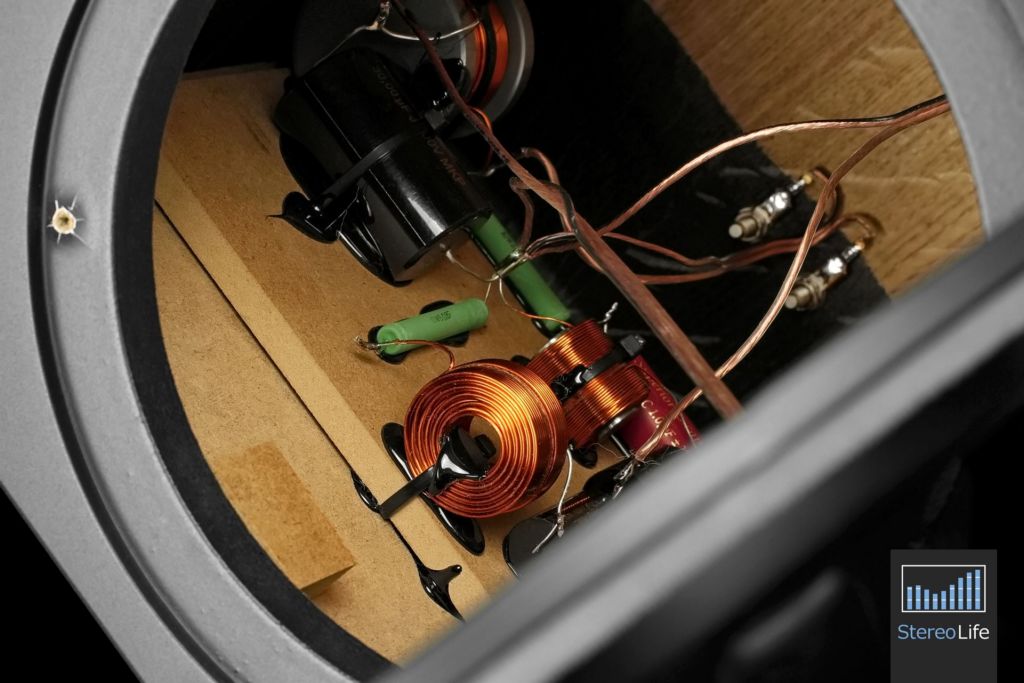
The cabinet is made of thick MDF panels and internally reinforced at several critical points. Natural sheep's wool is used for damping, intended to reduce standing waves and unwanted noise from the bass-reflex port. This is an interesting choice, because wool is rarely seen today. Most loudspeaker manufacturers use synthetic alternatives. Pylon chose a traditional material, and what is even more interesting is that it appears behind the tweeter, while the lower part of the cabinet remains relatively empty. Perhaps the idea was to let the "tens" sound lively and natural while allowing the wide ports to work freely. Directly behind the woofer, on a separate MDF board, sits a crossover built from very high-quality components, including Jantzen Audio Superior Z-Cap capacitors, known for minimal inductance thanks to interleaved winding and manufacturing methods that maintain high material tension, reducing vibration and microphonic effects. The polypropylene film is metallized with aluminum and zinc particles, while the leads are made of PCOCC copper. Once again, it is clear that Pylon did not skimp on parts. And yet the company does not brag about any of this. To find out, I first had to disassemble the test speakers and then investigate the individual components myself. In its own materials, the Polish manufacturer does not talk about space-age cables or absurdly expensive capacitors. Instead, it speaks about precisely matching the filters to the specific drivers, which sounds very reasonable. Perhaps this is another wink toward those who know the subject. Beginners will learn nothing from the markings on the capacitors, while experienced audiophiles will immediately understand what they are looking at.
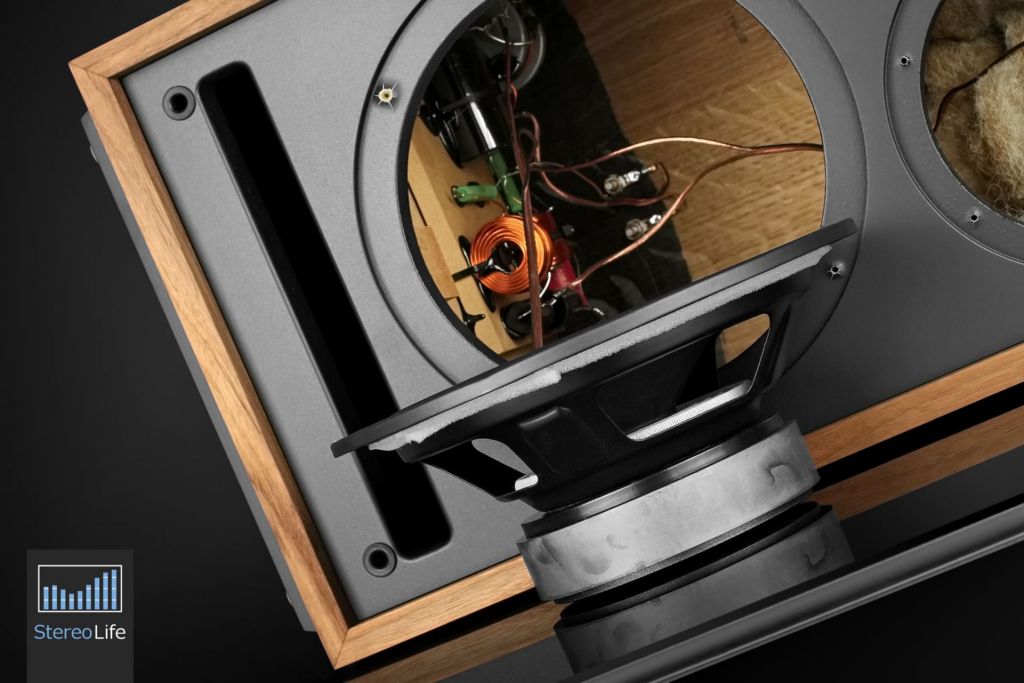
Despite these positives and the high overall build quality, while disassembling the speakers I noticed a few details that I initially found difficult to understand, and which will certainly catch the eye of people interested not only in how hi-fi equipment looks and sounds, but also in how it is built. Take the mid-woofer and its mounting. The woofer basket is stamped steel and actually bends under the mounting screws. It is lined with foam from the inside, which is good, but the screws go directly into the front baffle. In speakers at this price, threaded inserts would not have been unreasonable. The internal wiring looks fairly ordinary, and even if someone believes this does not make much difference, the wires could at least have been wrapped in foam or sponge to make sure they do not touch other parts and start vibrating. The crossover, however, may raise the most eyebrows. As I mentioned earlier, I have no complaints about the quality of the components, but the point-to-point assembly looks unusual, to put it mildly. Coils and capacitors held in place with zip ties and covered in black glue, wires forming webs, twisted and soldered in a rather inelegant manner - today, such things are rarely seen. So what is going on here? Did the manufacturer decide to add a little 1970s charm even where nobody is supposed to look? I learned the explanation during my test of the Diamond 25 mkII. Pylon's engineers claim that this type of assembly is best from the standpoint of sound quality. Apparently, dozens of listening tests were carried out, and a crossover built this way always beat the "prettier" version mounted on an elegant printed circuit board. And in the end, sound is what matters most, right? If that explanation does not convince you, you can always treat it as part of the vintage aesthetic. In similar speakers, you will find all kinds of oddities - driver baskets covered with thick, poorly cut foam, jumpers on the front baffle or bass-reflex ports that are nothing more than holes cut into the cabinet and painted black, if painted at all. In modern loudspeakers, such solutions would probably be ridiculed. Fortunately, Pylon did not go too far in that direction, which is why the Jade 10, although at first glance it looks as if it had been found under a pile of cardboard boxes in grandpa's garage, is civilized and simply handsome.
System configuration
Audiovector QR5, Equilibrium Nano, Unison Research Triode 25, Octavio AMP, Hegel H20, Auralic Aries G1, Silent Angel M1T, Auralic Vega G1, Marantz HD-DAC1, Clearaudio Concept, Cambridge Audio CP2, Cardas Clear Reflection, Tellurium Q Ultra Silver II, Tellurium Q Ultra Blue II, Van den Hul CS-122 Hybrid, Albedo Geo, KBL Sound Red Corona, Enerr One 6S DCB, Enerr Tablette 6S, Enerr Transcenda Ultimate, Fidata HFU2, Melodika Purple Rain, Final Audio Design A8000, Sennheiser HD 600, Beyerdynamic DT 990 PRO, Beyerdynamic DT 770 PRO, Meze 99 Classics, Bowers & Wilkins PX5, Pro-Ject Wallmount It 1, Custom Design RS 202, Silent Angel N8, Vicoustic VicWallpaper VMT, Vicoustic ViCloud VMT.
Verdict
The easiest way to describe the Pylon Audio Jade 10 would be with a handful of attractive phrases - retro styling, horn driver, classic monitor with a large woofer and bold, concert-like sound. The problem is that none of these phrases fully captures what this speaker is about. Retro? Yes, but not as a surface treatment designed to follow a trend. Rather, as a complete package of technical choices and design decisions. This is not an imitation. It is a distillation of vintage style. Horn tweeter? Yes, and one based on a driver intended for studio and stage applications, but implemented and tuned with enough skill that we get much more than the brightness and ruthless clarity often associated with this type of unit. Big woofer? Yes, but it does not try to be the only star of the show. Concert-like presentation? That description also fits, although it is more about freedom and scale than an exaggerated PA-like temperament that would become exhausting in the long run.
And I think this is where the real secret of the Jade 10 lies - its greatest strength is the surprising consistency and unity of the presentation. These are not speakers that shine in one area and leave the rest to chance. Bass, midrange, treble, dynamics and space all serve one idea - the sound should be interesting, engaging, present, free and clear, but still natural, correct and well-balanced enough not to trigger an allergic reaction, fall into parody or become tiring during long listening sessions. Music should have rhythm and energy, but it should not beat the listener over the head for no reason. It should reveal detail, but without dissecting recordings into atoms. It should deliver genuine listening pleasure, not merely pretend to satisfy dreams of vintage equipment that does not have to be imported from the other side of the world in the hope that the driver surrounds can be replaced, the crossovers rebuilt and the cabinets restored like old furniture. Here, we get all of that in the form of brand-new-smelling speakers - and yes, they really do smell - that simply need suitable electronics and a little free floor space. The rest happens on its own.
What impressed me most is that the Jade 10 does not try to justify itself. It does not apologize for its form, does not pretend to be something it is not and does not try to please everyone. Instead, it offers a very specific way of experiencing music, and it does so with a kind of freedom and confidence that is increasingly rare in audio equipment. It has charm, a strong personality, but it is not a caricature. It is one of those products that may divide listeners, but those who understand it will probably not merely like it - they may become attached to it. I also appreciate the courage behind the project. Pylon could have kept doing what it already does very well - refined, modern, rational loudspeakers that fit easily into contemporary interiors and systems. Instead, it decided to build something that appears to come from another world, even though it was created with modern tools, in a modern factory, by people who clearly know what they are doing. The result is not a historical reconstruction, but a reconstruction of an emotion. It is a nostalgic loudspeaker from a country that never had exactly this kind of nostalgia. And yet the whole thing works. For me, these are among the most interesting speakers Pylon has ever made. Not because they are the most linear, the most universal or the most technically advanced, but because they have their own language and speak it fluently.
This review became something more than an assignment for me - more, even, than one of those occasions that bring the simple pleasure of listening or the satisfaction of spending time with another interesting piece of hi-fi. From the very beginning, it turned into a series of small discoveries that kept putting a smile on my face, pleasant surprises and little twists in the story, experiments with placement and cabling, and even the rediscovery of albums I probably had not played in well over a decade. Did I let myself get carried away? Possibly. But I should add that I turn forty this year, so this is not exactly time travel in the literal sense. I never owned speakers like these. If I were to reach back into my own memory, I would mostly be thinking of a history written over the past ten years rather than half a century ago. I have also spent some time with genuinely vintage gear, and although I have enormous respect for those who love it, I have never felt the urge to buy speakers like that. I wouldn't have the patience, either, to monitor auction websites and then hunt down a specialist willing and able to restore such speakers properly. The Pylons solve that problem neatly. I do not have to search for them or bring them back to life, because they are standing right next to me, playing better and better, and putting a smile on my face every single day. And you know what? I am not giving them back. I will place them right up against the wall, play the wonderfully juvenile music of my youth through them, and to make the whole thing even more entertaining, at the next opportunity I will ask the entire Pylon team to sign their grilles for me. Huge applause for the courage and for reconstructing memories we never had the chance to form.
Technical data
Speakers type: Floorstanding/standmount, two-way, ported
Sensitivity: 88 dB
Impedance: 8 Ω
Frequency response: 38 Hz - 20 kHz
Dimensions (H/W/D): 52/30/35 cm (without feet)
Weight: 20 kg (piece)
Price: €3,250 (pair)
Manufacturer: Pylon Audio
Sound performance
Editor's rating
9.2Overall9Sound9Functionality10Design10Quality8Price