
- News
- Posted
Topping E50 II
Topping has introduced the E50 II, a compact pure DAC with preamp functionality and no onboard headphone amplifier. The new model joins the company's popular E Series of budget-friendly converters and is designed for desktop systems, hi-fi setups, active speakers, separate headphone amplifiers and even more demanding studio-oriented use. It is a small device, but the feature set is unusually broad, combining a modern AKM DAC chip, balanced and single-ended outputs, high-resolution USB input, Bluetooth, app control and a sophisticated parametric EQ system.
The E50 II belongs to Topping's popular E Series, a line of small DACs intended to deliver strong technical performance without the size, cost or complexity of larger components. It does not include a headphone amplifier, which is worth noting from the start. Instead, it focuses on digital-to-analog conversion, flexible output options and system control. This makes it a natural partner for a separate headphone amp, integrated amplifier, power amplifier or active speakers. It can also feed more than one setup at the same time, which gives it an unusual level of flexibility for such a compact device.
At the heart of the E50 II is AKM's AK4497S DAC chip, part of the Japanese manufacturer's latest Velvet Sound generation. This is one of the most important details in the product, because many affordable DACs are built around older or simpler conversion chips. By using a newer and more capable AKM platform, Topping is positioning the E50 II not merely as a convenient small DAC, but as a serious conversion stage for users who want high-quality digital playback without moving into a much higher price bracket.
Topping has built its own supporting architecture around the DAC chip, including the TopSync circuit with JitterNull processing. Jitter is a timing error in digital audio, and although it is often discussed in abstract terms, its practical importance is easy to understand - a DAC needs stable timing if it is to reconstruct the signal cleanly. In the E50 II, Topping uses a custom-programmed FPGA and PLL-based synchronization system to suppress timing errors before they can affect conversion. The claimed jitter suppression reaches extremely low levels, but the useful takeaway is that Topping has treated clocking and signal integrity as central parts of the design, not as afterthoughts.
The measured performance is presented as a major strength, and in this case the figures are meaningful because they show what Topping is trying to achieve at this level. A dynamic range of 131 dB and THD+N of 0.0001% at 1 kHz are very strong results for an affordable DAC, suggesting a conversion and output stage designed to remain quiet, clean and transparent in normal use. Rather than treating these numbers as decoration, they help explain why the E50 II is being positioned as a small DAC capable of working in more serious desktop, hi-fi and studio systems.
Connectivity is deliberately broad. The E50 II accepts digital audio through USB-C, optical and coaxial inputs, while a separate 5 V USB-C power input keeps power and data physically separated. This is a sensible design choice in a compact DAC, because USB power and digital data can otherwise share the same connection and increase the risk of noise contamination. On the output side, Topping provides both single-ended RCA and balanced 6.35-mm TRS outputs. The balanced TRS output is particularly useful because it makes the E50 II easier to integrate with active monitors and professional or semi-professional setups, not just conventional hi-fi equipment.
The RCA and balanced TRS outputs can be controlled independently and assigned different settings, including output level and parametric EQ profiles. They can also be used simultaneously, allowing the DAC to feed two systems at once - for example, a speaker setup and a dedicated headphone amplifier. The E50 II can work in fixed-output DAC mode when connected to an integrated amplifier or separate preamp, or in preamp mode when driving a power amplifier or active speakers directly. This is one of the product's more practical strengths, because it allows the same compact unit to serve several different roles as a system evolves.
High-resolution support is handled by a 16-core XMOS XU316 USB interface working with the AKM DAC platform. The E50 II supports PCM up to 32-bit/768 kHz and native DSD up to DSD512. These are not everyday file formats for most listeners, but they indicate that the DAC is unlikely to become a bottleneck for common digital libraries or modern playback software. More importantly, they show that the E50 II is designed as a current-generation digital component rather than a stripped-down entry-level model with limited format support.
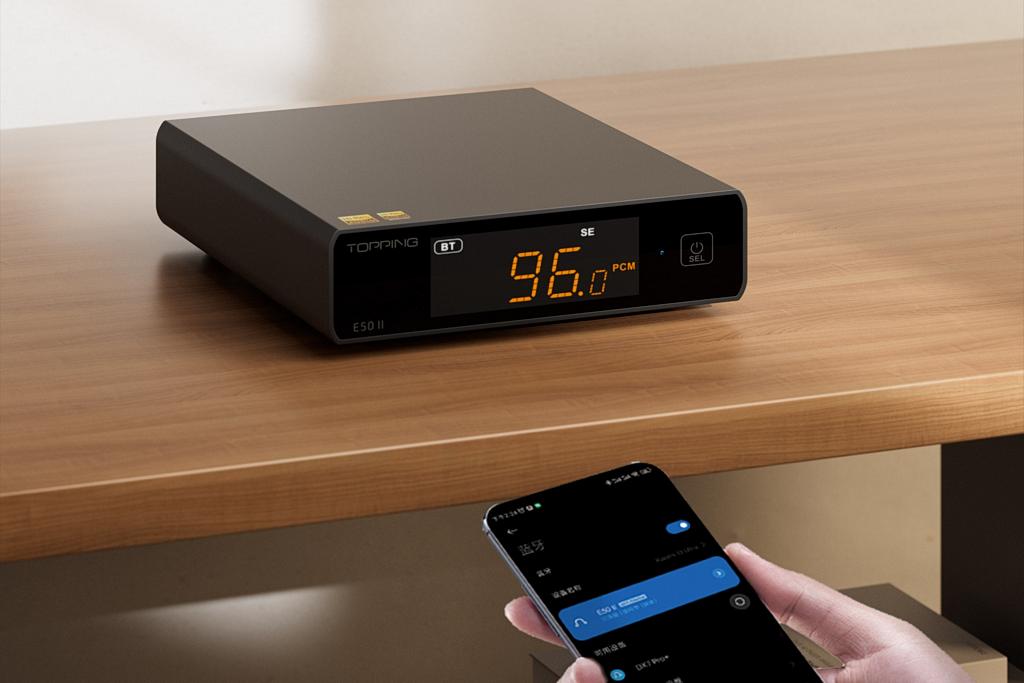
Bluetooth is also included, but not as the main attraction. Using a Qualcomm QCC5125 chip, the E50 II supports higher-quality codecs including LDAC, aptX Adaptive and aptX HD. This makes wireless playback more useful than basic Bluetooth reception, especially for casual listening or quick connection from a phone or tablet. A wired digital input will still be the more serious option, but Bluetooth adds convenience without reducing the product to a purely lifestyle DAC.
One of the more unusual features is ADAT support via the optical input. ADAT, also known as Lightpipe, is widely used in studio environments for multichannel digital audio. The E50 II's optical input includes an FPGA-based intelligent detection engine that can automatically recognize and decode both standard S/PDIF and ADAT. This gives the DAC relevance beyond typical domestic hi-fi use, especially for home studios, small production rooms and users who move between music listening and content creation.
The output stage has also been designed with both domestic and studio contexts in mind. User-selectable output amplitude allows the E50 II to match different downstream equipment more precisely, whether feeding a portable headphone amplifier, an integrated amp or powered studio monitors. The balanced TRS output can be switched to a high output level, which is useful in professional environments where stronger line-level drive may be required. In normal hi-fi use, the same flexibility helps avoid overload on sensitive inputs or insufficient level into equipment that expects a hotter signal.
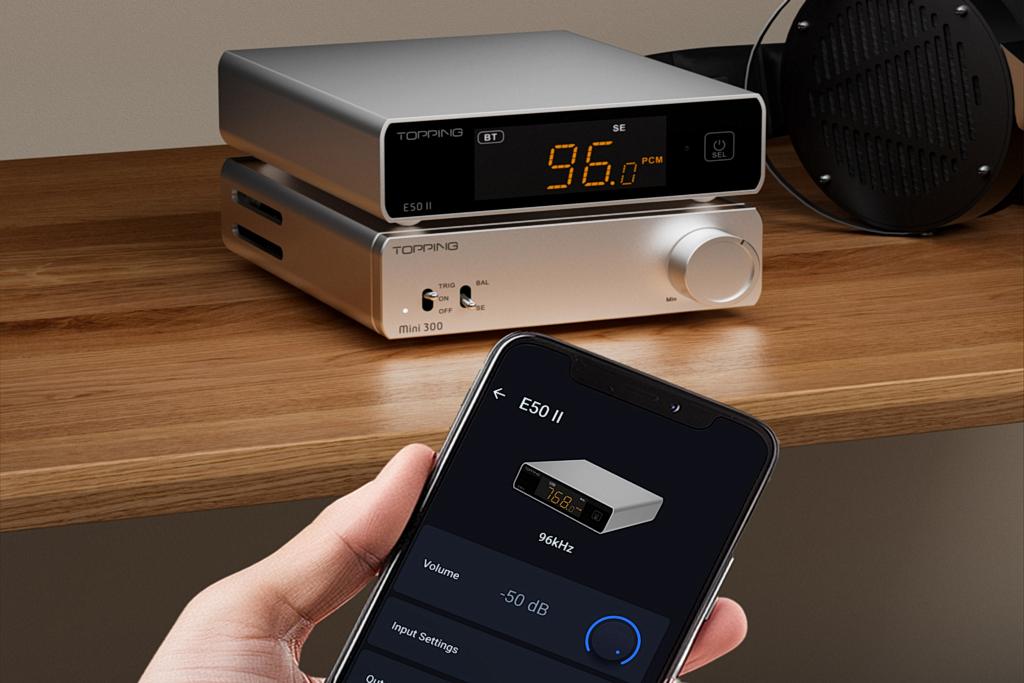
The E50 II is also the first of Topping's new generation of compact "smart DACs" compatible with the Topping Home app for iOS and Android. The app connects to the DAC via Bluetooth, so it does not require Wi-Fi or internet access, and provides control over playback, volume, input switching and sound settings. This is useful because the E50 II is physically small and minimalist, with only a touch-sensitive button on the front panel. Full app control makes the DAC easier to configure without cluttering the chassis with buttons.
The most significant software feature is parametric EQ. The E50 II supports Topping's firmware-level 10-band PEQ system, allowing precise adjustment of frequency, gain and Q. This can be used to compensate for room behavior, active speakers, headphones connected through a separate amplifier or personal taste. Other Topping DACs with PEQ require the Topping Tune desktop software for more advanced configuration, and the E50 II supports that too, but the addition of mobile app control makes the system far more accessible in everyday use. At this price level, such a sophisticated EQ system is unusual.
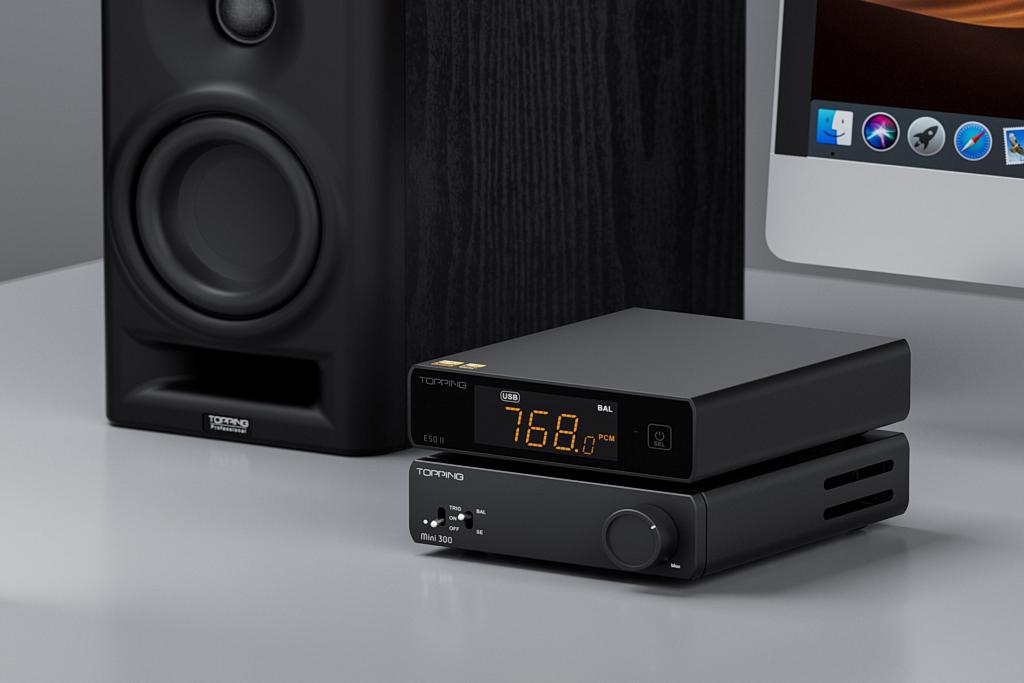
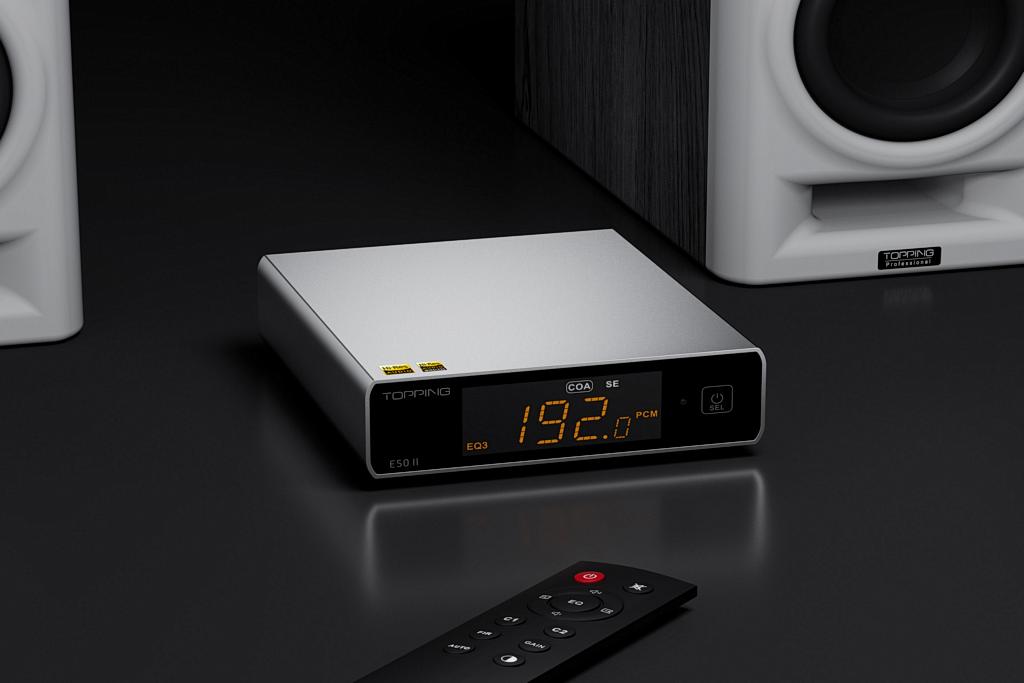
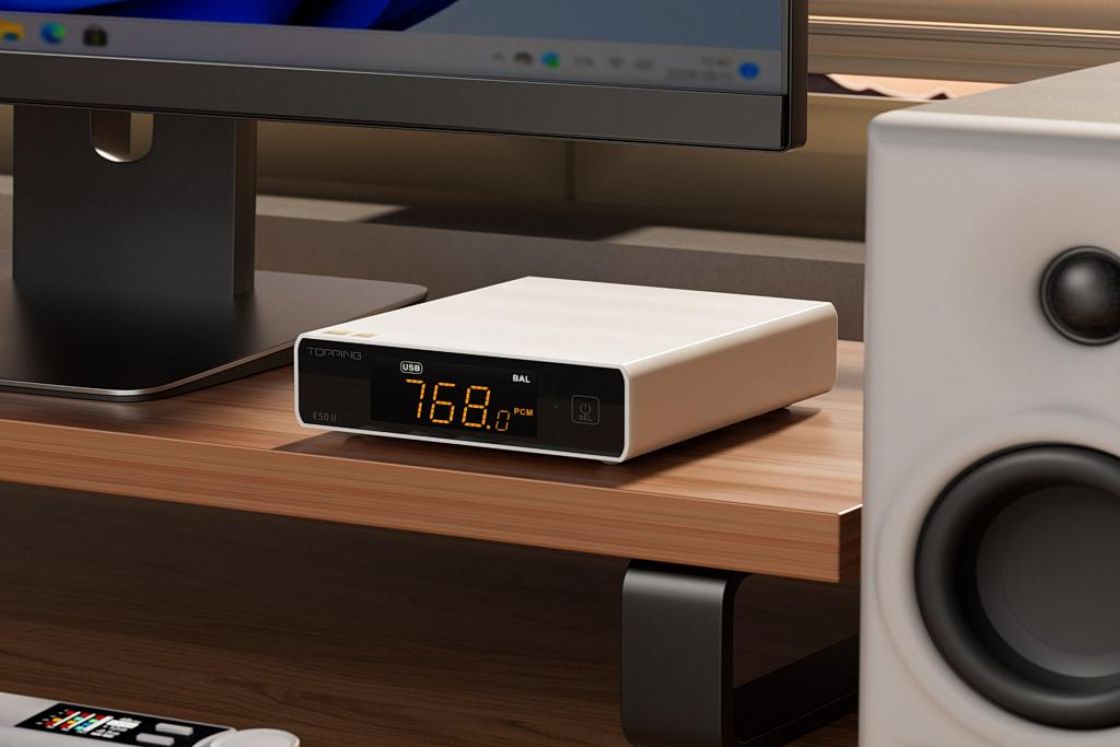
Physically, the E50 II is compact enough for a desk but styled like a proper miniature component. The aluminum enclosure measures 129 x 41 x 155 mm and is available in black, white or silver. The front panel uses a central OLED display with orange segmented numerals that give the unit a slightly retro digital-clock character. Display brightness can be adjusted manually or automatically, which is useful in desktop and living-room systems where a bright front panel can become distracting.
The E50 II is not a product built around one dramatic feature. Its appeal comes from the combination of a modern AKM DAC chip, strong measured performance, balanced and single-ended outputs, preamp functionality, app control, PEQ, ADAT compatibility and a compact chassis that can fit into many different systems. It can work as a desktop DAC, a hi-fi digital hub, a preamp for active speakers, a partner for a headphone amplifier or a practical tool in a small studio. That flexibility is what makes it more interesting than a simple low-cost converter. The E50 II is available in black, white or silver and is priced at €199/£199/$199. Info and photos by Topping.