
- News
- Posted
DALI Basik Sub
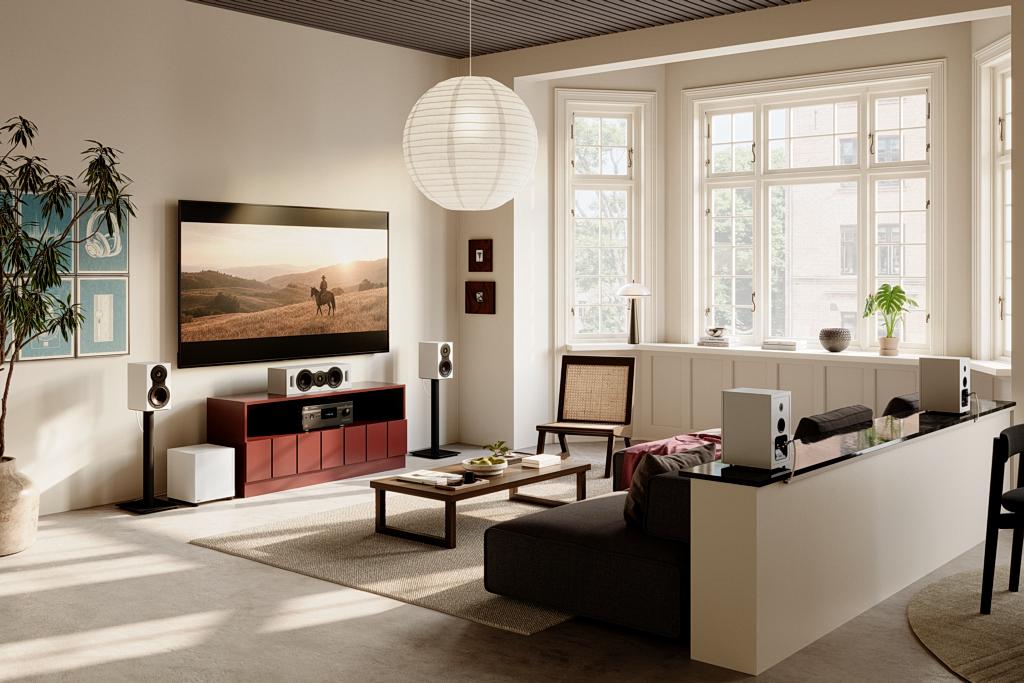
Compact bookshelf speakers and small streaming amplifiers have become enormously popular in recent years, but there are some laws of physics that even the cleverest engineers cannot completely overcome. A stereo system that fits comfortably on a sideboard, shelf, or small media cabinet can deliver surprisingly mature and sophisticated sound, but when it comes to the lowest frequencies, it will usually have to concede some ground to larger designs. One way to address this limitation is to add an active subwoofer, extending the system's bass response without immediately replacing everything with a pair of large floorstanding speakers. This is precisely the idea behind DALI's new Basik Sub, a compact model designed primarily to complement smaller stereo systems while remaining equally suitable for home theater applications.
The Danish manufacturer specifically mentions its own Kupid and Sonik 1 bookshelf speakers as natural partners, although the concept obviously extends far beyond these particular models. The Basik Sub is intended for the growing market of compact systems built around bookshelf speakers, small streaming amplifiers, turntables, and all-in-one components. Krestian Pedersen, DALI's Director of Product Management, points out that the popularity of such setups continues to grow alongside the emergence of relatively affordable streaming amplifiers and other components that make it possible to build a proper stereo system without spending a fortune or surrendering half the living room to audio equipment. Increasingly, these devices also offer dedicated subwoofer outputs and bass management features, meaning that putting together a 2.1 system no longer requires an AV receiver or a particularly complicated setup procedure.
At the heart of the Basik Sub is a DALI-designed 8-inch long-excursion woofer mounted in a downward-firing configuration. Its cone is made from paper pulp, a material chosen to combine low moving mass with the rigidity required for controlled bass reproduction. The motor assembly incorporates an oversized ferrite magnet and a high-flux magnetic circuit, while the long, vented voice coil is intended to improve heat dissipation and reduce compression at higher output levels. Pointing the driver toward the floor is more than just a mechanical design decision. According to DALI, this arrangement helps distribute low-frequency energy more evenly throughout the room while providing greater flexibility when positioning the subwoofer. The idea is to achieve powerful, well-controlled bass without making the location of the subwoofer itself immediately apparent to the listener.
Power comes from a Class D amplifier delivering 170 watts of continuous output and 220 watts at peak power. A switch-mode power supply helps keep energy consumption and heat generation relatively low, while a built-in two-stage limiter protects the system against overload and maintains control when the amplifier is driven harder. In other words, the Basik Sub is not intended merely to provide a subtle reinforcement of the lowest frequencies. DALI clearly expects it to give smaller speakers something they cannot easily achieve on their own - a greater sense of scale, authority, and dynamic freedom. Whether the system is being used for music, movies, or everyday television viewing, the additional low-frequency capability should make the presentation feel considerably more substantial without overwhelming the main speakers.
The manufacturer has also made sure that the Basik Sub can be adapted to a variety of systems and listening environments. Its adjustable crossover operates between 40 and 120 Hz, while phase can be adjusted continuously from 0 to 180 degrees. An independent level control completes the basic adjustment options. In systems equipped with their own bass management, some of these responsibilities can be handled by the source component or amplifier. In a more traditional stereo setup, however, the built-in controls allow users to integrate the subwoofer manually with their main speakers and the acoustic characteristics of the room. The rear panel provides stereo Line L/R inputs and a separate mono LFE input, allowing the Basik Sub to work with conventional stereo amplifiers, AV receivers, and modern streaming amplifiers equipped with dedicated subwoofer outputs. This flexibility is particularly important for a product designed to appeal to listeners who may be adding a subwoofer to an existing system for the first time.
The cabinet is constructed from MDF and, according to the technical specifications, uses a bass-reflex design. Four decoupled feet raise the enclosure 25 mm (approximately one inch) above the floor, providing the clearance required for the downward-firing woofer to operate properly while helping to reduce the transmission of mechanical vibrations. The entire unit measures 319 x 295 x 310 mm (12.6 x 11.6 x 12.2 inches) and weighs 9.75 kg (21.5 lb), making it a genuinely compact proposition by subwoofer standards. DALI expects the Basik Sub to be relatively easy to accommodate near a wall or in a corner, which could be just as important as its acoustic capabilities for systems intended for living rooms, bedrooms, or smaller dedicated listening spaces. After all, a subwoofer that performs impressively but proves impossible to accommodate in a normal room is unlikely to appeal to the audience DALI has in mind.
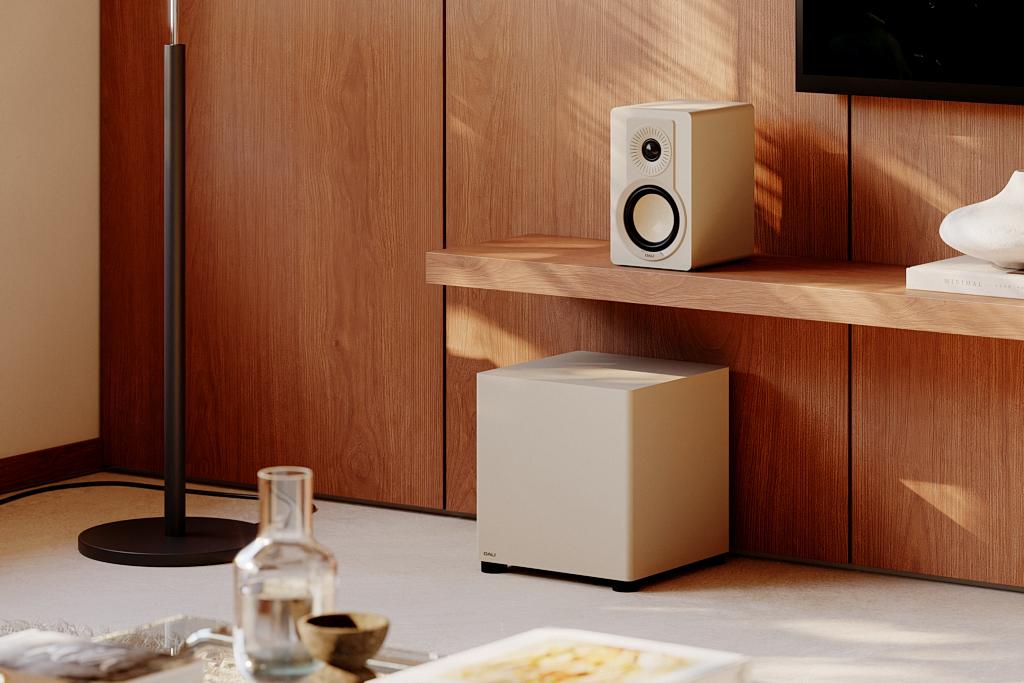
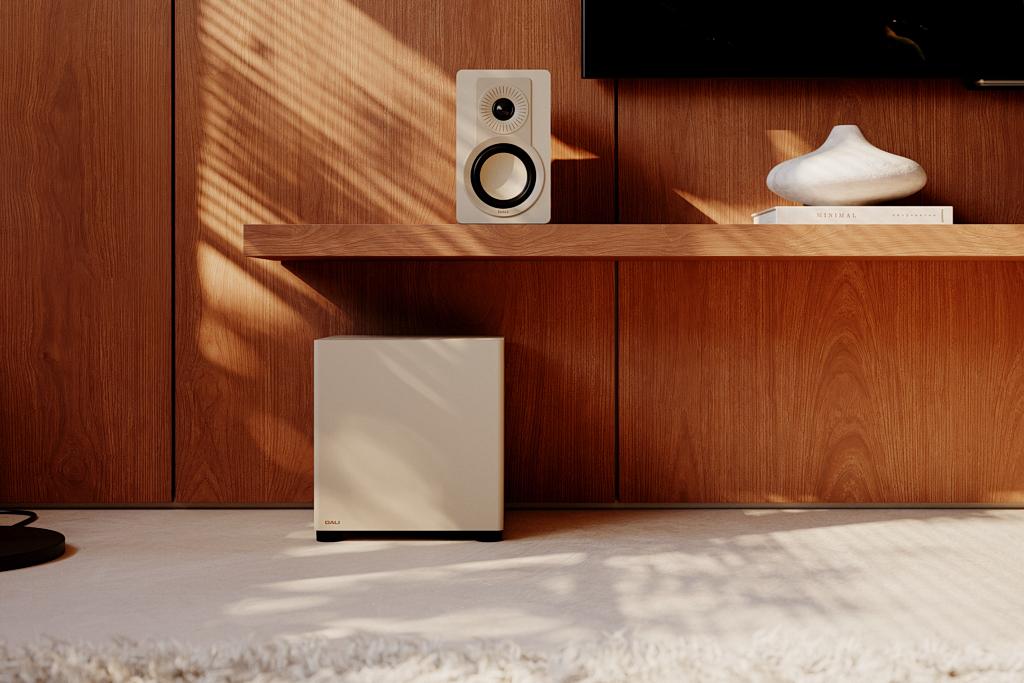
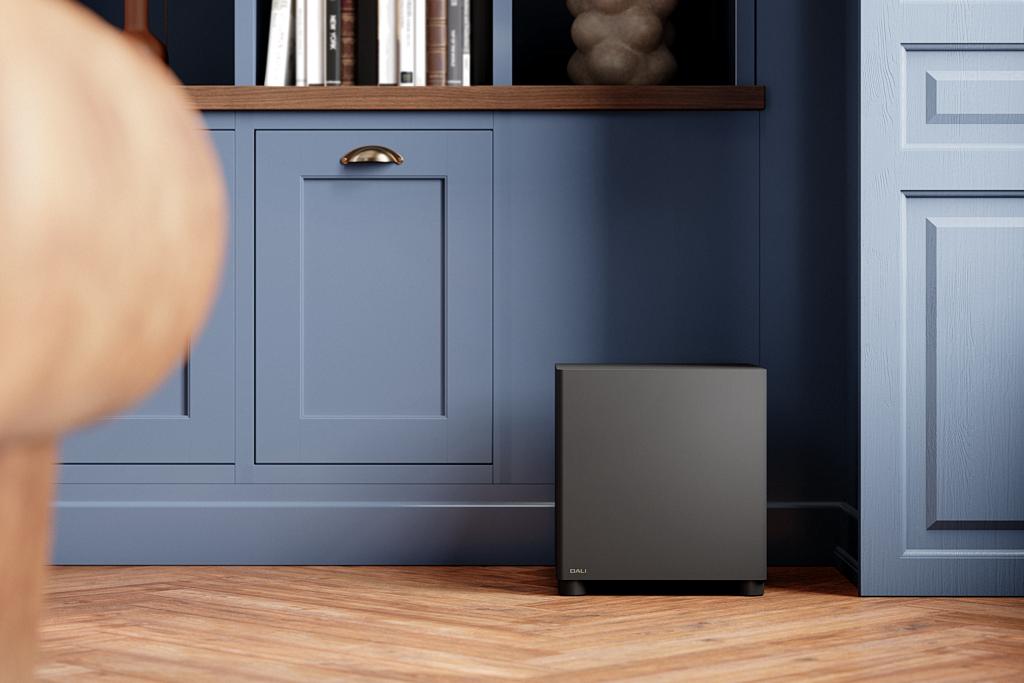
The company has also taken a rather unusual approach to styling. Instead of limiting the Basik Sub to the customary black and white finishes, DALI will offer no fewer than five color options: Solid Black, Solid White, Caramel White, Golden Yellow, and Chilly Blue. The palette has been coordinated with the finishes available for the company's compact speakers, particularly the Kupid and Sonik ranges, allowing owners to create a visually consistent system rather than adding an unrelated black box to an otherwise carefully arranged living room. The yellow and blue versions are especially interesting, demonstrating that DALI wants to move beyond the traditional idea of a subwoofer as something that should ideally be hidden out of sight. Here, the bass enclosure can become part of the room's interior design, complementing furniture and other decorative elements rather than merely occupying an inconvenient corner.
For everyday convenience, the Basik Sub offers three power modes - On, Auto, and Off. In automatic mode, the amplifier enters standby after approximately 20 minutes without an incoming signal, reducing power consumption to just 0.4 W. It may seem like a relatively minor detail, but it matters in a system intended for regular use, where the subwoofer can remain connected and simply wake up when music or another audio signal is detected. Indeed, the entire concept of the Basik Sub revolves around this kind of straightforward ownership experience. Rather than encouraging listeners to build increasingly large and complicated systems, DALI is offering a relatively simple way to give compact stereo setups the low-frequency extension, physical presence, and dynamic scale they may otherwise lack. The DALI Basik Sub is scheduled to become available through authorized dealers worldwide in October 2026, with suggested retail prices of $800 in the United States, €499 in Europe, and £429 in the United Kingdom. Info and photos by DALI.