
- News
- Posted
Musical Fidelity M6xi
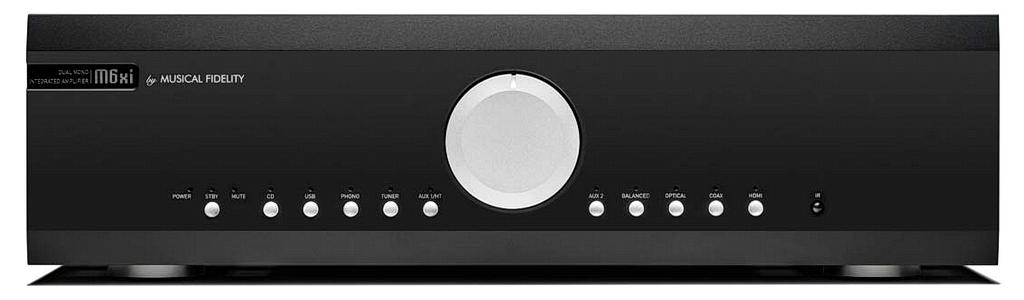
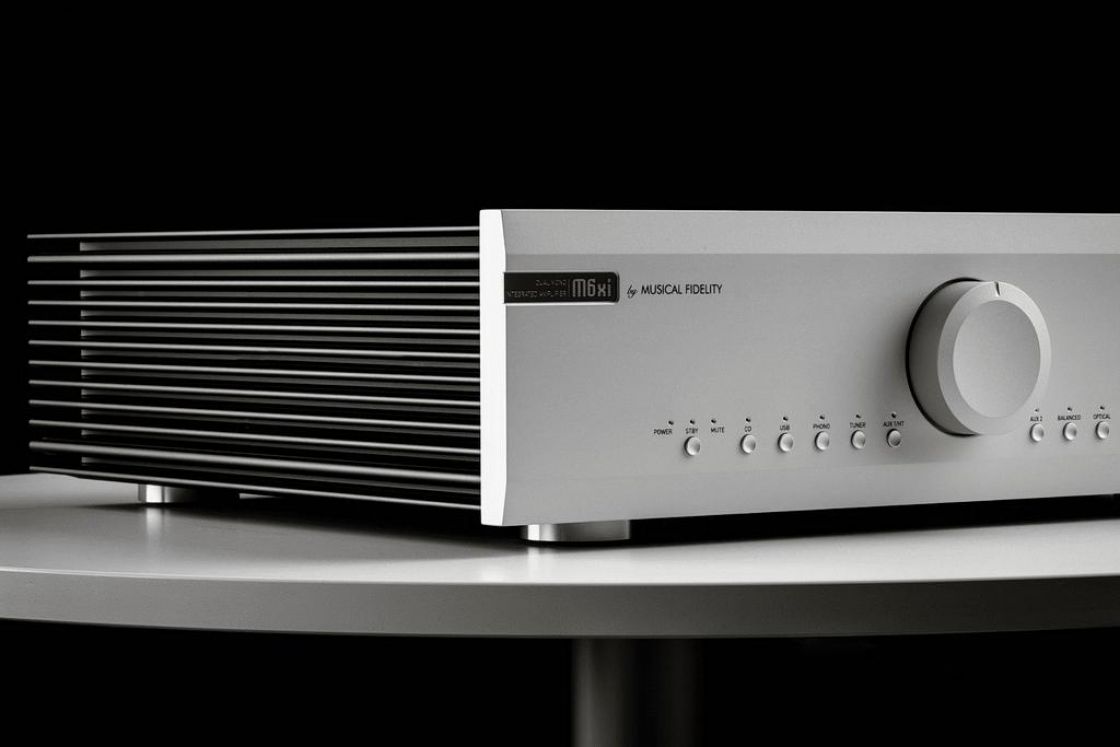
Musical Fidelity has introduced the M6xi, a new integrated amplifier that updates one of the company's longest-running high-power platforms with expanded digital connectivity and broader system-integration capabilities while preserving the core analog architecture that defined the earlier M6si. Rather than replacing the established concept behind the M6 series, the new model represents part of Musical Fidelity's wider "xi" generation refresh, which brings HDMI ARC, USB-C audio connectivity, and improved installation flexibility across several amplifier lines including the M2, M3, and M5 models.
Like its predecessor, the M6xi is designed as a high-current integrated amplifier capable of functioning as the central control component in demanding stereo systems. Output power is specified at 230 watts per channel into 8 ohms and 390 watts into 4 ohms, placing the amplifier firmly among the most powerful conventional integrated designs in its class. Although the numerical increase over the earlier M6si appears modest, the revised output stage draws more directly on circuit principles developed for Musical Fidelity's flagship Titan amplifiers, with a Darlington output configuration intended to improve linearity, reduce crossover distortion, and increase stability with difficult loudspeaker loads.
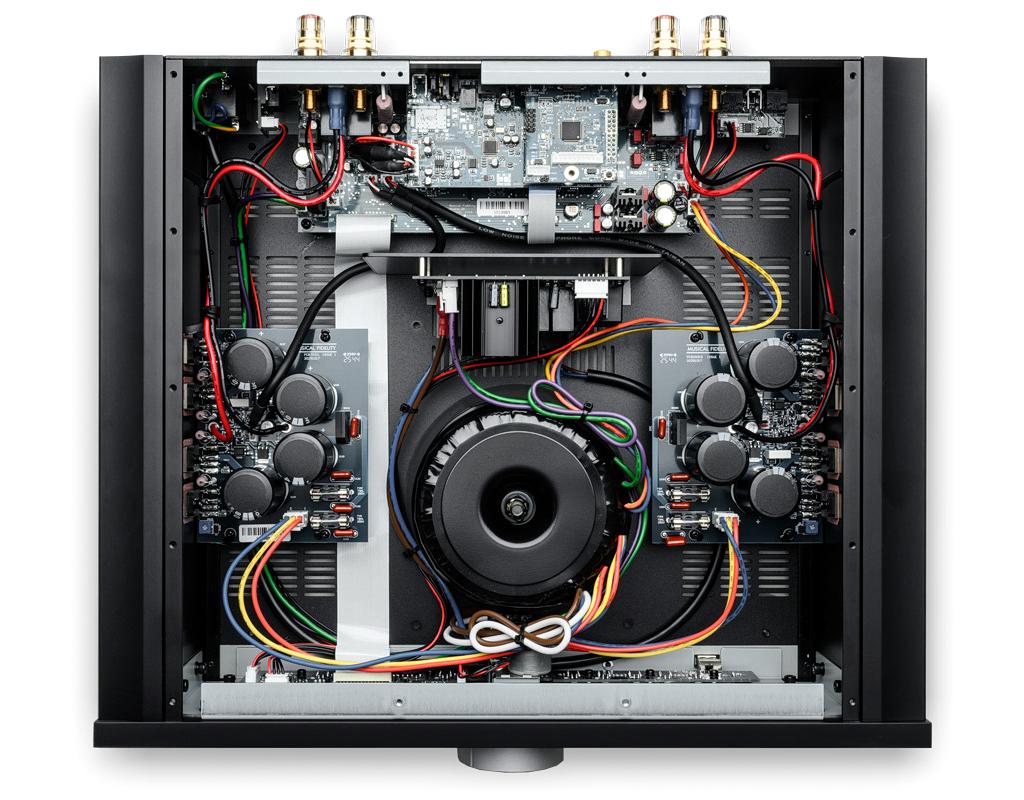
As in previous M6-series amplifiers, the internal architecture effectively combines a dedicated preamplifier section with two monoblock-style power amplifier stages within a single chassis. This approach has long been central to Musical Fidelity's design philosophy and helps explain the series' reputation for unusually strong current delivery compared with many conventional integrated amplifiers of similar rated output power.
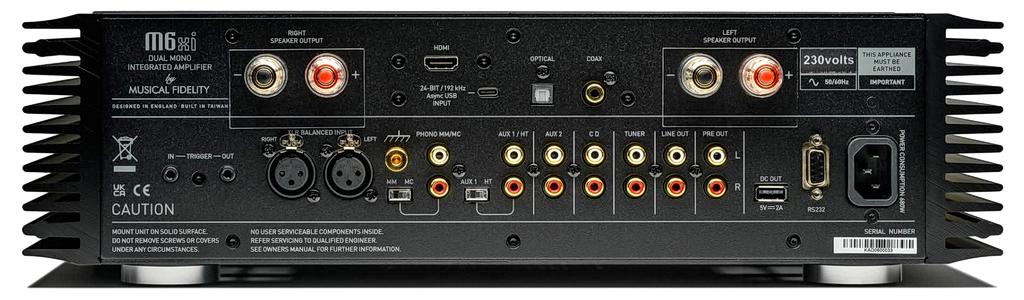
Where the M6xi differs most clearly from the earlier M6si is in its digital interface stage. The addition of HDMI ARC allows direct integration with modern televisions without external converters, making the amplifier suitable not only for traditional two-channel listening but also for mixed music and video systems. Optical and coaxial digital inputs remain available alongside a newly implemented USB-C audio interface, marking a departure from the USB-B connections used in previous Musical Fidelity integrated amplifiers and aligning the platform with current laptop- and tablet-based playback environments.
Analog connectivity continues to reflect the amplifier's role as a complete system hub rather than a minimalist signal path design. Multiple line-level inputs are joined by a built-in phono stage supporting both MM and MC cartridges, allowing direct connection of a wide range of turntables. A pre-out connection enables subwoofer integration or bi-amping configurations, while a dedicated home-theater bypass input allows the amplifier to function as a pure power stage within multichannel installations. An RS232 interface further supports integration into custom-installation environments and advanced automation systems.
Additional practical features reinforce the M6xi's positioning as a modern control amplifier rather than a traditional analog integrated design. A rear-panel USB-A output rated at 5 V/2 A provides clean auxiliary power for external streamers or network bridges such as compact Ethernet transports or USB-powered digital interfaces, reducing the need for separate power supplies in simplified system layouts. Volume adjustment is handled by a Burr-Brown stepped attenuator designed to maintain accurate channel tracking across the entire adjustment range, contributing to stable stereo imaging and consistent tonal balance at low listening levels.
Internally, Musical Fidelity has implemented an optimized PCB layout intended to reduce circuit asymmetry and minimize susceptibility to electromagnetic interference, while fully analog power-supply stages remain central to the amplifier's architecture despite the expanded digital feature set. This reflects the company's continuing emphasis on preserving signal integrity through high-current linear supply design rather than relying heavily on switching-supply solutions in the audio path. Mechanical construction follows the established M-series approach, using extruded aluminum panels on the front, top, and sides of the chassis to improve rigidity and shielding. This enclosure strategy supports stable operating conditions for the output stage while maintaining the restrained industrial aesthetic associated with Musical Fidelity's upper-tier integrated amplifiers.
Founded in the 1980s, Musical Fidelity is known for amplifier designs emphasizing high current delivery and wide dynamic headroom. Over the decades the company has developed a broad catalog of integrated amplifiers, preamplifiers, power amplifiers, and digital components, with the M6 platform representing one of the company's most established reference points in the upper segment of its integrated amplifier range. Although final retail pricing has not yet been officially confirmed, the outgoing M6si carried a typical retail price of approximately $2,999/€2,799/£2,499. Info and photos by Musical Fidelity.