
- News
- Posted
Canor Crius H5S
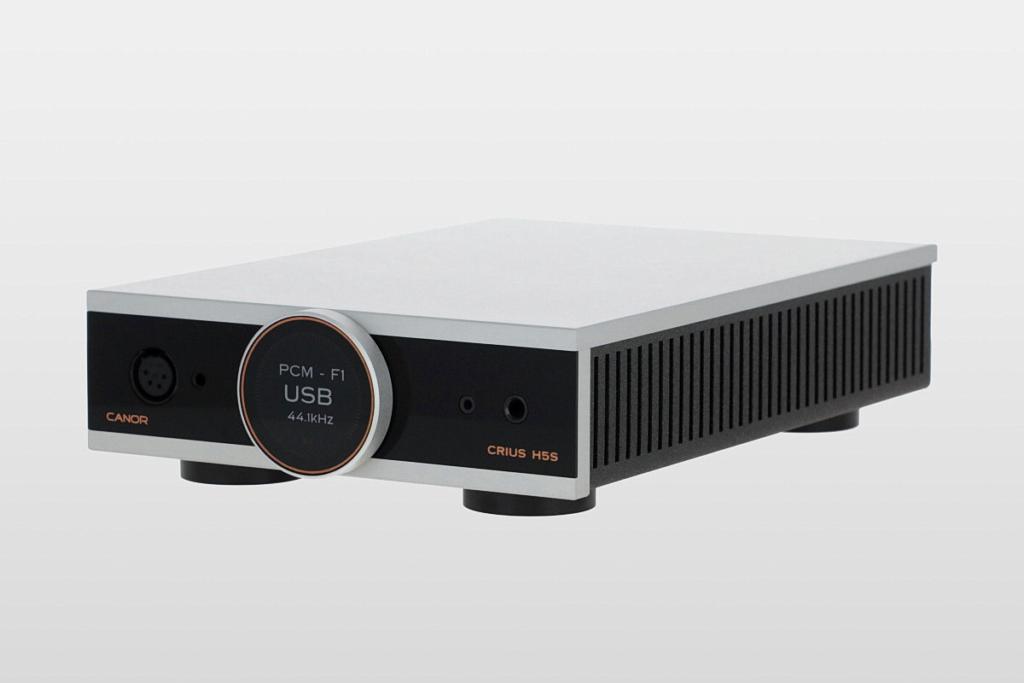
For many years, Canor built its reputation primarily on tube-based audio equipment, but the Slovak manufacturer has recently been expanding its solid-state offerings with increasing confidence. The latest example of this strategy is the Crius H5S, a compact headphone amplifier, digital-to-analog converter, and preamplifier combined in a single chassis. The new model marks the debut of the Essential Line, a series intended to bring engineering solutions developed for Canor's more expensive components into smaller, more versatile, and more affordable products. Although the Crius H5S has been designed primarily for owners of high-quality headphones, it can also serve as the control center of a compact stereo system, feeding a separate power amplifier or active speakers.
At the heart of the new component is a fully discrete amplification circuit that dispenses with operational amplifiers and coupling capacitors in the signal path. Rather than relying on heavy global negative feedback, Canor's engineers have implemented optimized local feedback to achieve excellent linearity and extremely low distortion. Another interesting feature is an adaptive bias circuit that provides a smooth transition between Class A and Class AB operation. According to the manufacturer, this topology combines the clarity, precision, and natural character of Class A amplification with the current delivery required to drive more demanding headphones effectively. Power output from the balanced headphone connections reaches 4 W into 30 ohms and 500 mW into 300 ohms. The single-ended outputs deliver 1 W and 130 mW into the same respective loads. Output impedance remains below 0.02 ohms regardless of connection type, which should ensure consistent performance with a wide variety of headphones, including models with complex impedance characteristics.
The digital section of the Crius H5S is built around two ESS Technology ES9039Q2M DAC chips operating in a dual-mono configuration. Each channel therefore has its own dedicated converter, with the signal subsequently passing through fully discrete, balanced analog output stages. Three digital inputs are provided - USB-C, optical, and coaxial. The USB connection supports PCM signals at resolutions up to 32-bit/768 kHz, along with native DSD up to DSD512 and DSD256 via DoP. The optical and coaxial inputs accept PCM signals up to 24-bit/192 kHz. Canor has also included nine selectable digital filters, giving users some freedom to tailor the converter's operation to their personal preferences. The specified dynamic range of the digital section is 128 dB, while the analog circuitry achieves a signal-to-noise ratio exceeding 114 dB.
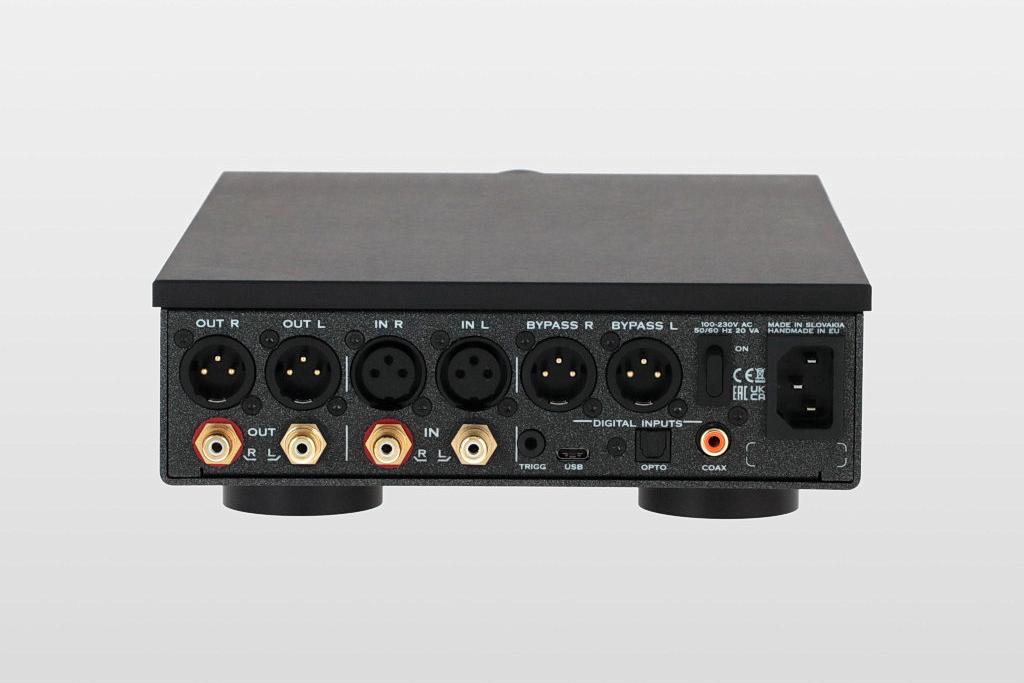
Particularly impressive is the Crius H5S's extensive connectivity. No fewer than four headphone outputs are located on the front panel, allowing most popular wired headphones to be connected without additional adapters. Two balanced connections are available - a 4-pin XLR socket and a 4.4 mm jack - alongside two single-ended outputs using 6.3 mm and 3.5 mm jacks. Around the back, users will find both RCA and XLR analog inputs, as well as corresponding outputs in both formats. There is also a dedicated pair of XLR BYPASS connectors, allowing the device to be integrated into a balanced analog signal chain. As a result, the Crius H5S is not limited to headphone listening and can function as a fully capable preamplifier in a conventional stereo system. Users can also adjust the gain of the line outputs, with three settings available for each connection type: -6, 0, and +5 dB for RCA, and 0, +6, and +11 dB for XLR. A 12 V trigger output makes it easier to coordinate operation with other compatible components.
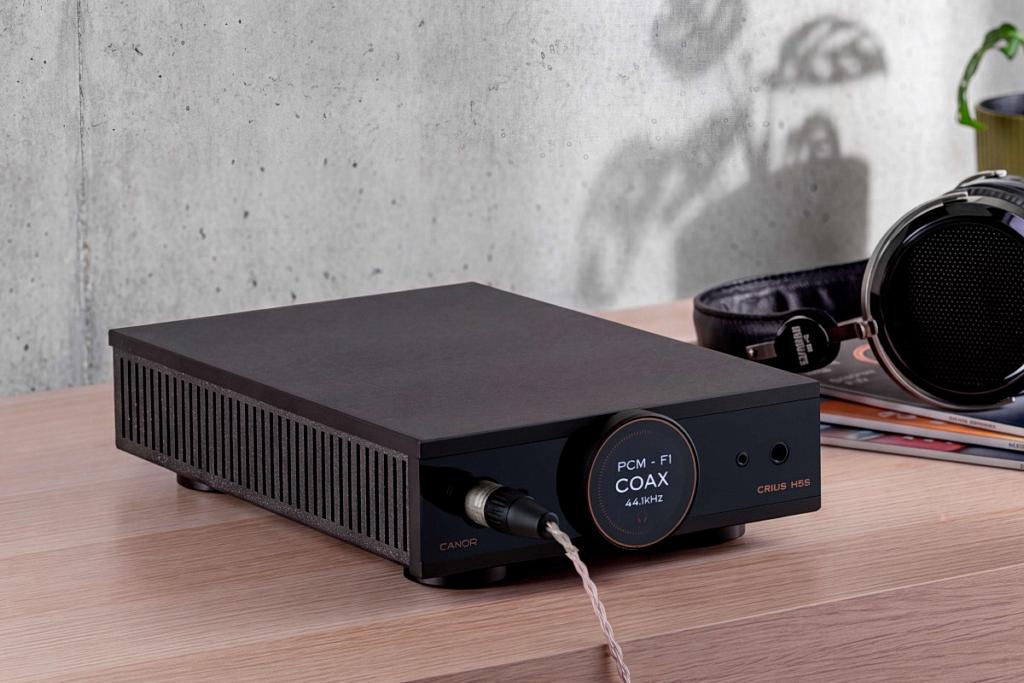
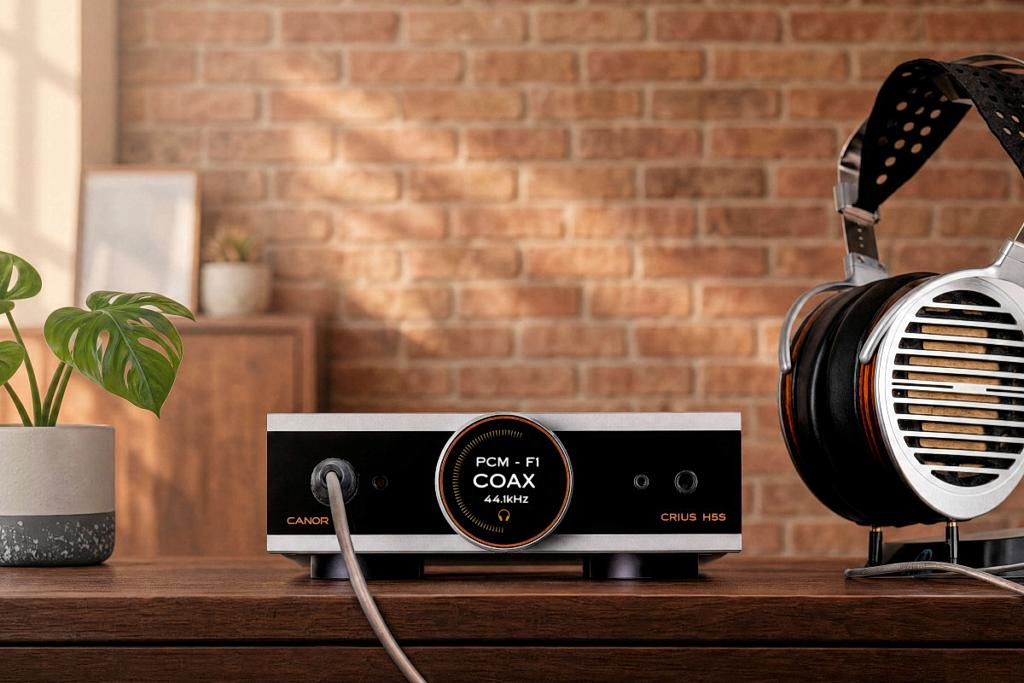
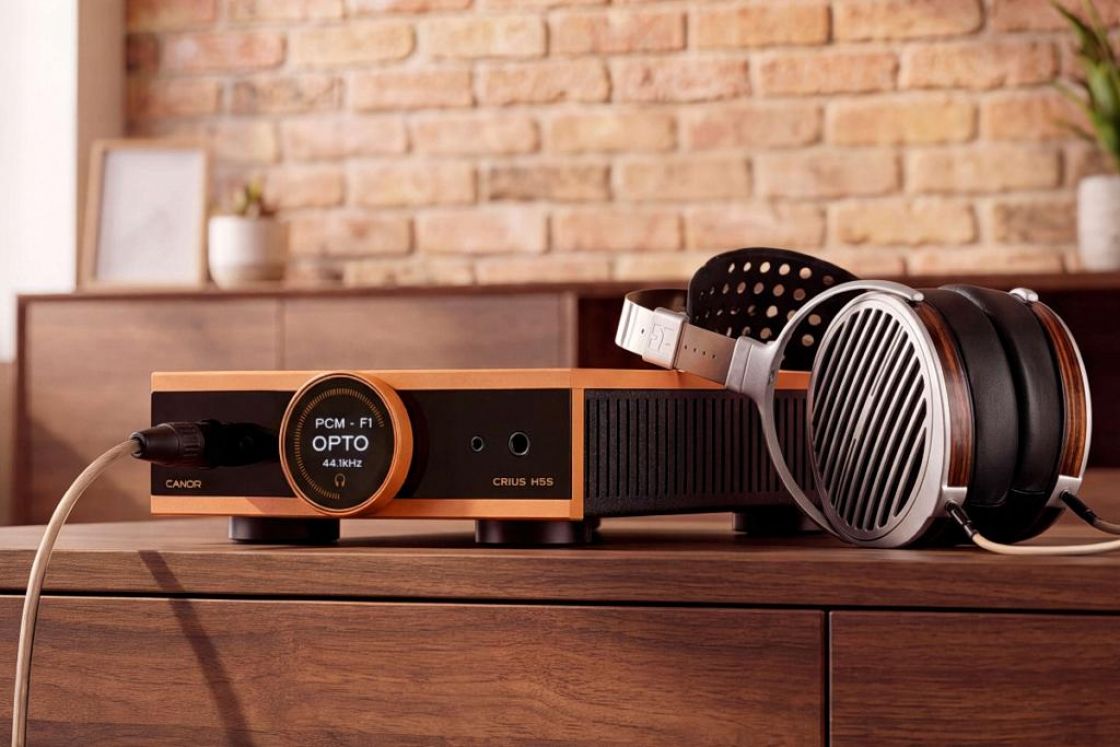
Visually, the Crius H5S follows the design language established by Canor's larger components, although its proportions have been adapted for desktop use. The chassis combines aluminum, steel, and glass, measuring just 21 cm (8.3 inches) wide, 7.5 cm (3 inches) tall, and 30 cm (11.8 inches) deep. Despite these relatively modest dimensions, the unit weighs a substantial 4 kg (8.8 lb), partly due to its robust mechanical construction and built-in power supply. Canor has therefore avoided the external power adapters commonly found in this category, choosing instead to accommodate the entire power supply inside the enclosure. The most distinctive element of the front panel is the large volume control, which incorporates a circular 1.8-inch display. The knob itself is mounted on two bearings to ensure smooth, precise operation. The integrated screen does more than display basic information, providing access to the device's settings, including fine adjustment of the balance between the left and right channels. This is particularly useful during headphone listening, where even relatively small differences in channel levels can affect the perceived stereo image. The Crius H5S also supports firmware updates via a wired connection.
The introduction of the Crius H5S represents another milestone in the development of a company whose roots go back to 1995. That year, the engineers behind the Slovak manufacturer presented a prototype of the TP101 tube amplifier at an exhibition in Brno, laying the foundations for a business that initially operated under the Edgar name. Over the following decades, Canor developed its own manufacturing facilities and proprietary technologies, establishing itself as a specialist in tube amplification before gradually expanding into hybrid and fully solid-state designs. The new Essential Line represents a further step in this evolution, bringing more compact and versatile components to the company's catalog without abandoning the engineering principles associated with its more expensive products. The Canor Crius H5S will be available in three finishes - black, silver, and bronze - with European deliveries scheduled to begin in November 2026. The suggested retail price is €1,899 in Europe and £1,799 in the United Kingdom. Official US pricing has not yet been announced. Info and photos by Canor.