
- News
- Posted
Davis Acoustics Renoir Evolution
The growing popularity of small tube amplifiers comes with one fundamental problem - not all modern loudspeakers are particularly interested in working with them. Increasingly elaborate driver configurations, relatively low sensitivity, and demanding impedance curves mean that a handful of watts is not always enough, even when the specifications suggest that everything should work reasonably well. The Davis Acoustics Renoir Evolution takes precisely the opposite approach. These are imposing three-way floorstanding speakers equipped with massive 12-inch woofers and weighing approximately 220 lb each, yet they offer a sensitivity of 94 dB and a nominal impedance of 8 ohms, with a minimum of just 5 ohms. The French manufacturer therefore openly suggests that its new speakers should work extremely well with low-powered amplifiers, including single-ended designs based on 300B triodes, which typically deliver around 8-10 watts per channel. In other words, the Renoir Evolution promises the scale and authority of a large, full-range loudspeaker without forcing its owner to invest in an equally enormous solid-state power amplifier.
The new model is an evolution of the original Renoir introduced in 2016, with its development also drawing on experience gained during the creation of the Cesar. The fundamental concept remains refreshingly traditional. Rather than filling the cabinet with numerous smaller drivers, Davis has opted for three large, highly specialized units arranged in a conventional three-way configuration. The biggest of these is the aforementioned 12-inch (31 cm) woofer, which uses a cellulose pulp cone. Its motor assembly is no less impressive, with the magnetic system alone weighing approximately 22 lb (10 kg). The manufacturer has designed this substantial driver to deliver bass that is not only deep and powerful but also fast, tightly controlled, and capable of excellent transient response. The large surface area of a single cone is intended to provide both the physical scale of the lowest frequencies and the effortless sense of weight that can be difficult to achieve with considerably smaller woofers. A front-facing laminar bass-reflex port completes the low-frequency section, while the frequency response extends from 28 Hz to 28 kHz.
The remaining drivers are also developed by Davis and demonstrate some of the technologies for which the company has been known for decades. The midrange is handled by a 6.3-inch (16 cm) Kevlar-cone driver featuring a stationary phase plug at its center. High frequencies are reproduced by a 28 mm cone tweeter with a diaphragm made from aramid fibers. This is therefore not the conventional dome tweeter found in the vast majority of modern loudspeakers. Davis points out that related technology has also been employed in the considerably more expensive Stellar model. The company has been designing and manufacturing its own drivers for many years, with materials such as Kevlar and aramid fibers playing an important role in its engineering philosophy. As a result, the Renoir Evolution is not a loudspeaker assembled from off-the-shelf drivers ordered from outside suppliers. All three drivers are manufactured in France, as are the complete loudspeakers themselves.
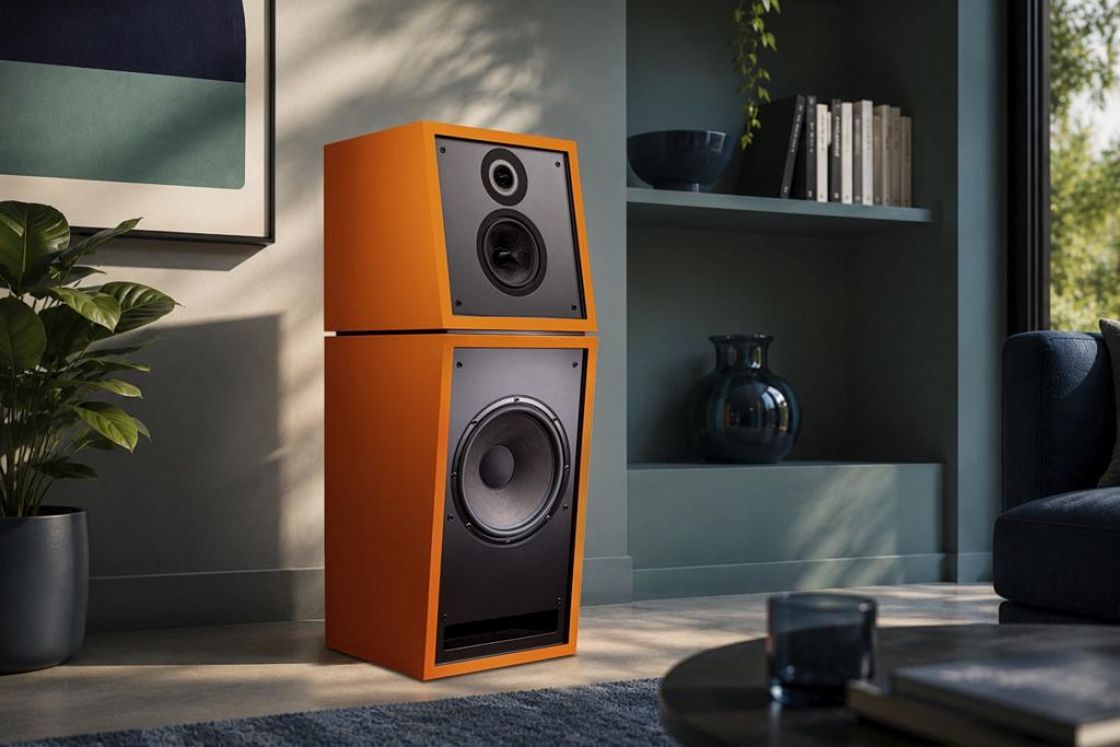
The arrangement of the individual sections is equally distinctive. Instead of a conventional tall rectangular cabinet with three or four drivers arranged in a vertical line, the Renoir Evolution features a considerably wider lower section built around the substantial woofer, with a visually separate midrange and tweeter module positioned above it. This gives the speakers unusual proportions, but the design is not purely aesthetic. The arrangement also allows the manufacturer to create appropriate operating conditions for the different drivers while maintaining the structural rigidity required by such a large bass unit. The cabinet's sheer weight is perhaps the best illustration of its substantial construction. Each speaker weighs approximately 220 lb (100 kg), almost as much as some complete audio systems consisting of loudspeakers, an amplifier, and a source component. With dimensions of 43.3 x 15.7 x 17.3 inches (110 x 40 x 44 cm), the Renoir Evolution is not exceptionally tall, but its broad front baffle, enormous woofer, and massive lower cabinet make it virtually impossible to mistake for one of today's slender floorstanding designs.
All that weight, however, is not there simply to make the specification sheet look more impressive. The rigid enclosure is intended to provide the large woofer with a stable mechanical foundation while minimizing the transfer of unwanted energy into the cabinet and supporting surface. This becomes particularly important with a driver measuring more than 12 inches across, where a substantial cone area is set in motion whenever the system reproduces low-frequency information. The front-mounted bass-reflex port also means that the vent does not fire directly toward the wall behind the speaker, potentially making placement somewhat easier than with certain rear-ported designs. Nevertheless, the Renoir Evolution is certainly not intended for small listening rooms, nor is it the kind of loudspeaker that can be casually placed wherever the previous pair happened to stand. The weight alone makes delivery, unpacking, and positioning a job for several people, preferably ones who know exactly what they are getting themselves into.
At the same time, Davis has resisted the increasingly common tendency to associate large, sophisticated loudspeakers with low sensitivity and demanding amplifier requirements. With a rated sensitivity of 94 dB, the Renoir Evolution should require relatively little power to achieve substantial listening levels, while its minimum impedance of 5 ohms looks considerably more amplifier-friendly than the 2-3 ohm loads encountered with some elaborate modern floorstanding speakers. This explains why the manufacturer places such emphasis on tube amplification and, in particular, the legendary 300B triode. Of course, sensitivity and minimum impedance alone do not tell the complete story of the electrical load presented to an amplifier. Phase angles, impedance variations across the frequency range, and listening conditions also matter. Nevertheless, the published specifications make it clear that the Renoir Evolution was designed from the outset to accommodate amplifiers delivering just a few or a dozen watts, rather than exclusively partnering with enormous solid-state monoblocks. For enthusiasts who appreciate the particular qualities of low-powered single-ended tube amplification but have always wanted a more physically commanding sound, that combination could be extremely appealing.
The Renoir Evolution is also the first Davis Acoustics loudspeaker developed in collaboration with Absolue Créations, a French company specializing in high-end audio cables and accessories. The manufacturer has not specified precisely which elements of the design resulted from this cooperation, so it would be premature to attribute particular components of the crossover network or internal wiring to the partnership. Nevertheless, the collaboration itself says something about the position the Renoir Evolution occupies within the Davis portfolio. This is not simply a larger version of one of the company's popular models, but one of its most ambitious loudspeaker projects, drawing on the original Renoir, the experience accumulated during the development of the Cesar, and engineering solutions associated with the brand's more advanced designs. Davis has also placed the model within its Capsule Collection, a range dedicated to distinctive loudspeakers that do not necessarily fit into the conventional categories of its regular product lineup.
Two finishes are available, giving the same imposing loudspeakers completely different personalities. The first is natural walnut, which complements the traditional proportions, large drivers, and classic hi-fi character of the design. The second is a striking orange lacquer finish that makes the Renoir Evolution virtually impossible to overlook, even in a generously proportioned listening room. Both retain the distinctive two-part architecture, with the wide bass enclosure supporting the separate midrange and tweeter section. Considering that each speaker weighs approximately 220 lb, choosing the finish is probably something worth thinking through carefully before placing an order. Moving the speakers around later, just to find out whether walnut or orange looks better against a particular wall, is unlikely to become anyone's favorite weekend activity. The Renoir Evolution is available now, with European retail pricing listed at €14,990 per pair. Official US and UK prices have not yet been confirmed. Info and photos by Davis Acoustics.