
- News
- Posted
Topping DX9 Discrete
Topping has built much of its reputation on DACs and headphone amplifiers that combine ambitious engineering with unusually strong measured performance. The DX9 Discrete takes that formula into a more premium and more distinctive direction. It is a fully balanced DAC, preamplifier and headphone amplifier in one compact chassis, but its main point of interest is not the number of functions it combines. The real story is the conversion architecture. Instead of relying on an off-the-shelf DAC chip, Topping has used its own discrete 1-bit PSRM technology, bringing one of the company's most advanced digital designs into an all-in-one component for headphones, active speakers and conventional hi-fi systems.
The DX9 Discrete is not the first Topping product to use PSRM, or Precision Stream Reconstruction Matrix. It follows the D90 III Discrete and the D900, but applies the technology in a different context. The D900 remains the pure DAC and preamp flagship with a larger 32-element PSRM architecture, while the DX9 Discrete uses a refined 16-element implementation in a device that also includes a powerful headphone amplifier. That makes it particularly interesting for users who want a serious DAC, a preamp and a high-output headphone stage without building a separate stack of components.
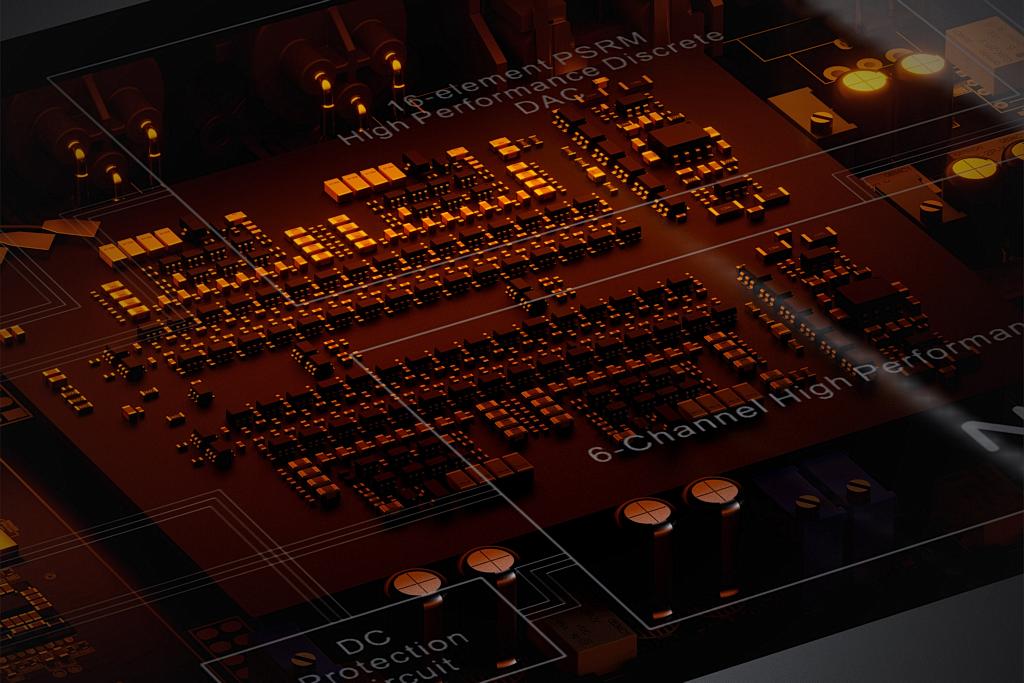
PSRM is unusual because it is not an R2R ladder DAC, even though the word "discrete" often leads people in that direction. In essence, it is a discrete 1-bit delta-sigma architecture developed by Topping. Instead of using a commercial integrated DAC chip, the system converts digital audio into an ultra-fast stream of 1-bit pulses and reconstructs the analog signal through a carefully controlled analog filter. The density of these pulses represents the waveform level, while Topping's own implementation, switching logic and circuit choices determine how precisely the final signal is recreated.
That may sound abstract, but the practical goal is easy to understand. Topping is trying to build a DAC architecture that offers the precision and noise isolation of a highly controlled digital system while avoiding dependence on a standard chip solution used by many other manufacturers. In the DX9 Discrete, the PSRM section is fully balanced, with 16 discrete high-speed switching voltage references for each channel. This helps maintain channel separation and reduce crosstalk, while the dedicated voltage reference supply is designed to keep the extremely fast digital switching behavior from contaminating the analog output.
The technical result is ambitious. Topping specifies a dynamic range and signal-to-noise ratio of 131 dB, a figure that makes more sense when understood as a reflection of how quiet and controlled the PSRM architecture is intended to be. In a device like this, the number is less important as a bragging point than as confirmation that the conversion stage is designed to preserve very low-level information without adding obvious noise or grain. That is particularly relevant when the same component may be used with sensitive headphones, active monitors or a revealing hi-fi system.
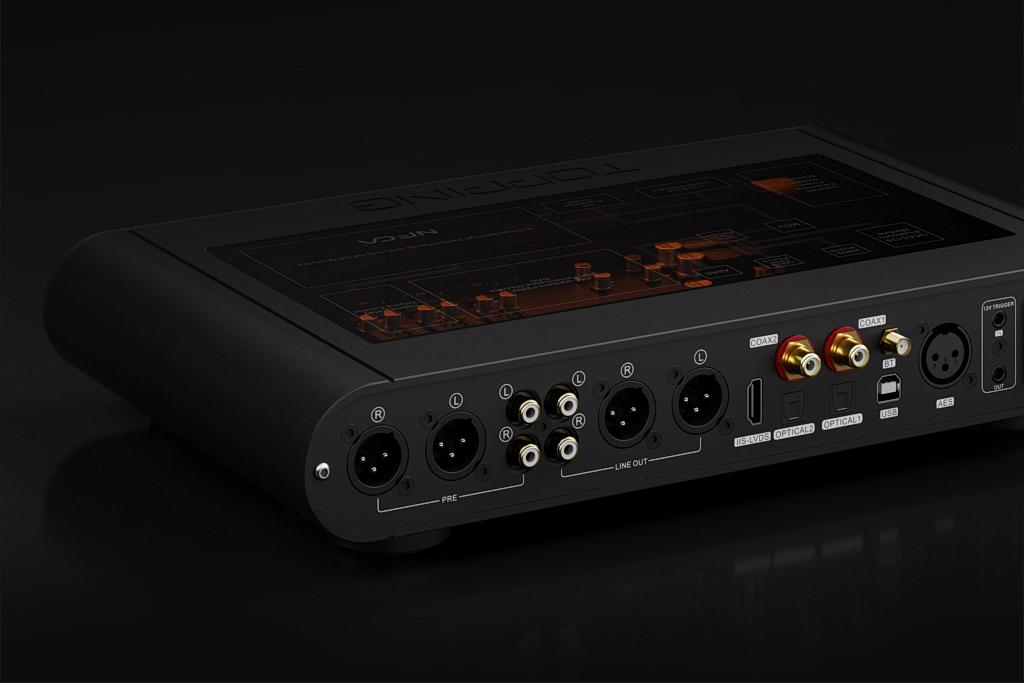
The digital input section is correspondingly broad. The DX9 Discrete includes asynchronous USB, two optical inputs, two coaxial inputs, AES and IIS-LVDS over HDMI, with Bluetooth added for convenience. USB and IIS-LVDS accept PCM up to 32-bit/768 kHz and native DSD512, while the other wired digital inputs support PCM up to 24-bit/192 kHz and DSD64. Those maximum figures are not the most important part of the story, because most music will not approach them, but they show that the DX9 Discrete is unlikely to become format-limited in any normal digital setup.
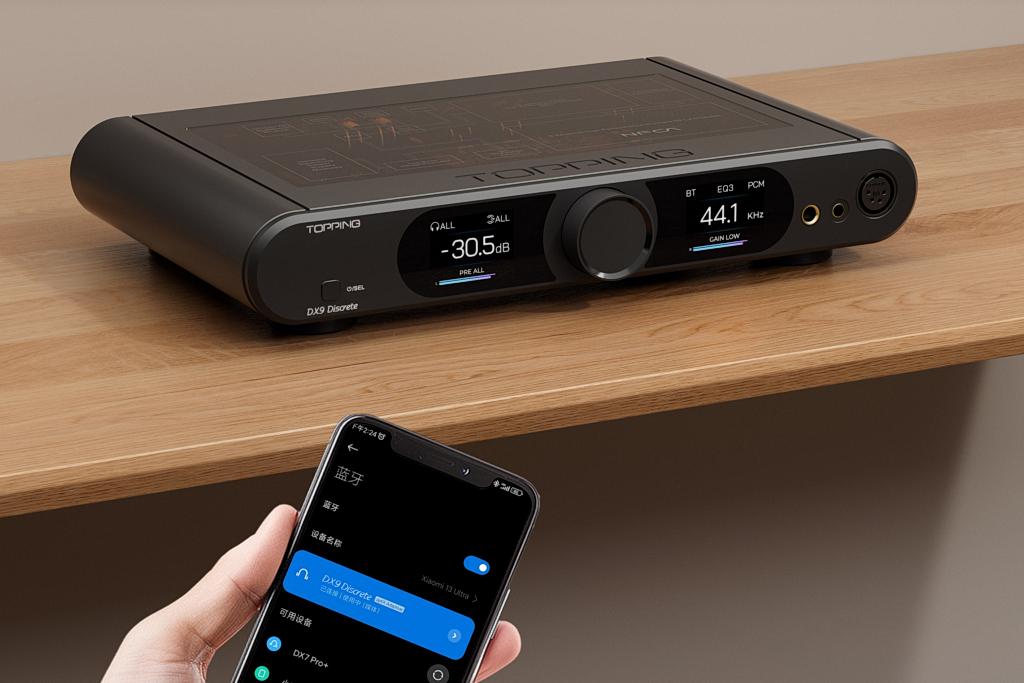
Bluetooth is handled more seriously than usual for a product of this type. The DX9 Discrete supports high-definition codecs including LDAC, aptX Adaptive at up to 24-bit/96 kHz and aptX HD. This does not turn Bluetooth into the equal of a good wired digital connection, but it makes the wireless input more useful for casual listening, quick device connection and systems where convenience sometimes matters as much as ultimate performance.
Before the signal reaches the DAC stage, Topping uses a dual-stage purification system combining a precision clock with a CPLD, or Complex Programmable Logic Device. The aim is to suppress jitter, which is timing error in the digital signal. Topping claims jitter levels as low as -160 dB, and the important point here is not the isolated number, but the design intent. In a DAC built around such fast discrete switching, timing stability is central to preserving definition, focus and spatial precision.
After conversion, Topping has developed its own I/V conversion and volume control circuitry. I/V conversion is a critical stage in any DAC because it turns the current generated by the conversion process into the voltage signal needed by an amplifier. In the DX9 Discrete, this is handled by a proprietary circuit that combines low-distortion op-amps with discrete components. Volume control uses a fully balanced hybrid relay-resistor network, intended to avoid channel imbalance at low levels while keeping distortion and noise under control. That is especially useful in a device serving both loudspeaker systems and headphones, where volume settings can vary widely.
The analog output options make the DX9 Discrete more flexible than a simple desktop headphone DAC. For loudspeaker systems, it offers balanced XLR and single-ended RCA outputs in both preamp and fixed line-output form. The pre outputs are volume controlled for use with a power amplifier or active speakers, while the line outputs are intended for integrated amplifiers or external preamps. Users can also route the signal to the headphone amplifier, the preamp output or both simultaneously, with the fully balanced signal path maintained throughout.
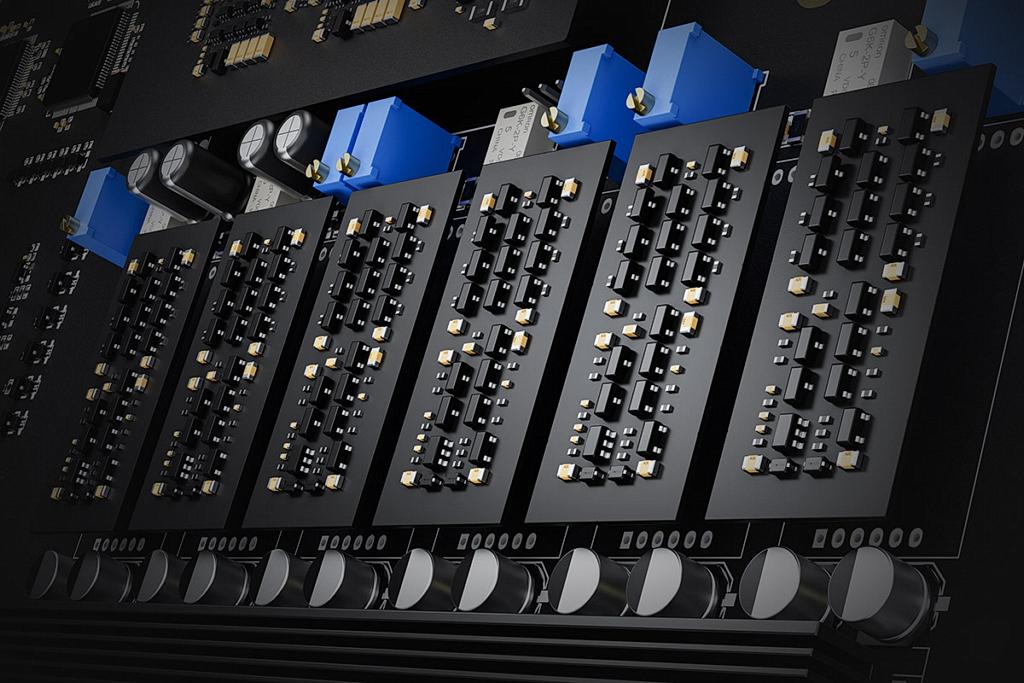
The headphone amplifier section is based on an elevated version of Topping's NFCA, or Nested Feedback Composite Amplifier, architecture. Here it is implemented as a six-channel discrete hybrid design, with independent amplifier circuits for balanced and single-ended outputs. This matters because the DX9 Discrete is expected to work with very different loads - from sensitive IEMs that reveal background noise immediately to demanding planar magnetic headphones that need substantial current and headroom.
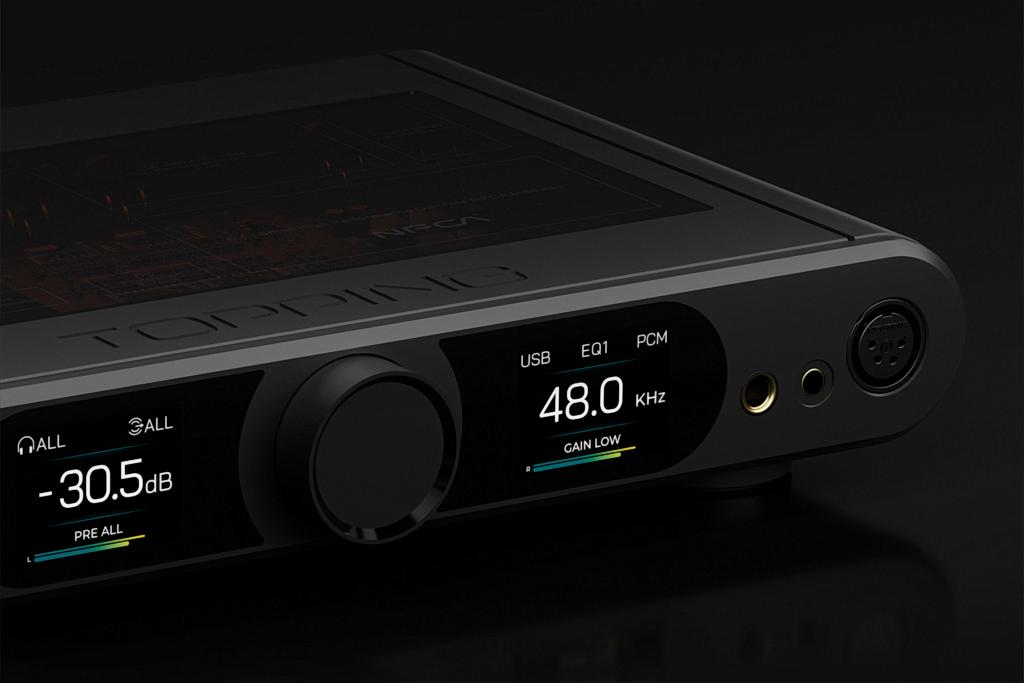
The headphone output section is one of the strongest practical arguments for the product. Balanced outputs are provided on both 4.4-mm and 4-pin XLR connectors, with a 6.35-mm single-ended output also included. Topping rates the balanced headphone outputs at more than 7 W per channel into 32 ohms and 10 W per channel into 16 ohms, which is far beyond what most headphones require and gives the DX9 Discrete serious authority with difficult planar models. At the same time, the noise floor is specified below 0.5 microvolts, which is the figure that matters for users of sensitive IEMs. In other words, the amplifier is designed not only for raw power, but for a wide usable range.
Topping has also included two forms of more advanced listening adjustment. The first is firmware-level parametric EQ, configured through the free Topping Tune software for Windows and macOS. Users can create 10-band profiles, adjust frequency, gain and Q, import target curves and then upload profiles directly to the DX9 Discrete. Once stored, these profiles can be selected from the device's menu without needing the software to run in the background. For headphone users in particular, this is much more useful than basic bass and treble controls because it allows compensation for specific headphones, room conditions or personal preferences.
The second feature is headphone crossfeed. Topping has implemented a convolution-based system designed to simulate aspects of HRTF and room acoustics, reducing the hard left-right separation and in-head localization that can make headphone listening fatiguing with recordings mixed for speakers. A simpler BS2B-based crossfeed mode is also available for users who want a more natural presentation while retaining more of the familiar headphone character. These are enthusiast features, but they are genuinely relevant in a DAC/headphone amp aimed at serious head-fi users.
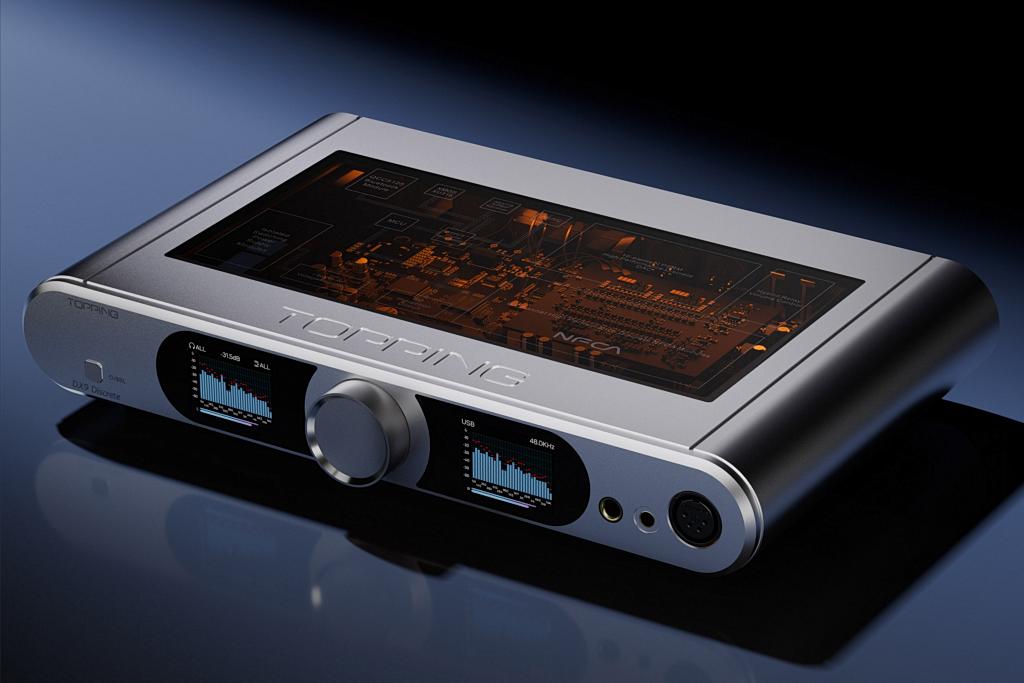
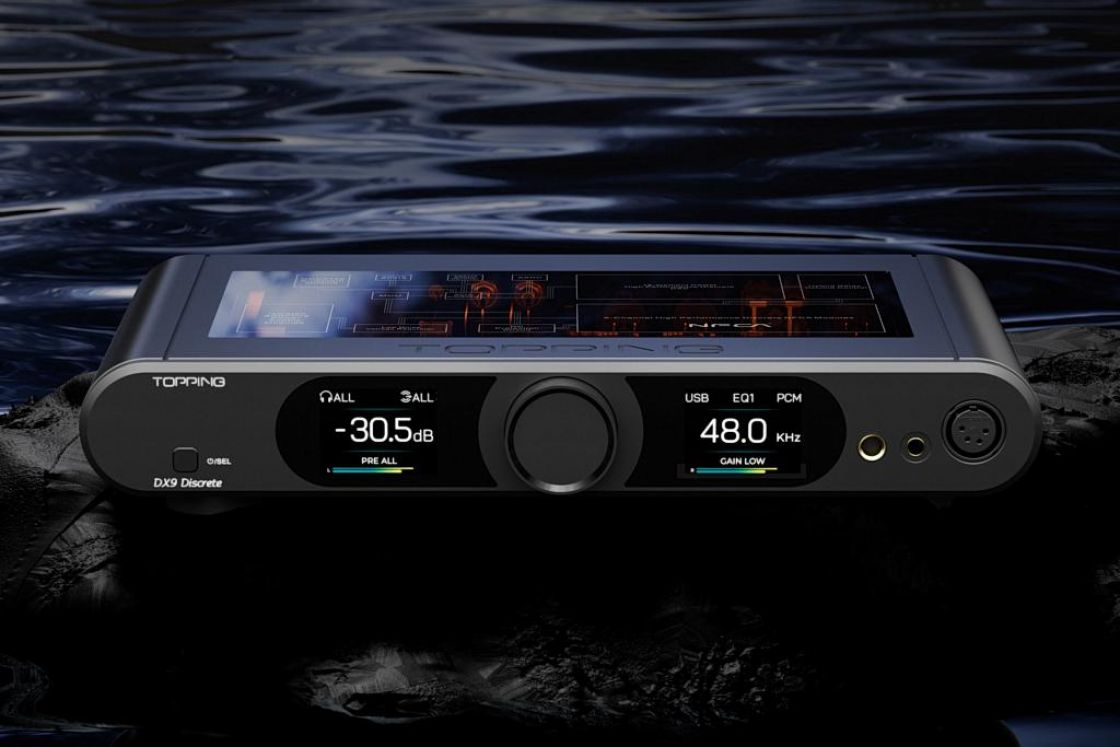
The physical design is more expressive than many earlier Topping products. The aluminum chassis measures 340 x 60 x 225 mm, making it compact enough for a desk or sideboard while leaving enough room for the internal architecture. The top panel includes a tempered glass window revealing the circuitry beneath, with etched section markings and soft orange illumination. The front panel has a central multifunction rotary control and two 2-inch color displays using Topping's Aurora UI. Users can configure color schemes, brightness and displayed information, including file format, sample rate, volume, spectrum analyzer views or VU-style meters. The DX9 Discrete is available in black or silver and is priced at €1299/£1299/$1299. Info and photos by Topping.