
- News
- Posted
NuPrime SiGa Power75
Power supplies are rarely the most exciting part of a hi-fi system. Nobody invites friends over to admire a particularly impressive wall adapter, and even the most enthusiastic audiophiles probably spend more time discussing DAC chips, amplifier topologies, and speaker cables than the electronics responsible for keeping everything running. Yet power supplies have become an increasingly important topic as our systems have filled up with streamers, network switches, reclockers, digital transports, and other compact devices. Many rely on external DC adapters, which makes them relatively easy to replace without modifying the equipment itself. The usual upgrade path involves swapping the manufacturer's switching adapter for a heavier, more expensive linear power supply. NuPrime, however, has decided to approach the problem from a different direction. Its new SiGa Power75 combines silicon carbide and gallium nitride semiconductors with an active noise cancellation circuit, offering six regulated DC outputs for compatible audio and digital equipment. It promises the low-noise characteristics enthusiasts typically associate with sophisticated linear supplies, but achieves them through a rather different set of technologies.
The name provides the first clue. "SiGa" is a combination of SiC, short for silicon carbide, and GaN, short for gallium nitride. Both materials have attracted considerable attention in power electronics because they offer certain advantages over conventional silicon semiconductors, particularly when high switching speeds, efficiency, and thermal performance are important. NuPrime uses silicon carbide Schottky diodes in the rectification stage, taking advantage of their extremely low reverse-recovery charge. In a conventional silicon diode, switching from conducting to blocking current can produce a brief reverse current as stored charge is removed. Under certain conditions, this generates sharp high-frequency disturbances that can propagate through the power supply. SiC Schottky diodes largely avoid that problem, helping reduce switching artifacts before the electrical signal even reaches the subsequent filtering and regulation stages. It's not the sort of technology that produces an immediately recognizable change in the appearance of a product, but it addresses one of the challenges associated with designing a fast, efficient, and electrically quiet power supply.
Gallium nitride takes responsibility for another part of the job. The SiGa Power75 uses GaN transistors operating at switching frequencies exceeding 500 kHz. Their advantage isn't simply that they can switch extraordinarily quickly, but that they can do so with relatively low energy losses. This matters because the current demanded by a digital component is not necessarily constant. A streamer, network processor, or DAC may experience rapid changes in power consumption as its various circuits perform different tasks. A power supply has to respond to those fluctuations while maintaining the correct output voltage. If it reacts too slowly, brief voltage deviations can occur, potentially affecting the operation of sensitive circuitry. NuPrime claims that the high-speed GaN stage provides exceptionally fast transient response, helping maintain stable operating conditions even when the connected devices make sudden demands on the supply. The company also quotes conversion efficiency of up to 93% under a 12 V/5 A load, reducing wasted energy and the heat generated during operation. For a unit designed to power several components simultaneously, efficiency is more than just a nice number to include in the specification sheet.
Of course, fast switching is only part of the story. Anyone familiar with switching power supplies knows that high operating frequencies can introduce their own challenges, particularly when it comes to electromagnetic and radio-frequency interference. NuPrime's solution is a technology called CM-ANC, or Common-Mode Active Noise Cancellation. The name may sound familiar to anyone who owns noise-canceling headphones, and the underlying principle is broadly similar, although the application is completely different. Instead of listening to environmental noise through microphones, the circuit monitors unwanted common-mode electrical interference in the power supply and generates an opposing signal intended to cancel it. NuPrime says the system operates over a bandwidth extending to 1 MHz, targeting high-frequency disturbances that can travel through power connections, grounding arrangements, and the various cables linking components in an audio system. Rather than relying entirely on conventional passive filtering, the company is attempting to suppress some of that interference actively.
It's an interesting approach, particularly because common-mode noise is not necessarily confined to the component that originally generated it. Digital equipment contains processors, high-speed interfaces, oscillators, and switching circuits that can create electrical disturbances, and some of that unwanted energy may find its way into other parts of a connected system. Ground connections and signal cables can provide additional paths for interference, depending on the equipment and how everything is connected. In principle, reducing the amount of noise circulating through these paths can help create a cleaner electrical environment. Whether that translates into an audible improvement is a separate question, of course. A well-designed DAC or streamer may already have excellent internal power regulation and filtering, making it relatively insensitive to changes in its external power supply. Other devices may behave differently. Still, the engineering objective behind CM-ANC is clear, and NuPrime has included an unusually convenient way of exploring its effects.
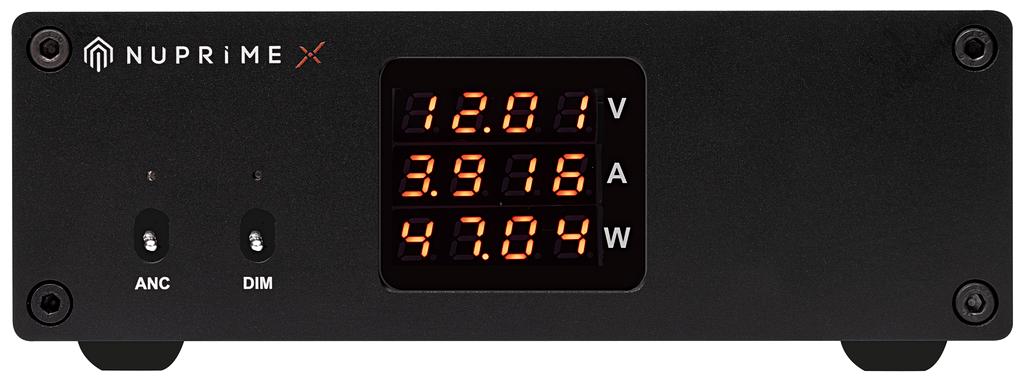
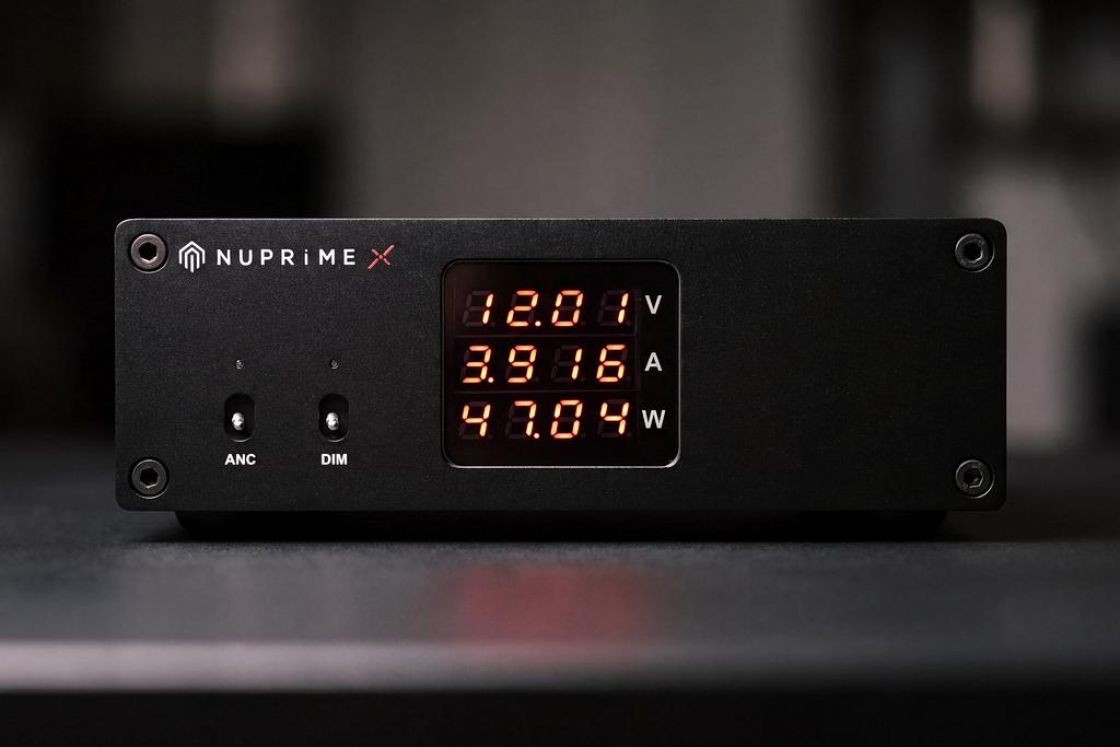
On the front panel is a dedicated ANC button that allows users to switch the active cancellation circuit on or off. This makes it possible to compare the two operating modes without changing cables, reconnecting equipment, or substituting another power supply. More importantly, NuPrime provides measurements indicating what the circuitry is supposed to achieve. With ANC enabled, typical ripple at the 12 V output is specified at less than 1 mV RMS, compared with approximately 2.5 mV RMS when the function is disabled. The manufacturer also quotes a combined ripple and noise level below 2.5 mV RMS across a measurement bandwidth of 10 Hz to 110 kHz. These figures provide a more meaningful starting point than vague promises of greater musicality or a deeper soundstage. They suggest that the active circuit is capable of reducing measurable electrical disturbances, although independent testing would still be useful to establish how the results compare with competing power supplies and whether the improvement has any practical effect on connected audio components.
NuPrime has paid attention to the more conventional aspects of power supply design as well. Between the rectification and voltage regulation stages is a two-stage filtering and energy-storage network intended to maintain low output impedance, suppress ripple, and provide a reserve of energy during sudden changes in load. Low output impedance is particularly desirable because it helps a power supply maintain its voltage when the connected equipment draws rapidly varying amounts of current. Inside the enclosure are also polymer capacitors and a separate regulation stage for the 5 V outputs. The GaN module has been placed inside a dedicated bronze shield, which the manufacturer says helps contain radio-frequency interference and prevent unwanted interaction between different sections of the circuitry. The shield also adds mechanical mass and damping, reducing the potential for vibration and resonance. Bronze might seem like an unusual choice for this task, but NuPrime evidently sees advantages in combining electromagnetic shielding with a relatively substantial, non-resonant mechanical structure.
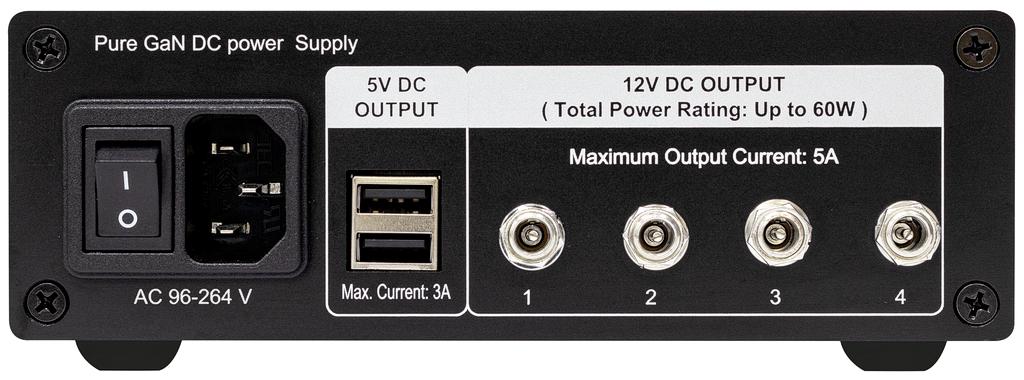
The SiGa Power75 is also considerably more versatile than a typical external adapter. Instead of supplying a single component, it can power several compatible devices at once. Its rear panel provides four 12 V DC outputs using 5.5 x 2.5 mm barrel connectors, each rated for up to 5 A, along with two 5 V USB-A outputs capable of supplying up to 3 A apiece. There is one important limitation, however: those individual ratings cannot simply be added together. The total power drawn from all six outputs must remain within the unit's overall 75 W capacity. This distinction matters when planning a system, since four outputs rated at 12 V/5 A do not mean the power supply can simultaneously deliver 60 watts through every connector. The advantage is flexibility. Depending on the requirements of the connected equipment, the Power75 could replace several individual adapters supplying a streamer, network switch, reclocker, or other low-voltage components. It can also power equipment from manufacturers other than NuPrime, provided the voltage, current requirements, connector dimensions, and polarity are compatible.
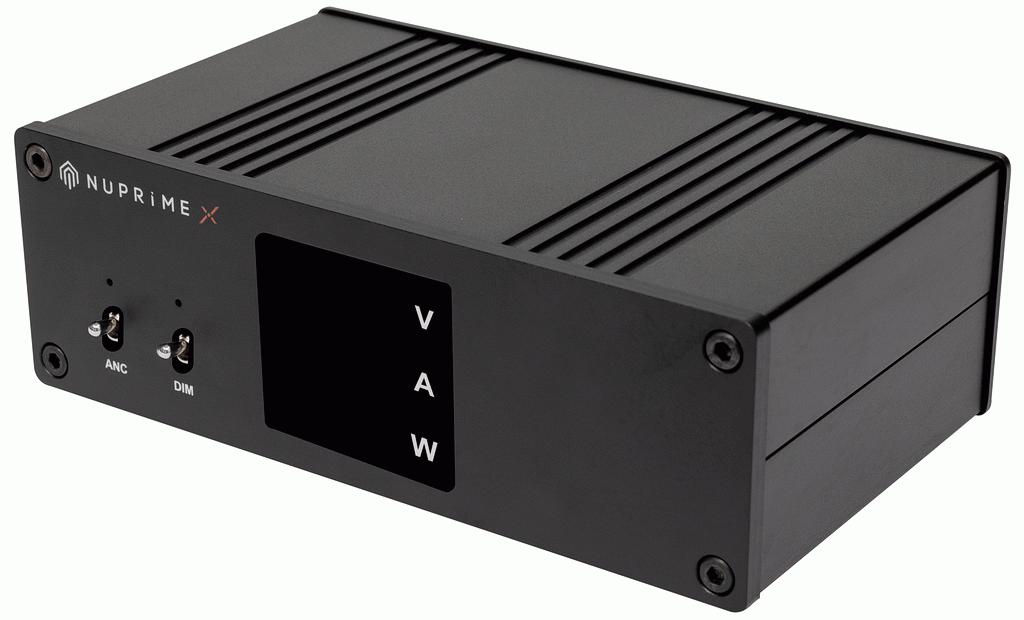
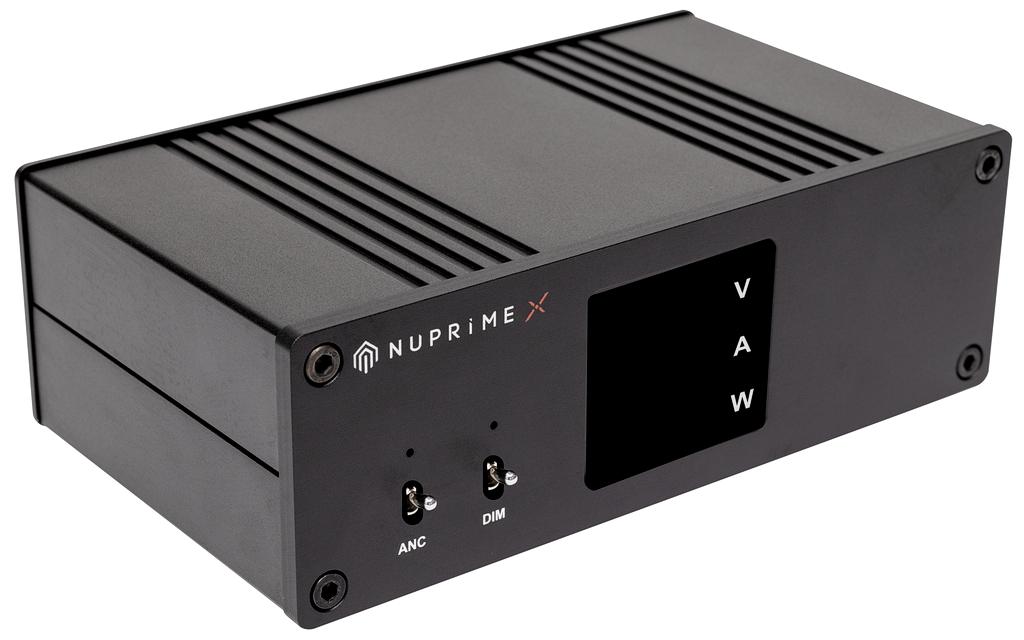
To make keeping track of all this easier, NuPrime has fitted the front panel with a display showing output voltage, current, and power consumption in real time. It's a practical feature, particularly when several devices are connected and the owner wants to check how much of the available power budget is being used. Alongside the ANC button is a DIM control for adjusting the brightness of the display. That might seem like a minor detail, but anyone who has spent an evening listening to music in a darkened room while an unnecessarily bright LED shines from the equipment rack will probably appreciate it. Despite the relatively sophisticated circuitry and multiple outputs, the Power75 remains a compact device, measuring just 95 x 170 x 60 mm (3.7 x 6.7 x 2.4 inches) and weighing approximately 1 kg (2.2 lb). It is therefore better understood as a centralized power hub for smaller audio components than as another full-size piece of hi-fi equipment demanding its own shelf.
NuPrime has also provided a list of its own products that can be used with the new supply. Among the 12 V devices are the CDT-9 CD transport and several components from the NuPrime-X family, including the H16-AIP, H16-AES, AoAES-F22D, and AoANA-F04A. The 5 V outputs can be used with compatible products such as the LP10 NuPrime Edition, WR-2, Arc Mini, Stream Mini, and Stream Mini DAC, using the appropriate USB power cables. The actual range of possible applications is considerably broader, however, because compatibility is determined by electrical requirements rather than the name printed on the front panel. Matching the voltage is essential, and owners must also check current requirements, connector dimensions, and polarity before connecting anything. An external power supply is not an accessory that should be selected on the basis of whether the plug happens to fit. The package includes two DC cables with 5.5 x 2.5 mm connectors on the supply end and 5.5 x 2.1 mm plugs on the device end, along with an AC power cord and four self-adhesive rubber feet.
What makes the SiGa Power75 particularly interesting is that it challenges a fairly widespread assumption in enthusiast audio: that upgrading a power supply automatically means replacing a switching design with a linear one. There are good reasons why high-quality linear supplies remain popular, but switching technology has also advanced considerably, and the performance of any particular design depends on far more than the broad category to which it belongs. By combining SiC rectification, high-frequency GaN switching, an energy-storage network, shielding, and active common-mode noise cancellation, NuPrime is attempting to address several weaknesses associated with conventional switching supplies rather than simply abandoning the technology. The result is an unusually sophisticated power source that promises low electrical noise, rapid response to changing loads, and high efficiency without resorting to the large transformers and enclosures often associated with more elaborate linear designs.
That doesn't mean every streamer or DAC will suddenly sound dramatically better after being connected to the SiGa Power75. The relationship between power supply performance and audible sound quality is complicated, and improvements measured at the supply output do not necessarily translate into equally significant changes at the audio outputs of the connected component. Much depends on the equipment's internal regulation, grounding arrangements, susceptibility to interference, and overall circuit design. But dismissing the subject entirely would be equally simplistic. A stable, well-regulated, low-noise supply is a legitimate engineering objective, and NuPrime has taken an interesting route toward achieving it. The ability to power several devices from one compact unit, monitor consumption, and switch active noise cancellation on and off gives the Power75 practical appeal beyond any claims about sound quality. For systems populated by small digital components and their accompanying collection of power adapters, it could provide both a tidier installation and a more carefully controlled electrical environment. The NuPrime SiGa Power75 is available now, with an official US retail price of $379. Info and photos by NuPrime.