- Reviews
- Posted
Pylon Audio Opal 23 mkII
Most stereo equipment manufacturers would like us to associate their brands with the products at the very top of their catalogs - the finest, most visually striking models, packed with the most advanced technology. When we buy an affordable pair of bookshelf speakers bearing the shiny Bowers & Wilkins logo, we're supposed to picture the Nautilus or those imposing 801 D3s standing in London's legendary Abbey Road Studios. When we pick up a pair of audiophile headphones from Sennheiser, we're meant to feel as though we're getting a little taste of the Orpheus. Marketing and human psychology have always worked this way. Yet while flagship products shape a brand's image, the vast majority of sales come from the entry-level and midrange segments. Basic economics and the distribution of household incomes tell us everything we need to know about that. The interesting thing is that, at least in my opinion, the best way to judge a company's capabilities and the talent of its engineers is to look at the products rolling off its production lines in the greatest numbers. With an unlimited budget, after all, almost anything is possible - seven-foot-tall speakers with space-age drivers suspended in a silver framework, a million-watt amplifier that unfolds like a futuristic sculpture, or cables as thick as a fully grown python that most people would laugh at. Things become considerably more interesting when we introduce some serious constraints, particularly the most important one - money. That's when we discover who can make intelligent engineering decisions and who can't.
Pylon Audio certainly can, because that's exactly where the company started, and it has repeatedly shown us that speakers costing $600, $900, or $1,500 can sound absolutely wonderful. Pearl, Opal, Sapphire, Ruby - each of these series has found favor with music lovers looking for good equipment at a reasonable price. The Opals, however, were special because... they didn't quite sound like typical Pylons. They were noticeably more aggressive, never afraid to deliver a powerful dose of deep bass, bite your ears a little, or push vocals forward when the recording gave them an excuse to do so. Some listeners loved them for it, while others preferred the more polite, versatile Sapphire, Ruby, and Diamond models. Now, after ten years in production, the Opal series has finally received a substantial makeover, and the first representative of its new incarnation is the Opal 23 mkII floorstander.
At first glance, you might conclude that the Polish manufacturer has simply refreshed one of its most recognizable floorstanding speakers. The dimensions haven't changed, the driver arrangement remains the same, the cabinet still has the classic proportions of a slim, roughly three-foot-tall tower, and the price continues to place it in a segment where buyers aren't expecting luxury but rather honest, room-filling sound for sensible money. That assessment, however, would be far too superficial. The Opal 23 mkII isn't some hastily conceived product or a quick facelift dictated by the calendar. It marks the return of one of the most important designs in Pylon's history, developed by a company very different from the one that, more than a decade ago, was beginning to establish itself with simple, well-made, attractively priced loudspeakers.
Pylon's history is particularly relevant here because the Opal series had a special role in the company's catalog from the very beginning. It couldn't offer the same sense of luxury as the Diamond or Jasper ranges, but setting the budget slightly higher than that of the Pearl series gave the engineers room to work, and they made good use of it. Better drivers, stronger and more rigid cabinets, and crossovers assembled from higher-quality components - all of these improvements translated into better sound. The Opals were intended to give buyers the feeling that their money had purchased a proper, full-size loudspeaker designed for a real listening room, a real amplifier, and real music. Add fairly conventional vinyl finishes, black front baffles, and a general absence of unnecessary embellishments, and the concept becomes clear. Appearance took a back seat to engineering and workmanship. In the first generation, this formula worked extremely well. The Opal 23 quickly became one of those models that kept coming up in conversations about building a first serious stereo system, choosing sensible speakers for the living room, and discovering that a Polish manufacturer could offer something its international competitors struggled to match.
It also mattered that the original Opals appeared at a time when Pylon was moving beyond its origins as a cabinet manufacturer and beginning to establish its own engineering identity. The company, based in Jarocin, had always possessed considerable woodworking and furniture-making expertise, but over time, MDF machining, painting, and veneering were joined by proprietary drivers, in-house voice coils, increasingly sophisticated measurement techniques, partnerships with established component suppliers, and eventually a new factory, advanced machinery, a growing engineering team, and one of the most impressive anechoic chambers in this part of Europe. Today, Pylon is no longer a charming local workshop that people support partly out of patriotic enthusiasm. It's a manufacturer operating on a genuinely significant scale, present in numerous markets, exhibiting at major audio shows, supplying cabinets to other brands, and steadily moving its own product range upmarket. That's precisely why the return of the Opal 23 is so interesting. The basic concept is identical. Heck, even the appearance has barely changed. There was no reason to reinvent the wheel. But in Pylon's world, even a single year brings an enormous amount of progress, improvements, and important developments. Imagine what a decade means. Looking back at the original Opals, the Polish engineers must have thought more than once that the initial idea was sound, but with the tools now at their disposal, they could execute it much better.

Design and functionality
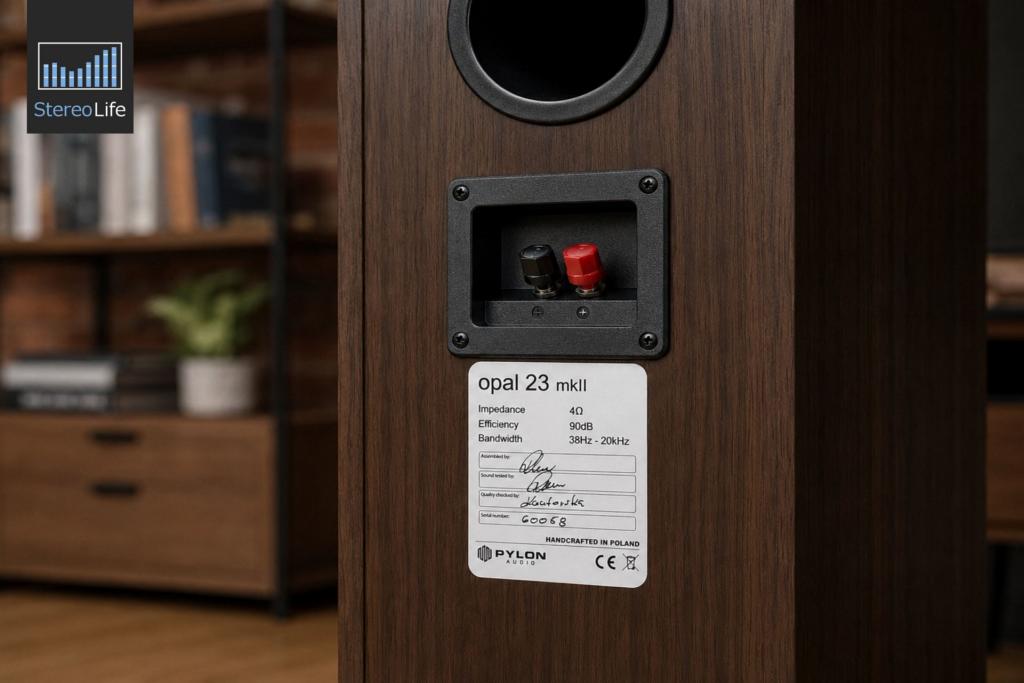
Let's start at the end, with the price. A pair of Opal 23 mkII speakers costs $1,199/€999/£849. By today's standards, that may not be pocket change, but in the world of full-size floorstanding speakers, we're still talking about the lower end of the midrange category at most. Frankly, anyone familiar with the broader audio market would probably still consider these budget speakers, albeit not the most brutally cheap kind, where cost-cutting is visible absolutely everywhere - right down to the absence of proper feet and a rear panel covered in rough black vinyl because, supposedly, nobody will ever look back there. Such speakers still exist, although manufacturers aiming higher prefer not to be associated with them. At this price level, compromises are inevitable, and they tend to be particularly obvious. Buyers quickly notice whether the manufacturer has cut corners on the cabinet, binding posts, drivers, crossover, or finish, not to mention whatever shortcomings emerge during listening. You can't disguise such deficiencies with romantic stories about exotic materials and legendary woodworking craftsmanship. On the other hand, a properly engineered speaker at this price can provide tremendous satisfaction, because it will usually end up in a system where laboratory perfection matters less than achieving a sensible balance between scale, musicality, dynamics, ease of placement, and... forgiveness toward less-than-perfect recordings and electronics.
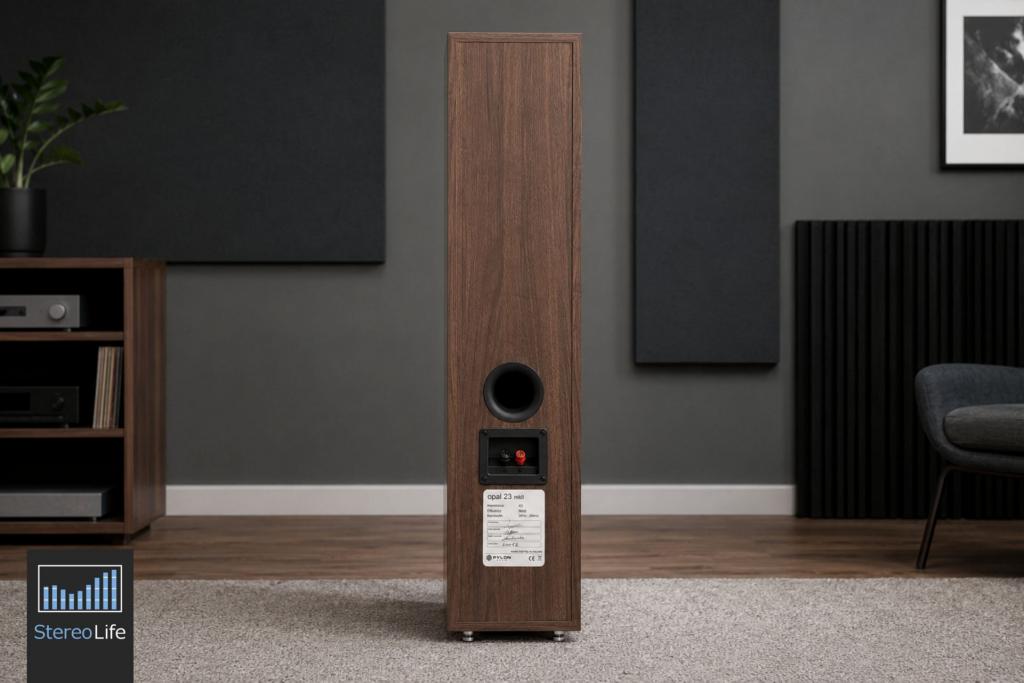
The original Opal 23 was exactly that kind of product. It delivered a big, rich, dynamic sound, powerful bass, an excellent midrange, the ability to disappear into the room, and a surprisingly well-organized soundstage. It wasn't perfect, though. In some rooms, the bass could become excessive or even troublesome, particularly when the speakers were placed close to a wall. The treble occasionally liked to make its presence known a little too enthusiastically. There were also minor reservations about the binding posts and certain practical aspects of the design. Nevertheless, the overall balance was extremely favorable. For relatively little money, the Opal 23 gave listeners the experience of a genuinely full-bodied, effortless sound rather than that of a small speaker desperately pretending to be a grown-up product. The new version preserves that philosophy, but almost every important acoustic component has been changed. In place of the two PSW 18.8 CS drivers, we now get the new PSW 18.8 CP units with thicker, stiffer, heavier cellulose cones, more powerful magnetic systems, and redesigned baskets. The old 25-mm (1-in) PST T-50/8 silk dome has made way for the 30-mm (1.18-in) PST 30.4-TGN tweeter, featuring a graphene-reinforced textile dome, a copper-clad aluminum voice coil (CCAW), a Faraday ring, a ventilated rear chamber, and a shallow waveguide molded into the front baffle. The crossover retains a similar basic architecture, but the manufacturer points to higher-quality components, including air-core inductors in the midwoofer section and a better capacitor in the tweeter circuit. The cabinet retains its original dimensions, but its internal bracing, damping, and bass-reflex tuning have been refined. The published specifications also suggest incremental progress. The frequency response now extends to 30 kHz instead of 20 kHz, sensitivity has increased from 89 to 90 dB, nominal power handling from 100 to 120 W, maximum power handling from 150 to 180 W, and the weight of each speaker from 17 kg (37.5 lbs) to 18 kg (39.7 lbs).
Reading between the lines of the first information released by the company reveals something else. Despite all these improvements, Pylon hasn't attempted to turn the Opal into something it was never meant to be. It hasn't enlarged the cabinet, added a third woofer, pushed the price toward Diamond territory, or surrounded the speakers with the kind of marketing language normally reserved for high-end equipment. Instead, it has taken a familiar, proven architecture and set about improving specific elements. This is a sensible approach, clearly indicating that the original concept worked and that demand for speakers of this kind remains substantial. The enthusiastic response from Pylon fans to the first announcements of the Opal 23 mkII may well confirm that. Almost immediately, people began asking where they could audition the new speakers and when the other models in the Opal mkII series might arrive.
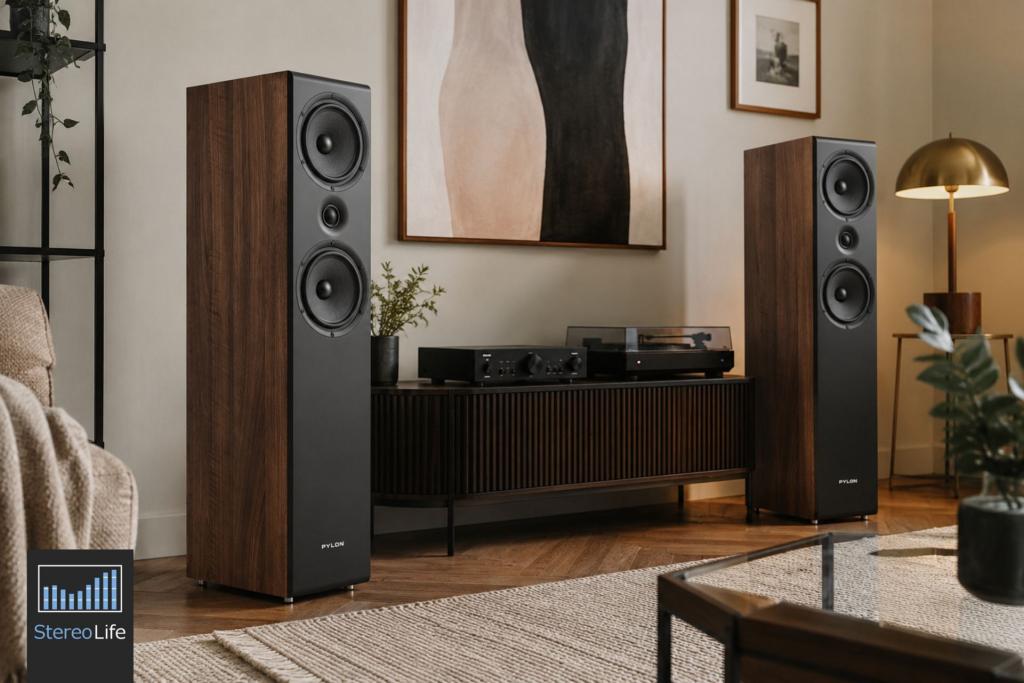
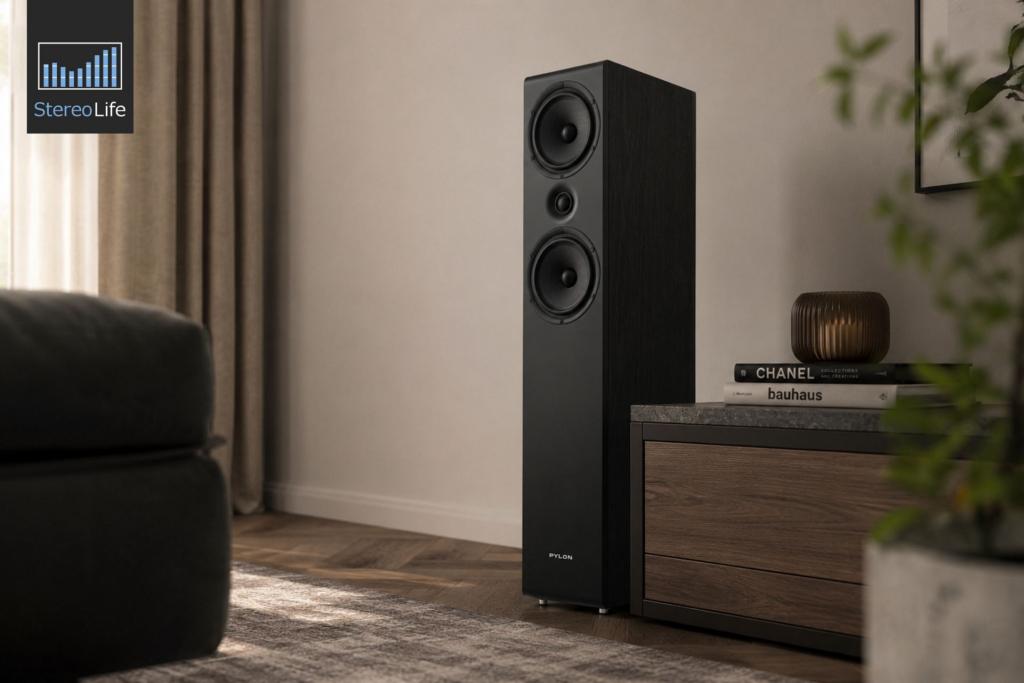
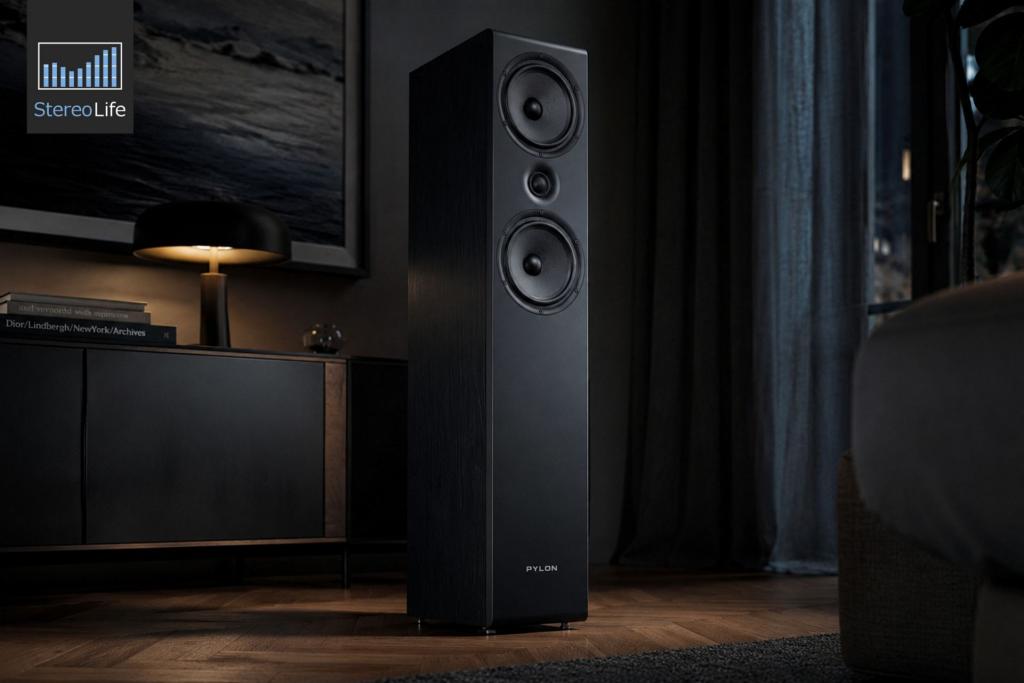
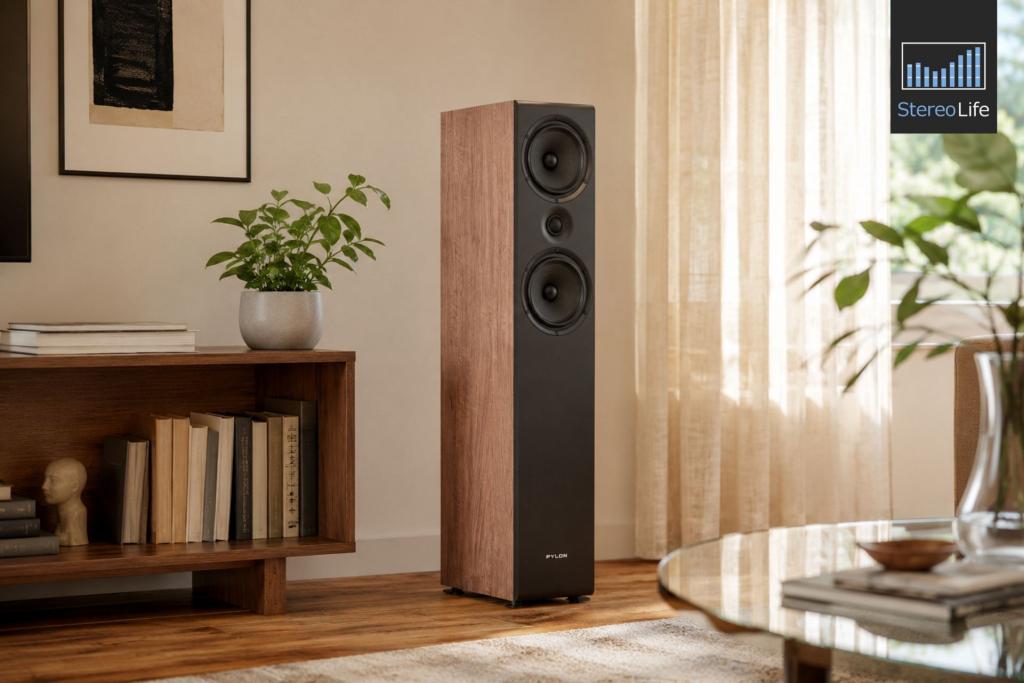
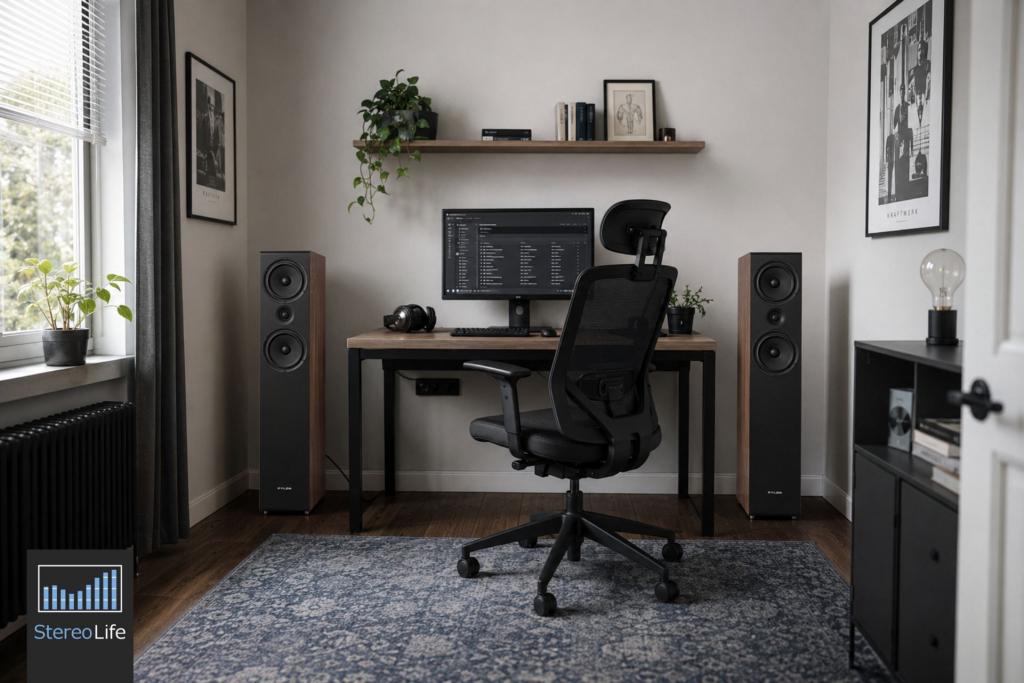
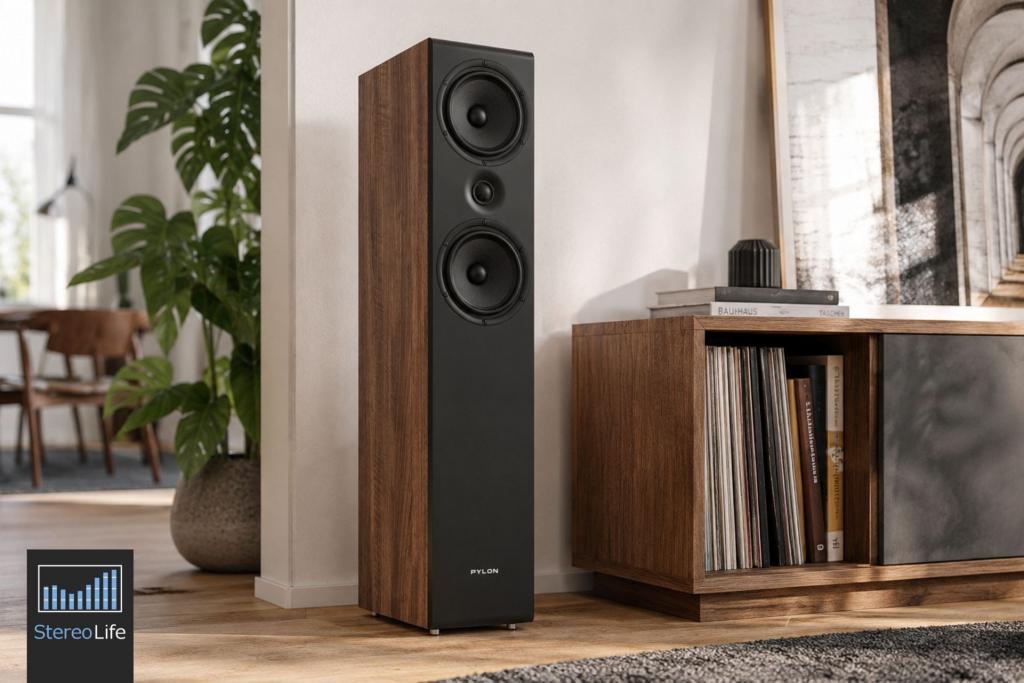
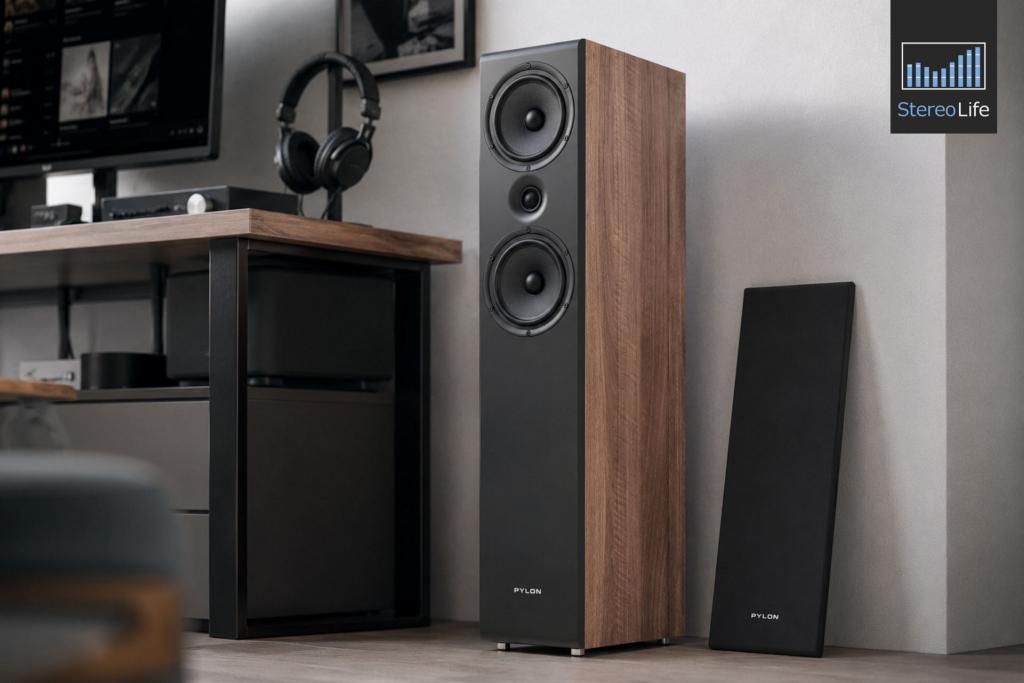
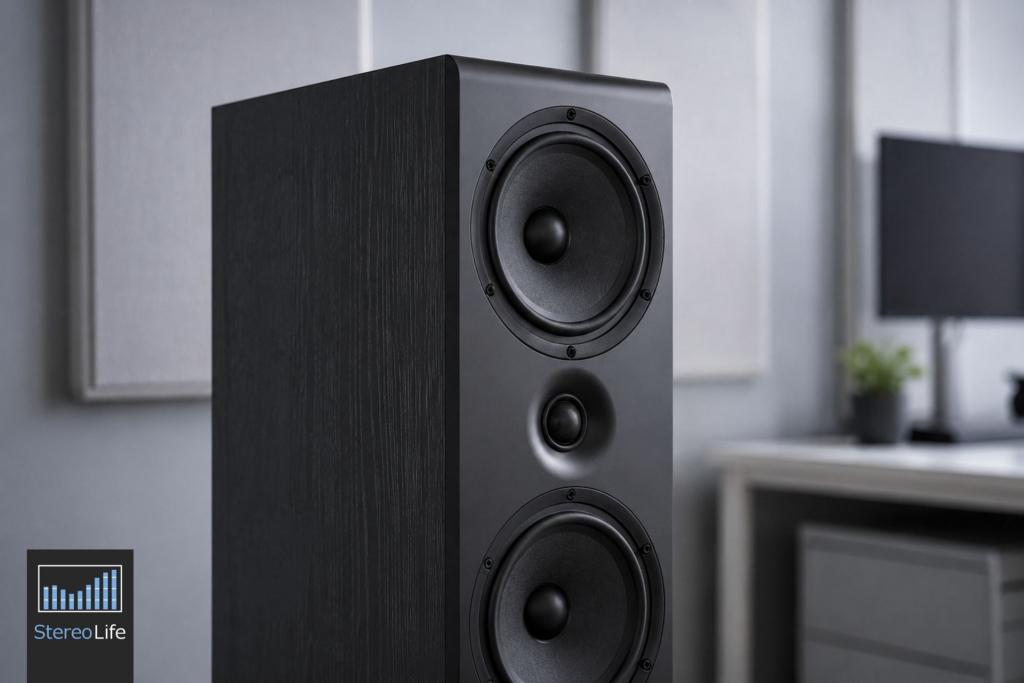
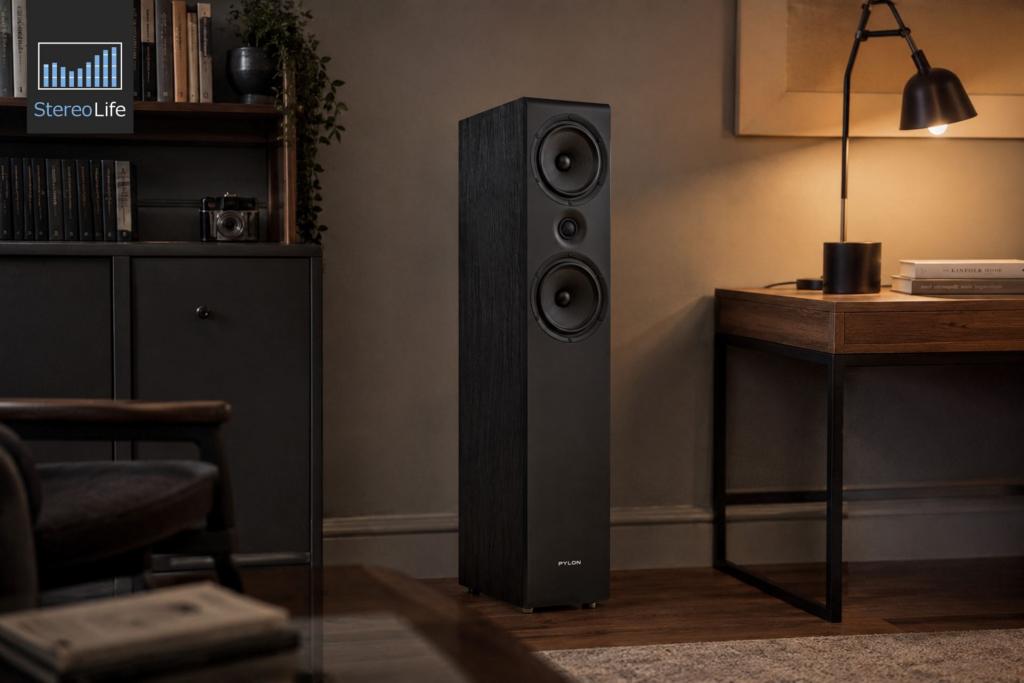
The Opal 23 mkII looks exactly as an affordable, full-size floorstanding speaker without unnecessary stylistic fireworks should look. It's a slender cabinet measuring 19 x 100 x 30 cm (7.5 x 39.4 x 11.8 in), tall enough to look substantial in a living room yet narrow enough not to dominate the space. The front is conventional but also distinctive. Two 18-cm (7.1-in) midwoofers flank a centrally positioned tweeter, forming a midwoofer-tweeter-midwoofer arrangement, commonly referred to as D'Appolito or MTM. This configuration offers several advantages. First, it provides greater total cone area without requiring a wide, bulky enclosure. Second, it can deliver excellent coherence and stable stereo imaging if the crossover and driver geometry are properly optimized. Third, it gives the speaker a symmetrical appearance and a certain sense of technical seriousness. It isn't entirely free of complications, however. The vertical dispersion characteristics of such designs can be more demanding than those of a conventional tweeter-midwoofer configuration. In practice, it's worth paying attention to listening height rather than assuming the speakers will perform identically when you're sitting on a sofa, in a tall armchair, or at a desk. This is particularly relevant here because, despite the cabinet's height, the tweeter sits approximately 77-78 cm (30.3-30.7 in) above the floor. I'm not suggesting that every acoustic principle must be followed religiously, but for the domes to sit exactly at ear level, the listener would have to occupy a low reclining chair or... sit on the floor.
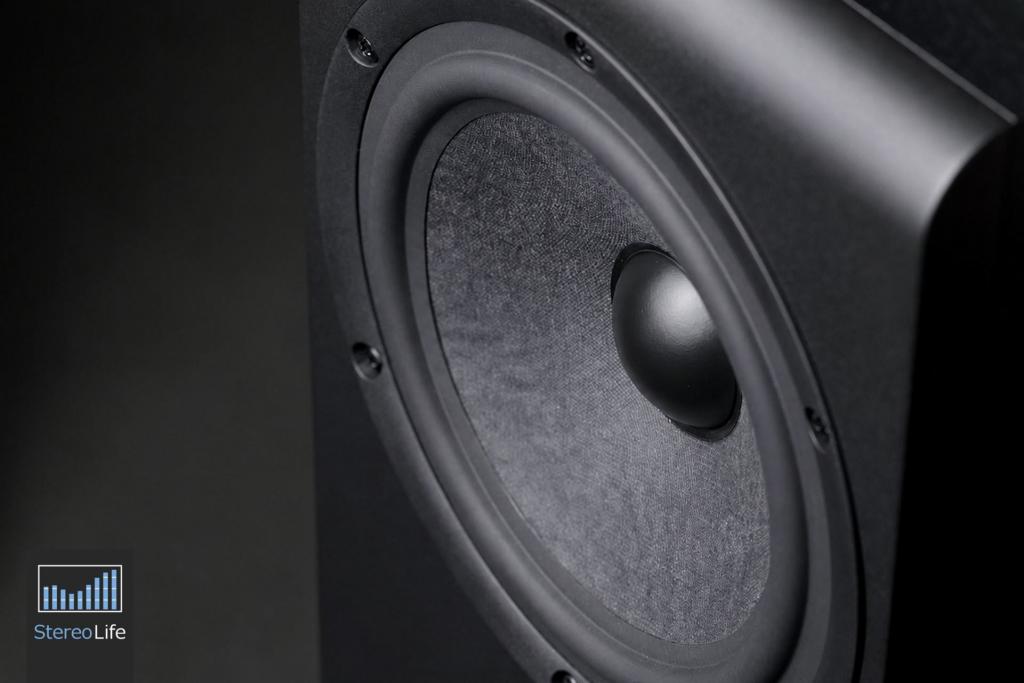
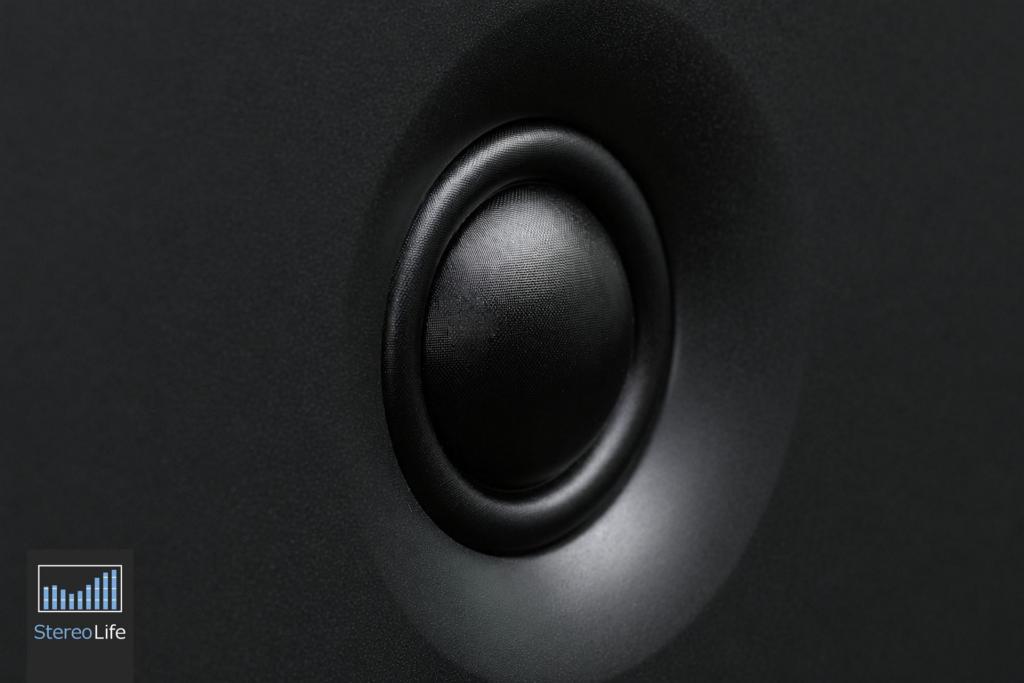
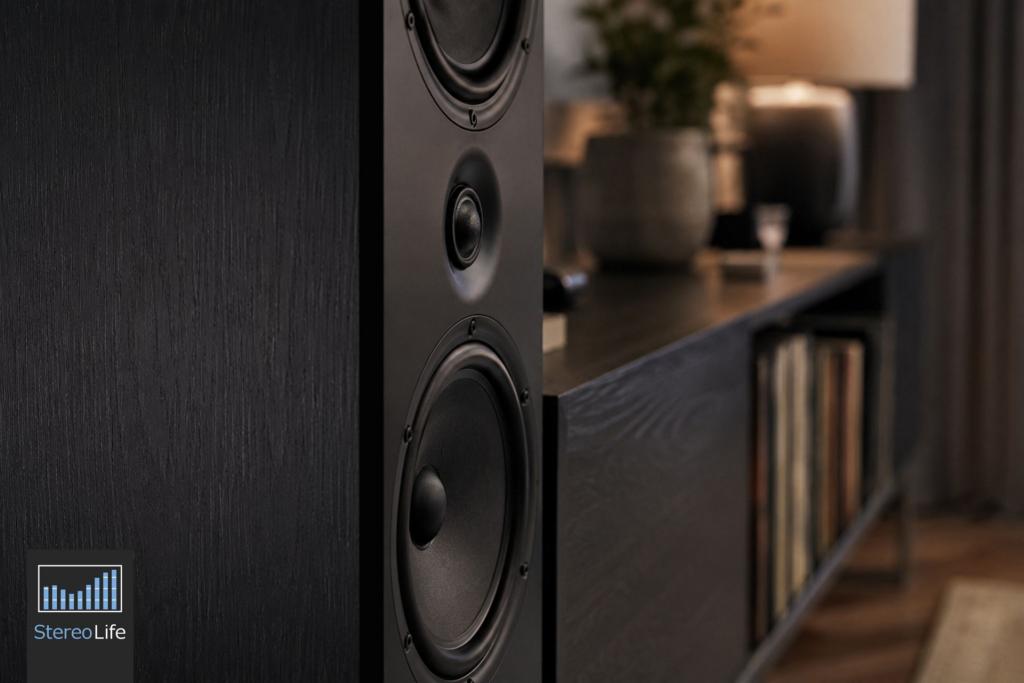
The most recognizable feature of the front baffle is the redesigned high-frequency section. Pylon hasn't simply installed a larger dome in an existing opening. Instead, the front panel has been shaped around the tweeter to create a shallow waveguide. It's a detail that may seem insignificant, but it makes considerable acoustic sense. The waveguide helps control high-frequency dispersion, improves integration with the larger midwoofers, and reduces unwanted diffraction from the cabinet edges. Importantly, this isn't a horn designed to increase efficiency at the expense of imposing its own sonic character, but a subtle contour in the front baffle. In theory, this should result in a smoother, more effortless, less aggressive top end. The midwoofers are interesting, too. Or rather, from a distance they appear dull, unremarkable, almost completely ordinary. Look closer, however, and you'll notice that their cones have an unusual texture. They're rough, rigid, lightweight, and covered with tiny raised bumps. To be perfectly frank, they look as though the drivers had been soaked in water and then dried too quickly, although I trust their appearance isn't the result of an unfortunate incident at the factory. According to the manufacturer, the cellulose cones are now thicker, stiffer, heavier, and more durable. Faster decay of their natural resonances is intended to improve transient response, while the increased cone mass lowers the resonant frequency and helps extend the response toward the lowest frequencies.
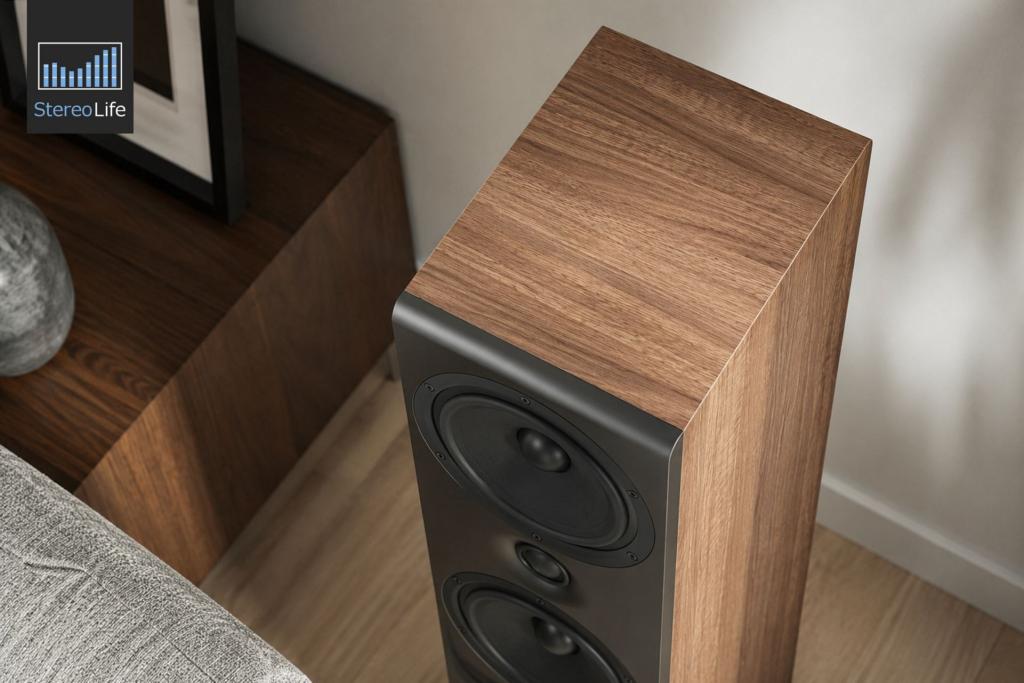
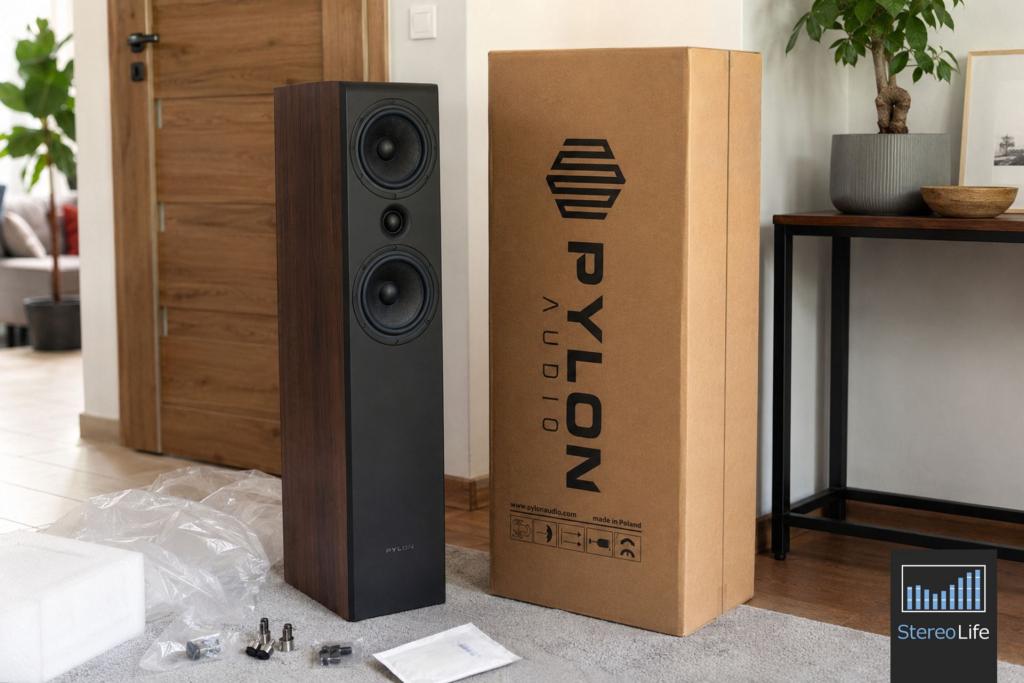
As is usually the case with Pylon speakers and products from other brands for which the Polish company manufactures cabinets, the quality of the woodworking deserves praise. The Opal 23 mkII may not be a luxurious floorstander covered in real wood veneer, but there's nothing to criticize about the fit and finish, the paintwork on the front baffle, the precision of the edges and joints, or details such as the company logo. In this respect, the workmanship is every bit as careful as on the Diamond, Jasper, or Jade models. The difference is simply that less expensive materials have been used. The cabinet is assembled from 18-mm (0.71-in) MDF, with a thicker, 22-mm (0.87-in) front baffle. Internal bracing and damping materials are employed, and the manufacturer emphasizes that the tuning process involved an anechoic chamber and laser vibrometer. That might sound like marketing jargon, but in Pylon's case, it carries more weight than it would with many other manufacturers. The company really has established its own advanced measurement facilities and has spent years building its expertise in cabinet manufacturing. In an affordable loudspeaker, cabinet quality is enormously important. Even the finest driver cannot save a design if the enclosure starts adding its own resonances to the music. On the other hand, making a cabinet extremely rigid and acoustically inert costs money. The challenge, then, is to achieve sufficient vibration control within a given budget without wasting resources that would be better spent on drivers and crossover components.
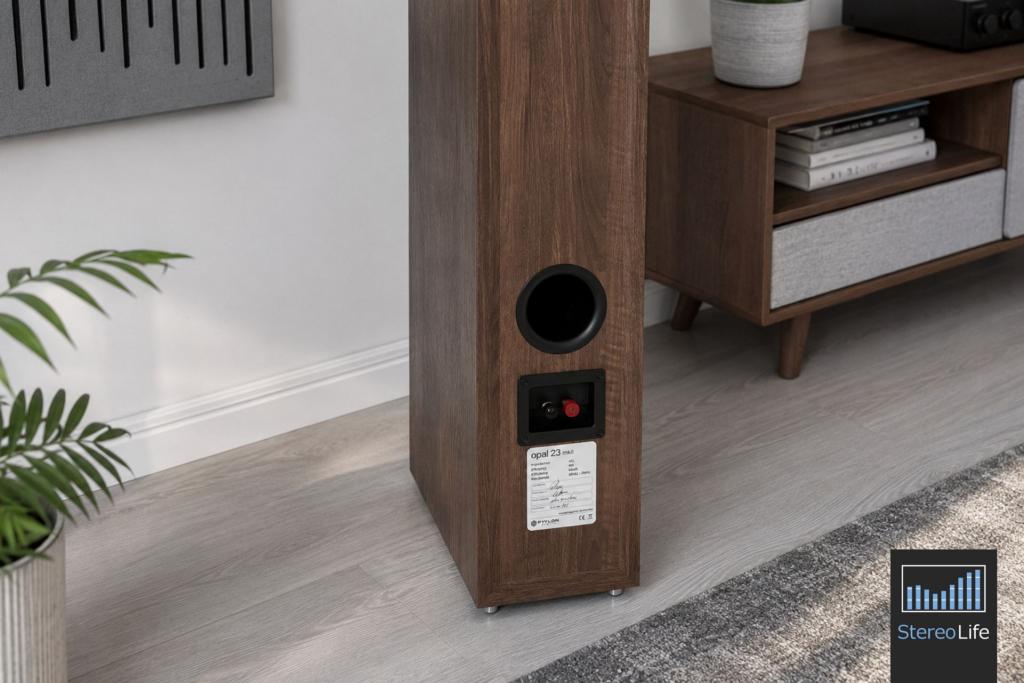
The range of available finishes is, at least for now, more limited than before. The Opal 23 mkII comes in two standard PVC vinyl finishes - Black Ash and American Walnut. I've also seen a version in a lighter oak finish, so I assume this will become a third option in the near future. Either way, there's no extensive catalog of exotic veneers, high-gloss lacquers, or RAL colors. You can look at this in two ways. On the one hand, it's a pity, because Pylon has accustomed its customers to a broad selection of finishes, and the possibility of ordering speakers in a more personalized version has always been one of its strengths. On the other hand, limiting the range to a few popular options makes sense at this price. Fewer variations mean a simpler production process, lower storage costs, and a more predictable retail price. Someone buying speakers for $1,199/€999/£849 will generally be more concerned with sound, durability, and whether they fit naturally into the room than with luxury finishes. Speaking of rooms, Pylon has always made it easier for customers to choose the right model by specifying the recommended room size. For the Opal 23 mkII, it's 20-35 m² (215-377 sq ft) - an almost ideal range for many listeners. I assume it's only a matter of time before smaller Opal 20 floorstanders and bookshelf models appear with the "mkII" suffix, so if you're worried that the speakers reviewed here might be too large, you can simply wait. I wouldn't base that decision solely on experiences with the original Opals, though. The manufacturer promises better-controlled bass in the second generation. If that proves true, perhaps the Opal 23 mkII shouldn't be dismissed even for rooms smaller than 20 m² (215 sq ft). On the other hand, the rear-firing bass-reflex port needs to be taken into account. Speakers like these generally benefit from a little breathing room. They may not need to stand a full meter (39.4 in) away from the wall like some temperamental high-end designs, but leaving at least 20-30 cm (8-12 in) behind them and allowing for a little toe-in should be part of the plan.
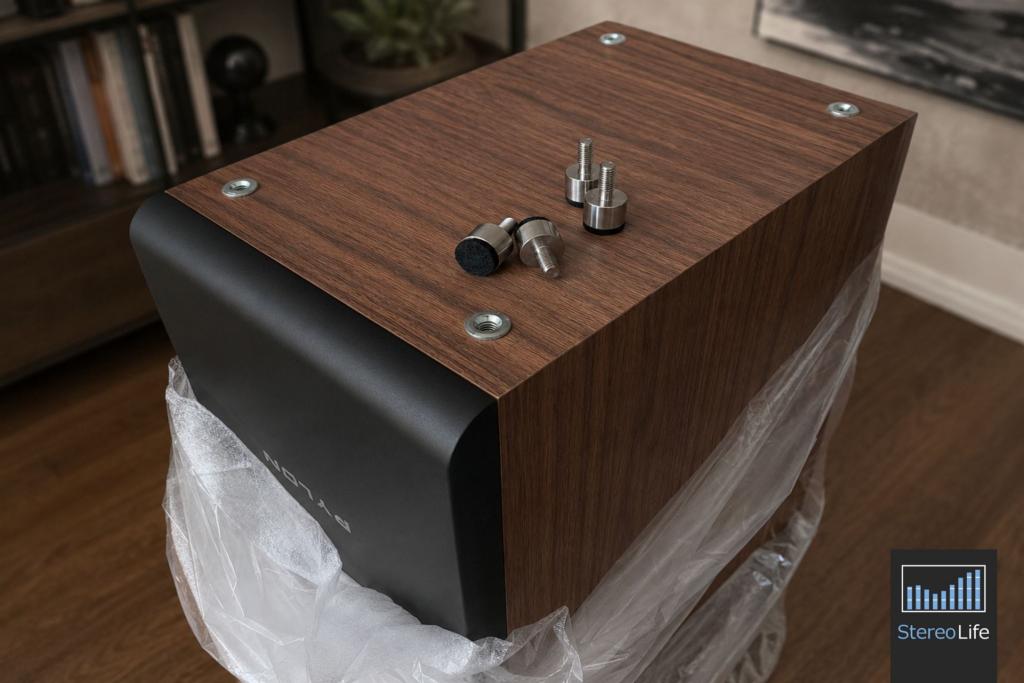
Because the Opal 23 mkII will be many buyers' first serious loudspeaker, Pylon has made sure its specifications are conventional, safe, and even rather accommodating. A nominal impedance of 4 Ω and sensitivity of 90 dB look encouraging on paper. That doesn't mean you can connect these speakers to absolutely any amplifier and expect perfect control, but you certainly won't need a powerhouse. They should work well with a wide variety of amplifiers, from traditional solid-state designs to modern Class D models, all-in-one systems, and even carefully chosen tube amplifiers. In practice, I can imagine these speakers in several very realistic scenarios. The first is a conventional living-room stereo system - an integrated amplifier, a streamer or CD player, a turntable, and a pair of speakers expected to handle everything from jazz to rock and electronic music. The second is a modern all-in-one setup, where the Opals are partnered with something like a Bluesound Powernode, Hegel H95, or Audiolab 6000A Play, becoming the main source of music in the home. The third is a system for someone who has outgrown small bookshelf speakers and wants to experience the scale, weight, and freedom of floorstanders without immediately moving into a five-figure budget in dollars. The fourth is a setup for a listener with some experience who, for whatever reason, doesn't want to pay for fancy veneer, a fashionable badge, or exotic materials, but simply for sound quality. At first glance, and even after a second or third look, the Opal 23 mkII appears capable of fulfilling all these roles - provided its owner exercises a little common sense when positioning the speakers and selecting the accompanying electronics. Any drawbacks? Grilles are optional, meaning they're not included as standard, but buyers who need them can purchase them separately. Grilles for the original Opals cost approximately $35/€30/£25 per pair, so I'd expect a similar price here. Actually, I rather like the fact that Pylon doesn't force customers to pay for something many of them will never use. Everyone does receive metal feet with felt pads, which screw into threaded inserts in the bottom of the cabinets. If you prefer steel spikes, Pylon sells them for approximately $3.50/€3/£2.50 apiece, with matching floor protectors costing around $2/€1.50/£1.30 each. In many homes, particularly those with children running around or pets constantly exploring, something resembling stabilizing plinths or outrigger bars would probably be more useful, but such accessories will have to be arranged independently.

Sound performance
After just a few minutes of listening, I knew that the improvement over the previous version was enormous. The Opals haven't lost their feisty charm (their sound still has a slightly playful, entertaining character), but they've taken two, three, perhaps even four steps forward in terms of overall quality and neutrality. This isn't merely an improvement in itself. It's also a change that brings these speakers much closer to the sonic character of Pylon's higher-end ranges, such as the Diamonds and even the Jaspers. What we get now is a big, full-bodied, almost concert-like presentation, but one that is also well-balanced, coherent, remarkably refined, and musical. Most importantly, it's free from the pitfalls of uneven bass or excessive emphasis around the transition between the midrange and treble. Such irregularities in frequency response and tonal character have a nasty habit of revealing themselves with certain recordings or particular combinations of electronics, distracting us from the music, which is precisely what we don't want.
These things occasionally happened with the original Opals, but they were easy to forgive because those speakers delivered such lively, dynamic, large-scale sound while remaining inexpensive and genuinely well-made. The second generation is still easy on the wallet, the cabinet workmanship is even better, and sonically we're dealing with a completely different league. You can hear it immediately, without elaborate comparisons, guesswork, or two weeks of break-in. The Opals have grown up and acquired better manners. You can listen to them for hours, yet when you examine the aspects of their presentation that were most impressive in the previous version - dynamics, transparency, bass authority, or stereo imaging - you discover that nothing has been lost. None of those attractions has been sacrificed in the name of refinement or political correctness. Quite the opposite! In many areas, the new Opals actually go a step further than their predecessors. The difference is that we don't find ourselves concentrating on individual strengths, because each has been integrated into something that has always been particularly important to Pylon - the presentation as a whole.
I suspect the description above will already have explained almost everything to those who have heard the original Opals and other Pylon loudspeakers and, like me, felt that the entire series stood somewhat apart from the rest of the company's catalog in terms of sonic character. In theory, there's nothing wrong with that. As the vintage-inspired Jade series has demonstrated, almost any experiment can be successful, and since not everyone is looking for universally appealing, well-mannered speakers, the first generation of Opals enjoyed considerable popularity. Now, however, everything fits together. The puzzle is complete. Music lovers looking for something more upscale can choose the Diamonds or Jaspers, enthusiasts of distinctive and unconventional products can turn to the Jades, while those who love the Pylon sound but find approximately €2,250 for the Diamond 25 mkII, €3,000 for the Jade 10, or €5,000 for a pair of speakers too much to spend can now order the Opal mkII without hesitation. They may not be getting sound of exactly the same caliber, but they will be getting a presentation built around the same principles. Incidentally, the difference in sound quality is considerably smaller than the price gap between the Opal mkII and, for example, the Diamonds might suggest.
If a reader had contacted us a few months ago, saying that they loved the sound of the Diamond 25 mkII but needed something less expensive and were considering the first-generation Opal 23, I would have strongly advised against it. Instead, I would have tried to steer them toward something like the Ruby 25 mkII (I still feel that the Ruby series is underappreciated, which is a shame). Today, my answer would be simple - absolutely, go for it. The Opal 23 mkII will do the job beautifully. This completely changes how I perceive the Opal series and strengthens Pylon's position in the segment of affordable yet genuinely capable, versatile, and easy-to-integrate loudspeakers. Once dealers realize what's happened here, I wouldn't be surprised if they start ordering the second-generation Opals by the pallet, perhaps without even bothering to unpack them. A few online orders will arrive in the morning, several customers will visit in the afternoon, two of them will buy two pairs each (one for themselves and another for a brother, or one for the living room and one for the home office), and by the evening there may be only two or four boxes left from the entire mountain stacked by the warehouse entrance. After all, a pair of large, attractive Pylon speakers for around $1,200/€1,000/£850 is already a tempting proposition. But if that money now buys you Pylons that actually sound like Pylons, I really have no further questions.
The easiest way to understand the Opal 23 mkII's character is to avoid expecting contradictory qualities or performance that only becomes realistic once you enter the world of speakers costing several times as much. These are not loudspeakers pretending to be compact studio monitors, surgically extracting every detail from a recording and placing the music under a microscope. Nor are they floorstanders designed to impress during a brief demonstration, with exaggerated bass and a glittering, metallic top end that sounds spectacular for the first five minutes and then becomes exhausting. Yes, certain elements of the original Opals' personality remain, but they're little more than seasoning, a minor addition to an exceptionally well-prepared dish. If I didn't know how the previous generation sounded, I would simply describe these as another remarkably successful design from the Jarocin manufacturer - speakers focused on fullness, coherence, richness, a generous sense of scale, and an expressive midrange. This design is supposed to produce a big, effortless, slightly warm sound without becoming sluggish. It's meant to provide enjoyment, but not through the easiest trick commonly employed at this price level - covering imperfections with a thick layer of sugar. Here, the recipe for success is more about bringing the music together, presenting everything in the right proportions, and demonstrating that an inexpensive floorstander can sound dynamic, tangible, intelligible, and deep at the same time.
The midrange is, of course, the most important part of the spectrum. This is where the continuity with the first-generation Opals is most obvious, as those speakers were frequently praised for their tonal richness, tangibility, and ability to establish a solid center image. The mkII follows the same path but sounds more mature and sophisticated. Vocals aren't aggressively pushed forward beyond the plane of the speakers, yet they remain solid, dense, and appropriately weighty. Acoustic instruments retain their natural proportions without becoming thin or artificially polished. Piano, guitars, saxophone, strings, and human voices all have a certain softness, but without sacrificing clarity. That's an important distinction. In many speakers at this price level, warmth means a rolled-off presentation, while a rich, tangible sound comes at the expense of detail. With the Opal 23 mkII, this isn't a trade-off. The designers wanted the midrange to be substantial, fleshed out, and naturally warm, rather than using those qualities to conceal the shortcomings of the speakers, recordings, or accompanying equipment. This engaging character may be the new Opals' greatest strength in everyday listening. They don't immediately try to prove how many details they can retrieve from a recording. They don't dissect music into individual atoms or force the listener to analyze the texture of every cymbal, every reverberation, and every finger sliding along a guitar string. Instead, they create a fluid, fairly dense sonic picture in which it's easy to follow the melody, rhythm, tone, and emotional progression of a piece. For anyone seeking speakers for extended listening sessions rather than five-minute demonstrations, this approach makes tremendous sense. You can listen loudly or quietly, move between excellent and mediocre recordings, and the speakers never lose their fundamental strength - the feeling of harmony and coherence in the presentation.
The second pillar of the Opal 23 mkII's sound is its bass. With two 18-cm (7.1-in) drivers housed in a slim but undeniably full-size enclosure, expectations are obvious. The Opal 23 mkII should deliver a bigger sound than a bookshelf speaker, fill a living room, and provide a solid foundation without requiring the listener to imagine what's missing. And that's exactly what it does. The low frequencies are powerful, resilient, present, and fully capable of conveying the scale of a recording. This isn't about achieving subwoofer-like extension simply for the sake of it, but about proper proportions, weight, and rhythmic drive. Kick drums have convincing impact, electric bass has appropriate substance, and a symphony orchestra is presented on a suitably grand scale, with real authority, rather than sounding like background music coming from a little radio at a summer cottage. Nevertheless, and once again we return to coherence, the bass doesn't feel disconnected from the rest of the frequency range. It doesn't insist on stealing the spotlight or use every recording as an excuse to demonstrate its capabilities. This is healthy, well-proportioned bass. Its job is to support the midrange, give the music a backbone, and ensure that these three-foot-tall speakers deliver the scale we would reasonably expect from cabinets of this size. Still, this is also the area where the greatest caution is required. The Opal 23 mkII isn't a speaker you can place just anywhere. Put it in a small room, push it against the wall, and connect it to an amplifier with soft, generous bass, and too much of a good thing is almost guaranteed. Admittedly, the second generation is considerably safer in this respect than the original, which could become boomy under less extreme conditions, but a little common sense is still advisable. A suitably sized room, some free space behind the cabinets, and an amplifier capable of keeping the drivers firmly under control are the foundations of success.
If I had to distinguish these speakers from their predecessors in a blind test consisting of short excerpts from my favorite tracks, I wouldn't concentrate on the midrange or bass. I would immediately turn my attention to the high frequencies. This was the most problematic area of the original design. The older version could sound detailed and open, but at higher listening levels, some listeners noticed a pronounced emphasis around the upper midrange and lower treble, accompanied by such "attractions" as sibilance, grain, and metallic coloration toward the top of the spectrum. The new tweeter, with its larger dome, graphene reinforcement, Faraday ring, ventilated chamber, and waveguide, was designed to provide greater freedom, air, and precision without becoming aggressive or excessively bright. I'm pleased to report that the results are exactly what I had hoped for. The treble isn't recessed, but neither does it demand attention. Cymbals can sparkle, small percussion instruments remain clearly audible, and reverberation tails decay naturally, but everything takes place within a refined, organized presentation that is unmistakably Pylon. Just like the bass, the treble isn't a separate performer trying to steal the show. It complements the midrange and blends with it beautifully. Achieving such a seamless transition is no small accomplishment, even in considerably more expensive speakers. At this price level, it usually happens only when the treble has been deliberately subdued, softened, and noticeably rounded off. In other words, clip the tweeter's wings and, yes, you can achieve a smooth transition between the midrange and high frequencies. But if you also want the sound to be properly illuminated, open, and detailed, you'll almost certainly have to sacrifice some of that coherence. Here, we get both. Bravo!
Stereo imaging was one of the most frequently praised aspects of the original Opals, and the mkII retains that strength. The sound readily detaches itself from the cabinets, and the soundstage is presented on an impressive scale while maintaining a distinct, substantial center image. This isn't about exaggerated, laboratory-like pinpoint localization of every tiny detail, but rather a convincing three-dimensional space in which the foreground has real substance and the layers behind it don't immediately collapse into the plane of the speakers. This is particularly important at this price, because plenty of floorstanders can produce a big sound, but not all of them can disappear. The Opal 23 mkII seems to belong to the more enjoyable group - speakers that physically occupy space in your room but stop being the focus of your attention after just a few minutes. Of course, this isn't the last word in spatial precision. More expensive loudspeakers can present an equally large soundstage while maintaining greater organization, sharper outlines, and more convincing placement. Compared with high-end speakers, the Opal 23 mkII paints with broader brushstrokes - attractive ones, spread across a fairly wide area and even suggesting a clear sense of depth, but without those vast pockets of empty space or instruments carved out with surgical precision. I don't see that as a problem. Nobody should expect a pair of floorstanders from the affordable end of the price spectrum to deliver everything that experienced audiophiles are willing to spend a year's savings to obtain. What matters is that the music is presented coherently and naturally, without the impression that the speakers are more interested in artificial effects than in the recording itself.
Another strength of this design is dynamics, although that shouldn't be understood merely as the ability to generate excessive sound pressure levels. The Opal 23 mkII also handles large dynamic swings and sudden, sometimes relatively subtle changes in energy very well. The two 18-cm (7.1-in) drivers, increased maximum power handling, and 90-dB sensitivity give it an advantage over smaller speakers. It rarely gives the impression of running out of breath when the music becomes demanding. More important, however, is its ability to maintain momentum, tension, and dynamic differentiation without allowing the sound to become loose or uncontrolled. Here, the new Opals seem nicely balanced. They're neither nervous nor unruly, but they know how to make music move. Generally speaking, you could say they play as though they actually want to, and that is really, really important. Imagine coming home from work, taking off your shoes, putting your briefcase on the floor, and noticing your cat lying on the sofa. It opens one eye, looks at you, and turns its head away. A moment later, another cat comes running toward you with its tail raised, rubs against your legs, and meows affectionately. Quite a difference, isn't it? Audio equipment can behave in much the same way. Some components seem to play music reluctantly, without emotion, as though the entire exercise is an unpleasant obligation. Others need only be switched on to spring into action, eager to show what they can do and clearly delighted to perform the very task for which they were created. The Opal 23 mkII belongs firmly in the second category. It's the cat that comes over to greet you and will soon be playing with you.
And speaking of playing, what kind of music do these speakers enjoy most? Their most natural territory seems to be music built around tone, rhythm, and space. Jazz, rock, vocals, blues, soul, pop featuring real instruments, electronic music with a strong pulse, and acoustic recordings all sound remarkably convincing. The Opals have enough weight and substance to prevent rock from sounding thin, enough midrange quality to keep vocals from disappearing into the background, and a sufficiently civilized top end to ensure that poorly produced recordings don't become instruments of torture. With heavier music, their slightly warm, dense character can actually be an advantage, emphasizing energy and physical impact rather than harshness and compression. With particularly precise classical recordings or audiophile material focused on microdynamics and texture, however, it becomes apparent that the Opal 23 mkII is more interested in the big picture than in individual details. That's not a problem if you understand what you're looking for. It simply tells us something about the designers' priorities. Compared with the original, the new version is considerably more mature. This isn't a complete change of personality but rather a refinement of its most important characteristics. The mkII doesn't eliminate the original's character. It smooths it out, strengthens it, and adapts it to modern expectations. At a time when even inexpensive loudspeakers increasingly strive to sound bright, fast, transparent, and spectacular, Pylon offers something more human - a fuller, more tangible presentation that doesn't need to shout to attract attention.
Any downsides? Despite the substantial progress over the previous version, the Opal 23 mkII still isn't a model of absolute neutrality. It adds a little here, warms things up there, smooths something else over, so theoretically it won't be the ideal choice for someone seeking an extremely linear, dry, monitor-like sound. But then again, which speakers costing around $1,200/€1,000/£850 would satisfy someone with such expectations? The Opal 23 mkII also wouldn't be my first choice for a very small room where the speakers cannot be moved away from the walls. Nor should we fall into the trap of excessive enthusiasm and assume that this price buys us the resolution and dynamics of the more expensive Diamonds, the precision of excellent studio monitors, or the kind of bass delivered by the Jade 20. But viewed realistically, the new Opals accomplish something extremely important. They deliver a big, coherent, rich sound that doesn't fall apart into pieces - sometimes large, sometimes small, but completely different every time you change the record. These are speakers that remain loyal to their character, providing a reassuring sense of confidence that even when you go wild with your musical choices, everything will be fine. At this price, that is worth more than earth-shattering bass, hyper-detailed treble, or a soundstage stretching from wall to wall.

Build quality and technical details
The Pylon Audio Opal 23 mkII is a two-way loudspeaker system housed in a bass-reflex enclosure. Like the first generation, it uses an MTM (D'Appolito) arrangement, meaning that two identical midwoofers operate on either side of the tweeter. In theory, this configuration can provide high sensitivity, excellent dynamics, substantial radiating area, and precise stereo imaging, but it requires careful engineering. If the crossover frequency is poorly chosen and the drivers' dispersion characteristics don't work together properly, problems can arise with vertical radiation, midrange coherence, and soundstage stability. That's why, in the Opal 23 mkII, the crossover, front baffle profile, and overall geometry are just as important as the drivers themselves.
The new PSW 18.8 CP midwoofers represent one of the most significant changes from the first generation. Pylon has retained cellulose cones, a decision entirely in keeping with the character of this series. Paper, in its various forms, may not be a particularly modern material from a marketing perspective, but it continues to offer numerous advantages. It's lightweight, has good internal damping characteristics, and can deliver a very natural sound while achieving an excellent balance between speed and richness. In the mkII version, however, the cones are thicker, stiffer, and heavier than before. This should improve their resistance to uncontrolled deformation and allow greater excursion at lower frequencies, but it also makes selecting the appropriate motor system particularly important. That's why the strengthened magnetic assembly matters just as much as the cone itself. The more powerful magnet is intended to preserve speed, improve damping, and give the bass greater discipline. The basket has changed, too. Earlier descriptions of the original Opal 23 mentioned stamped steel baskets, whereas in the mkII, the manufacturer specifies a precision-molded polymer basket. This is something we've been seeing more frequently lately, even in considerably more expensive speakers, and it isn't necessarily about cutting costs. Rather, the idea is to eliminate unwanted phenomena that can cause ringing. Pylon claims that the polymer basket provides the necessary rigidity without transmitting resonances or disturbing airflow behind the cone. This component also illustrates how comprehensively the Polish engineers approach their work. With an inexpensive speaker, many companies would make a few changes but stop short of redesigning everything. A new cone is the most immediately visible improvement, whereas developing new baskets, magnets, and voice coils costs money. We should remember, however, that the new Opals are arriving ten years after the introduction of the first generation. If the mkII remains in production for a similarly long period, the investment in improving not only the cone and motor system but also the basket supporting those elements will probably have been worthwhile. It's another sign that the "mkII" designation represents far more than a cosmetic refresh.
The PST 30.4-TGN tweeter is probably the most impressive item on the specification sheet. Its textile dome measures 30 mm (1.18 in) in diameter, making it larger than the typical 25-mm (1-in) dome used in the previous version. A larger diaphragm can integrate more effectively at a lower crossover frequency and work better with a powerful midwoofer section, but it can also be more challenging to control at the highest frequencies. That's where the graphene reinforcement comes in. The idea isn't to turn a soft dome into a metal one, but to improve its stiffness and stability without sacrificing the damping characteristics associated with textile materials. The CCAW voice coil, made from copper-clad aluminum wire, helps reduce the moving mass. The Faraday ring is intended to minimize distortions associated with operation in the magnetic field, while the ventilated rear chamber and heatsink contribute to thermal management and resonance control. Such an advanced tweeter is quite unusual at this price. More often, you'll see descriptions along the lines of "25-mm (1-in) soft dome with neodymium magnet," and that's it, because there really isn't much else to say. Here, however, the story doesn't end with the tweeter itself. Pylon has also integrated a waveguide into the front baffle. This subtle contour is intended to improve directivity control and reduce the influence of the cabinet edges. That's especially important in a product like the Opal 23 mkII, which is meant to be versatile. These speakers won't be used exclusively in carefully treated listening rooms. They'll be placed in living rooms, beside bookcases, among furniture, sometimes close to the walls, sometimes far apart, and sometimes much too close together. The more predictable the off-axis response, the greater the likelihood that the speakers will perform well under less-than-ideal conditions.
The crossover follows an architecture similar to that of the previous version but employs better components. This is interesting because it demonstrates the engineers' caution. Rather than discarding the entire concept, they've refined its execution. Older descriptions of the original Opal 23 referred to second-order filters, a crossover frequency somewhere around 2-2.5 kHz, an iron-core inductor and electrolytic capacitor in the midwoofer circuit, and a polypropylene capacitor and air-core inductor in the tweeter section. For the new version, the manufacturer highlights a higher-quality capacitor in the high-frequency circuit and air-core inductors in the midwoofer section as well. An iron-core inductor is less expensive and may offer lower resistance, but it can be more susceptible to saturation and distortion. An air-core inductor is larger, more expensive, and often more demanding from a design perspective, but eliminates those particular problems. It's another nice engineering detail that rarely fits into the budget of a loudspeaker costing around $1,200/€1,000/£850 per pair.
The published specifications are more than reasonable. A frequency response of 38 Hz - 30 kHz suggests that Pylon isn't promising miracles in the deepest bass but is claiming sufficient extension for normal music listening without a subwoofer. A lower limit of 38 Hz sounds entirely credible for a cabinet of this size containing two 18-cm (7.1-in) drivers. The upper limit of 30 kHz tells us more about the capabilities of the new tweeter than about the actual frequency content of music, although it may still have implications for linearity and listening comfort within the audible range. A sensitivity of 90 dB suggests that the speakers should be reasonably amplifier-friendly, but the nominal impedance of 4 Ω reminds us that just any amplifier won't necessarily do. Compared with the original Opal 23, all these relatively small changes add up to a substantially different product. The dimensions and recommended room size remain the same, but almost everything responsible for converting an electrical signal into sound has been improved. New midwoofers, a new tweeter, a better crossover, revised bass-reflex tuning, refined cabinet damping and bracing, higher sensitivity, greater power handling, and a wider frequency response - that's a substantial collection of upgrades. And the fact that the second-generation speakers look almost identical at first glance? Well, perhaps that simply demonstrates how much customers liked the original Opals' appearance. As the golden rule of cautious engineering goes, if it ain't broke, don't fix it!

System configuration
Audiovector QR5, Equilibrium Nano, Unison Research Triode 25, Octavio AMP, Hegel H20, Auralic Aries G1, Silent Angel M1T, Auralic Vega G1, Marantz HD-DAC1, Clearaudio Concept, Cambridge Audio CP2, Cardas Clear Reflection, Tellurium Q Ultra Silver II, Tellurium Q Ultra Blue II, Van den Hul CS-122 Hybrid, Albedo Geo, KBL Sound Red Corona, Enerr One 6S DCB, Enerr Tablette 6S, Enerr Transcenda Ultimate, Fidata HFU2, Melodika Purple Rain, Final Audio Design A8000, Sennheiser HD 600, Beyerdynamic DT 990 PRO, Beyerdynamic DT 770 PRO, Meze 99 Classics, Bowers & Wilkins PX5, Pro-Ject Wallmount It 1, Custom Design RS 202, Silent Angel N8, Vicoustic VicWallpaper VMT, Vicoustic ViCloud VMT.
Verdict
The Opal 23 mkII is exactly the kind of product we should have expected from the Pylon of today, assuming the company genuinely wanted to revisit one of its most important models with respect rather than rushing through an update dictated by marketing needs or the number of customers asking when the Opal series would finally receive a makeover. There is no revolution here, then, but there is a very substantial evolution. The format, purpose, and fundamental identity of the original Opal 23 have been preserved, while the elements that might have limited its potential have been improved. The new drivers, redesigned tweeter, upgraded crossover, and refined cabinet aren't merely excuses for adjusting the price list. They represent logical answers to the question of how to extract more control, spaciousness, refinement, and dynamics from the same basic architecture. These floorstanders look and sound as though Pylon's engineers had kept a box of ideas for improving their most popular designs somewhere in the factory, then, after many years, when some people had almost given up hope, finally opened it and implemented every modification at once. No wonder the mkII is so much better than the original. The only surprising thing is that it doesn't cost twice as much. Then again, sensible pricing is another of the company's traditions, and I'm delighted to see that it has been maintained here.
In sonic terms, the greatest strength of these speakers seems to be their balance between scale, tonal richness, and everyday listening enjoyment. The Opal 23 mkII doesn't try to be a studio monitor or the most spectacular-sounding speaker in a showroom. Its strength lies in something far more useful. It can deliver a big, rich, coherent sound, substantial bass, an expressive midrange, civilized treble, and a genuinely enjoyable, spacious soundstage. In a real-world system, these qualities matter more than pushing one aspect of performance to the absolute limit, especially when we're talking about speakers costing less than $1,200/€1,000/£850 per pair. Are they suitable for everyone? Of course not. Anyone seeking maximum neutrality, uncompromising analytical precision, and a sharply defined, cool presentation should audition something else. Likewise, someone with a small, acoustically challenging room who can only place the speakers directly against the rear wall should proceed with caution. The Opal 23 mkII appreciates some breathing room, a stable amplifier, and an environment in which its bass has space to develop. It doesn't demand luxurious conditions, but a little common sense goes a long way. The only question is whether buyers with higher expectations will find anything better at a comparable price. I think I know the answer, but I won't discourage anyone. If someone wants to keep looking, by all means, let them look.
The most interesting thing about this model, however, is something else entirely. The Opal 23 mkII demonstrates that a company's development doesn't have to mean abandoning its more affordable product lines. Pylon could easily concentrate on more expensive designs, where development costs are easier to justify and sophisticated engineering solutions are easier to market. Over the past ten years, the factory in Jarocin has undergone spectacular growth, and that's no exaggeration. In virtually every area and on every front. Pylon now possesses the capabilities to launch a full-scale assault on the high-end segment, simultaneously removing everything below the Diamond mkII series from its catalog. Instead, the Polish manufacturer has chosen to revisit the popular Opal range and apply much of the knowledge and experience acquired over the years. That's excellent news for ordinary hi-fi enthusiasts. After all, not everyone can afford, or even wants, to buy speakers costing $3,000, $10,000, or $30,000. Not everyone has the room, the system, or the budget for more ambitious product lines. Many music lovers simply need solid, good-sounding speakers that will work well in a living room, handle a wide variety of music, and won't require their owners to obtain a doctorate in acoustics. And that's exactly what the Opal 23 mkII delivers. Highly recommended!
Technical data
Floorstanding, two-way, ported
Sensitivity: 90 dB
Impedance: 4 Ω
Frequency response: 38 Hz - 30 kHz
Dimensions (H/W/D): 100/19/30 cm (39.4/7.5/11.8 in)
Weight: 18 kg (39.7 lbs) each
Price: $1,199/€999/£849 (pair)
Manufacturer: Pylon Audio
Sound performance
Editor's rating
8.8Overall9Sound9Functionality8Design8Quality10Price