- Reviews
- Posted
Sennheiser Momentum 5 Wireless
Some audio products come around so predictably that you could almost use them to mark the passing of time. A new smartphone every year. A new DAC every couple of years. An amplifier gets refreshed every three, usually gaining a slightly larger display, an updated streaming board, and a few extra connections along the way. Wireless headphones live on an even shorter clock because the electronics inside them age far faster than the parts that actually make sound. A good driver can remain perfectly competitive for a decade or more, and there is no reason a well-designed enclosure should suddenly become obsolete, but one new codec, a better ANC system, another Bluetooth revision, or a much better app can make a three- or four-year-old model feel surprisingly old. That makes the four-year gap between the Momentum 4 Wireless and their successor unusually long for this market. In 2022, Bluetooth 5.2 with aptX Adaptive was a serious selling point, 60 hours of battery life sounded borderline ridiculous, and manufacturers were still putting the word "adaptive" in front of noise cancellation as though that alone settled the matter. Today, expectations are much higher. Buyers want ANC that can deal with conversation as well as engine rumble, a transparency mode that sounds natural, seamless switching between devices, the best possible wireless audio quality, regular firmware updates, and an app designed for people rather than engineers. Sennheiser has not been standing still either. Since the Momentum 4 appeared, the company has launched the Accentum Wireless, expanded its true-wireless range, and - most importantly from an audiophile point of view - introduced the HDB 630, a model designed to bring some of the philosophy behind the HD 600 family into a modern wireless package. So the Momentum 5 Wireless are entering a very different world. They have tougher competition outside the company and, for the first time, a clearly defined rival within Sennheiser's own lineup.
The Momentum 4 had a much easier identity to explain. With that generation, Sennheiser deliberately left behind much of the luxury styling associated with the first three Momentum models. Polished metal and leather gave way to a lighter, cleaner, less conspicuous design built around comfort, practicality, battery life, and technology. The idea was simple: make a pair of travel headphones that people could wear all day, fill them with every useful feature the market expected, and make sure they still sounded like a Sennheiser. Looking back, it was absolutely the right move. The Momentum 4 Wireless did not have the jewelry-like appeal of their predecessors, but they were comfortable, exceptionally practical, packed with useful features, and good enough sonically that I ended my review by calling them some of the best - perhaps the best - wireless headphones you could buy for up to $500.
Four years later, things are more complicated. The market is packed with strong alternatives from Sony, JBL, Focal, Bose, and Bowers & Wilkins, and anyone willing to put sound quality ahead of convenience has an increasingly broad selection of wireless headphones with genuine audiophile ambitions. Then there is the HDB 630. Mechanically, they clearly share some DNA with the Momentum family, but their purpose is very different. They are tuned more neutrally, offer a parametric equalizer and crossfeed, and generally treat wireless listening with the seriousness one would normally associate with traditional hi-fi headphones. That changes the role of the Momentum series. The Momentum 5 no longer have to be Sennheiser's one-size-fits-all answer for the demanding wireless listener. The company's lineup now makes more sense as a split: HDB 630 for the audiophile who happens to want wireless freedom, Momentum 5 for someone who wants premium wireless headphones that can handle almost anything life throws at them.
And then there is the most unexpected part: the driver is not new. Sennheiser has once again used its 42-mm dynamic unit, manufactured in Tullamore, Ireland, and described by the company as drawing on ideas associated with the HD 600 family. Asked what has actually changed compared with the Momentum 4, Sennheiser is refreshingly straightforward - the driver hardware itself has not. There is no new diaphragm material to put in bold type, no redesigned magnet structure, no new voice coil, no dramatic story about starting from a blank sheet of paper. Apparently, the engineers looked at the Momentum 4 driver, decided it was not the problem, and spent their time improving everything around it instead.
That may not sound particularly exciting at first. Four years have passed, and the new model looks almost the same and uses the same driver? On paper, that sounds like a very conservative update. In practice, however, the list of changes is long, and most of them address things that actually matter when you use the headphones every day. Doubling the number of microphones in the ANC system goes after one of the Momentum 4's weaker points. The new eight-band EQ gives owners far more control over a tuning that is anything but shy. Dolby Atmos with head tracking has obvious uses with movies and spatial content. The smaller case saves meaningful space in a bag. USB audio at up to 24-bit/96 kHz makes the headphones far more useful with a laptop. And the replaceable battery addresses a problem that may matter far more five years from now than any codec does today. Sennheiser is not pretending the Momentum 5 are a clean break with the past. They are an attempt to take a successful formula, preserve what already worked, and update everything that had begun to show its age. The more time I spent with them, the more I appreciated that approach.
You could almost write the conclusion before opening the box. Keep the good parts, fix the weak ones, move on. I am perfectly happy with that philosophy. If Momentum 4 owners had spent the last few years complaining about comfort, build quality, design, or fundamentally poor sound, then reusing so much of the previous model would have been difficult to defend. But that was never the problem. The Momentum 4 were already very good where it mattered most. What they needed was four years' worth of progress in wireless technology, software, noise cancellation, and day-to-day usability. That is why the most interesting question here is not whether the Momentum 5 are radically different. They are not. The real question is whether all those smaller improvements add up to enough to put the Momentum back at the front of the class. And there is another possibility: perhaps the Momentum 5's toughest rivals are not the latest Sonys, Bowerses, JBLs, or Focals at all. Perhaps they are discounted Momentum 4s and Sennheiser's own HDB 630. With that in mind, let's see what four years of development have produced.


Design and functionality
Anyone hoping Sennheiser might bring back the look of the first three Momentum generations can give up on that idea immediately. The company made a clean break with the past when it introduced the Momentum 4, and nothing about the fifth generation suggests second thoughts. The original Momentum models had a sense of occasion about them. They were a little like a good mechanical watch, a leather briefcase, or an expensive pair of shoes: function mattered, of course, but part of the appeal was simply owning and handling something that felt special. The exposed metal headband, leather trim, distinctive adjustment mechanism, and elegant carrying case all reinforced that impression. The Momentum 4 abandoned almost all of it in favor of practicality. More plastic, a simpler headband, anonymous-looking ear cups - but also less weight, more comfort, and a much stronger focus on the things buyers had started caring about most. In my review of that model, I argued that Sennheiser had simply read the market correctly. ANC, battery life, codecs, and comfort had become more important to most customers than a polished steel arm connecting the cup to the headband. Four years later, the Momentum 5 make it clear that Sennheiser has no reason to reconsider.
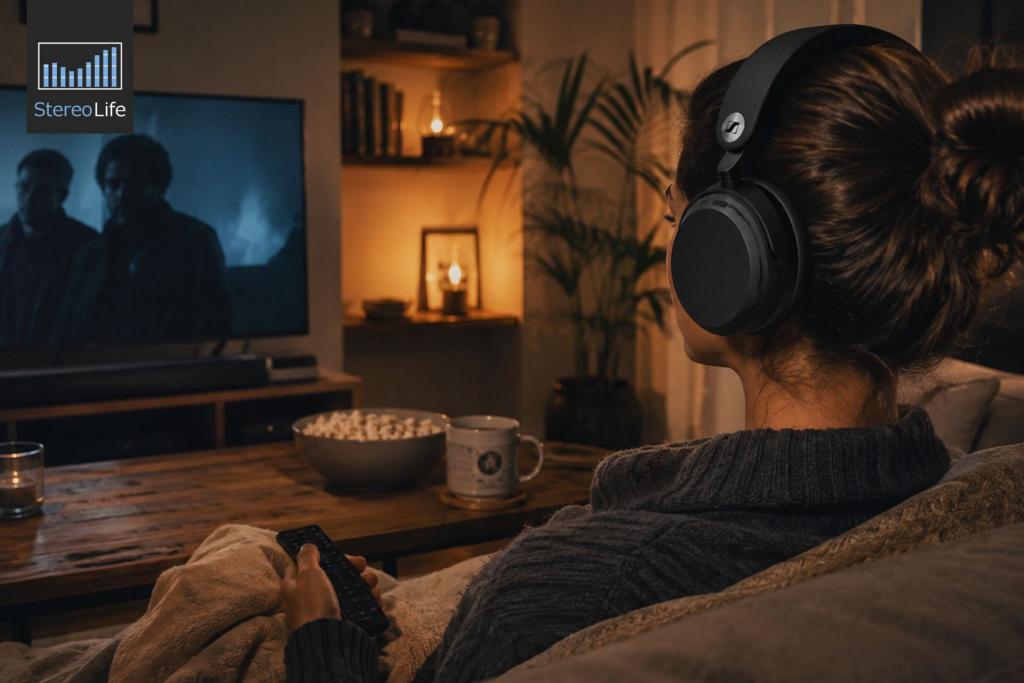
The basic architecture remains almost unchanged. The Momentum 5 are closed-back, over-ear headphones with oval cups, a broad headband finished with fabric across the top, and deliberately understated styling. The cups swivel flat but do not fold inward. Weight is around 290 g, which still counts as relatively light in a category where batteries, microphones, antennas, amplifiers, processors, and touch controls all have to fit somewhere. A difference of ten or fifteen grams may seem trivial when you are comparing specifications online, but travel headphones are worn for hours at a time. After three hours on a train or a full working day in front of a computer, small differences in weight and clamping force stop being theoretical. Sennheiser has clearly decided that keeping the structure light matters more than adding decorative metal just to make the product feel expensive when someone picks it up in a store. The company says the size of the ear cups and the clamping force are essentially unchanged from the Momentum 4, which will be reassuring to some buyers and less so to others. If the Momentum 4 fit you well, these probably will too. If you found the pads a little cramped, nothing fundamental has changed. Larger or more protruding ears can still brush against the inside of the cups, and like virtually every closed-back headphone with thick, soft pads, the Momentum 5 will eventually get warm. I would not call that a flaw so much as the price of the design. Sennheiser is prioritizing isolation, low weight, and effective ANC, not the huge ventilated ear chambers found on full-size open-back headphones.
Whether the build quality feels appropriate for the price depends largely on what you put next to them. Beside the Accentum Wireless, the hierarchy is obvious. The cheaper model was designed to hit a lower price and makes no great effort to hide that fact; the Momentum 5 feel much more polished and mature. Put them beside the Bowers & Wilkins Px7 S3, though, and Sennheiser has a tougher time. Bowers & Wilkins has put a great deal of effort into reducing bulk, refining the shape, improving the materials, and making the entire object feel expensive. The Momentum 5 are much more utilitarian by comparison. They do not look cheap, but neither are they the kind of headphones you pick up and spend five minutes admiring. Sennheiser seems to have decided that once a product is light, comfortable, durable, and well assembled, there is little reason to spend money on carbon fiber, decorative metal mesh, exotic trim, or elaborate hybrid pads simply for the sake of visual drama. Most owners would probably prefer that money to go elsewhere, and there is something appealing about how little attention the Momentum 5 draw to themselves. They are easy to live with, easy to travel with, and they do not need to be treated like an expensive object. That said, the fabric on the headband and the glossy discs carrying the Sennheiser logo do add just enough visual interest to keep the design from becoming completely anonymous, while subtly recalling the more luxurious materials that once defined the Momentum name.
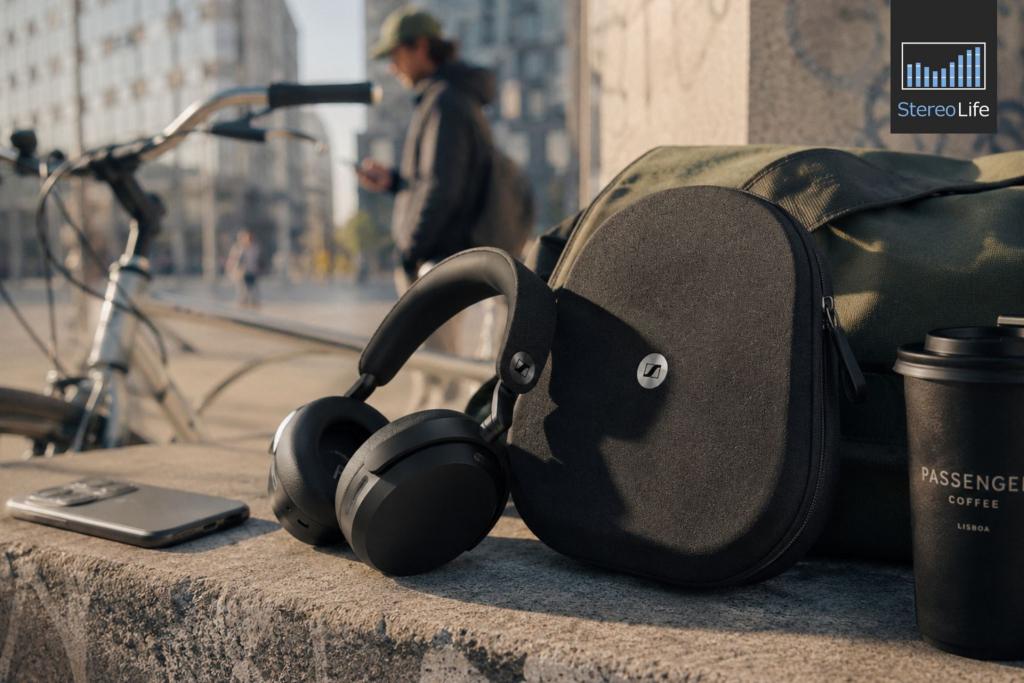
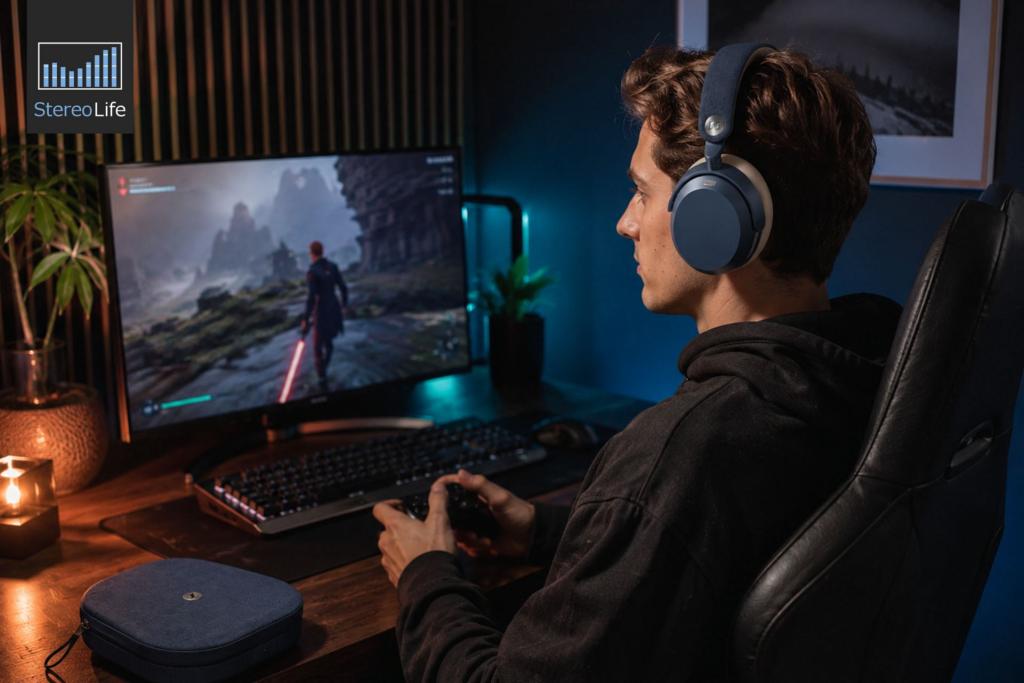
The carrying case tells a more interesting story. It is noticeably smaller than before, with Sennheiser quoting a reduction of roughly 18-20%. Most of that saving comes from thickness, which is exactly where it matters. A case can be beautifully made and technically compact, but if it is too thick to slide comfortably into a laptop bag, none of that helps when you are standing in an airport trying to make room for a charger, a bottle of water, and a stack of documents. At home, a few centimeters are irrelevant. On the road, they can be the difference between taking the case and leaving it behind. This is one of those changes that looks boring in a press release but makes perfect sense in daily use. The box also contains a USB-C cable and a 2.5-to-3.5-mm analog cable, so both digital and conventional wired operation are covered from the start. Unlike the HDB 630, however, the Momentum 5 do not come with Sennheiser's BTD 700 transmitter. That is an optional purchase. The distinction says a lot about how Sennheiser sees the two products. The HDB 630 are sold as a complete package for listeners who want to squeeze the best possible audio quality out of almost any source. The Momentum 5 assume that most people will use whatever their phone or laptop already provides.
Controls will be familiar to anyone coming from the Momentum 4. A physical button handles power, pairing, and a few secondary functions, while the large touch surface on the right cup does most of the everyday work. Taps and swipes control playback, volume, calls, and noise cancellation. Anyone who fundamentally dislikes touch controls is unlikely to be converted, but the system does have one major advantage: a large touch surface can handle a lot of commands without forcing Sennheiser to scatter tiny buttons around the edge of the cup. The obvious downside is accidental input when adjusting the headphones, although the touchpad can be disabled in the app if it becomes annoying. Sennheiser has also reworked the automatic behavior in ways that suggest it listened to Momentum 4 owners. Wear detection is still here, so removing the headphones can pause playback and putting them back on can resume it, but the Momentum 5 no longer spring back to life in quite the same overenthusiastic way as their predecessor. Leave them unused for long enough and they shut down. Put them in the case and they go to sleep. Take them back out and you press the button to wake them up. None of this sounds like a headline feature, but these small details often decide whether "smart" behavior feels genuinely smart or starts to feel like the product has a mind of its own.
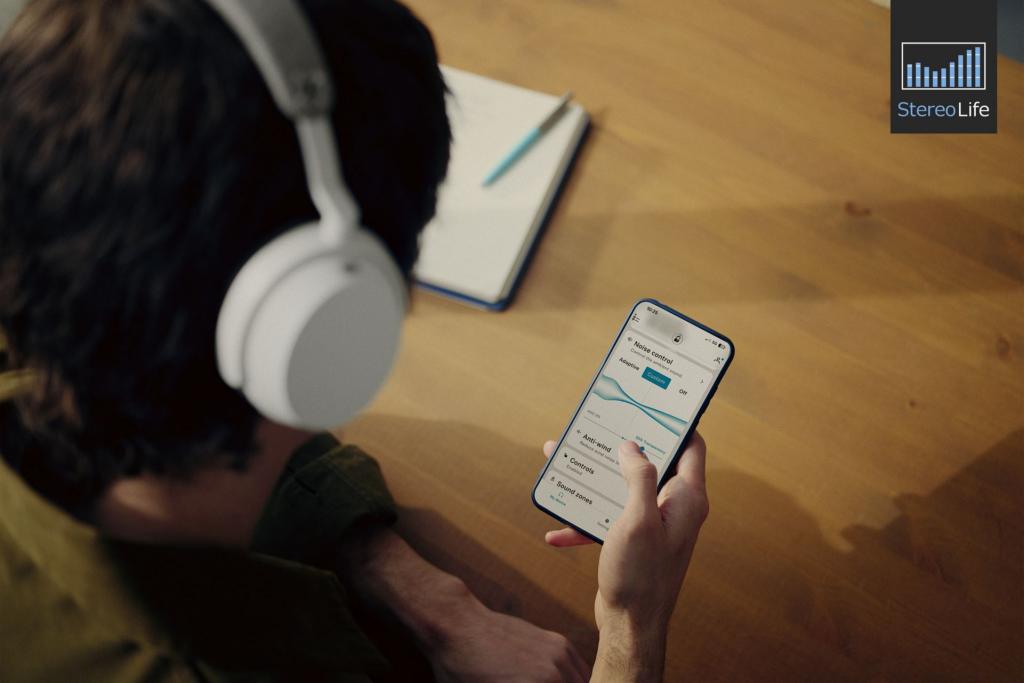
The Smart Control Plus app is where the bigger changes become obvious. The Momentum 5 now offer an eight-band graphic equalizer, user presets, and Sound Personalization. This is not the fully parametric EQ available with the HDB 630 - you cannot freely choose center frequencies, bandwidth, and every other filter parameter - but that is not necessarily a problem. A proper PEQ is an extraordinarily powerful tool in the right hands and a very efficient way to destroy a perfectly good frequency response in the wrong ones. The eight-band EQ is less flexible, but for most listeners it hits a useful middle ground: enough control to correct what bothers you, without requiring a working knowledge of filter design. With the Momentum 5, that matters because the stock tuning puts substantially more weight into the low end than the Momentum 4 did. If that is exactly what you want, there is no reason to touch anything. If it is not, the app lets you pull the bass back in seconds without turning the process into a science project. Sound Personalization approaches the same problem from the opposite direction. Rather than asking you to interpret a frequency graph, it plays prepared material with different layers and balances, asks what you prefer, and builds a DSP profile from your choices. It is intuitive, quick, and perfectly in keeping with the Momentum philosophy. Interestingly, the resulting profile is not simply an eight-band EQ preset hidden behind a prettier interface; it can make adjustments that are difficult to reproduce manually. In other words, Sennheiser offers two ways to get where you want to go. One is for the person who knows they want two or three decibels less bass. The other is for the person who only knows which version sounds better. Add ANC controls, transparency settings, connection management, firmware updates, quality options, and Dolby Atmos with head tracking, and the app has become a genuinely important part of the product rather than a setup utility you open once and forget.
Bluetooth 6.0 is a different matter. At launch, Sennheiser talked about hardware that was ready for a future upgrade, but the specification as it stands still says Bluetooth 5.4, while LC3 and Auracast are not currently listed as active features. It is worth being precise here because the consumer electronics world has a habit of turning "planned" into "included" somewhere between the press release and the retail page. For now, the Momentum 5 should be judged on what they actually support today, and fortunately that list is already extensive: SBC, AAC, aptX, aptX HD, aptX Adaptive, and aptX Lossless, all within the Snapdragon Sound ecosystem. That collection of acronyms translates into something much simpler in practice. Basic compatibility is covered, Android users with the right hardware can take advantage of the more advanced aptX variants, and aptX Lossless offers the closest thing currently available to conventional lossless Bluetooth transmission under suitable conditions. It does not magically make every phone sound like a cable connection, nor does every Android device support every codec on the list, but it gives compatible sources a great deal of room to work with. iPhone owners, as usual, are limited to AAC unless they add an external transmitter such as the BTD 700.
Sennheiser has taken wired use seriously too. The USB-C port is not just for charging; connect the Momentum 5 to a computer and they can accept digital audio at up to 24-bit/96 kHz. For anyone who works at a desk, this may end up being one of the most useful features on the entire product. Wireless headphones spend a surprising amount of their lives being worn within arm's reach of a laptop. In that situation, Bluetooth is convenient but not necessary, while USB removes the radio link entirely, guarantees the connection format, and charges the battery at the same time. Plug the headphones in and the computer sees them as an audio device. No wondering whether Windows has decided to use the right codec, no concern about radio conditions, no reason to think about the battery. It is exactly the sort of feature that sounds unglamorous until you realize you use it every day. The analog input remains as well, which may feel almost old-fashioned but gives the Momentum 5 another layer of flexibility. Airline entertainment systems, older portable players, legacy equipment, strange adapters in hotel rooms - sooner or later, there is always a device that does not want to talk Bluetooth or USB. In an industry increasingly obsessed with removing anything that can be removed, keeping the analog option feels refreshingly practical.
Noise cancellation is where the generational jump is easiest to notice. The Momentum 4 used four microphones; the Momentum 5 use eight, four on each side. Microphone count alone proves nothing, of course. You could fill the ear cups with microphones and still get mediocre ANC if the processing behind them were poor. Here, however, the hardware change comes with a clear improvement in performance. Sennheiser claims up to three times better attenuation in parts of the midrange, particularly around human speech. I would not treat that number as gospel without seeing the exact test conditions, but independent measurements do support the broader point: the new system is much stronger, especially below roughly 1.1 kHz. That is important because low, steady noise is the easy part. Even fairly ordinary ANC headphones can make a respectable dent in the drone of an airplane engine. Voices, office chatter, public-address announcements, and the constantly changing mixture of urban noise are much harder to suppress convincingly. Improving that part of the spectrum makes a far greater difference in real life than gaining a few more decibels at 50 Hz. This is one of those upgrades that matters far more than the specification sheet alone suggests.
Battery life presents a slightly amusing case because the headline number has actually gone backward. The Momentum 4 were rated at up to 60 hours, while the Momentum 5 promise 57. If this were a benchmark chart, somebody might call that a regression. In actual use, it is almost meaningless. Once battery life reaches this level, three hours either way barely matters. Many people will still charge these headphones once a week, perhaps even less often, and anyone who spends a significant amount of time using USB at a computer may almost forget that charging is something they need to do. One reviewer reportedly managed 48 hours and 30 minutes with aptX Adaptive and ANC running at full strength, which is arguably a more useful figure than the idealized "up to 57 hours" claim. Even under conditions that make the headphones work fairly hard, there is an enormous amount of reserve. Ten minutes on the charger should provide around seven hours of playback, although Sennheiser's own documentation is not completely consistent on the exact figure. Either way, fast charging feels more like an emergency feature than something you will depend on regularly, and that is precisely what good battery life should achieve: make you stop thinking about battery life.
The genuinely important battery news is not how long it lasts, but what happens when it eventually does not. The 700-mAh cell is user-replaceable. Properly replaceable. Remove the left ear pad, undo four screws, lift the cover, unplug the old battery, connect the new one, and put everything back together. No mailing the headphones to Germany, no replacing an entire ear cup, no repair bill so high that buying a new pair starts to look sensible. The pads can be replaced too. In a product full of Bluetooth standards, spatial audio, adaptive processing, and digital microphones, those four little screws may be the most genuinely forward-looking feature of all. Whether this was inspired by European right-to-repair legislation is difficult to say, and the rules surrounding small battery-powered electronics are more complicated than the popular shorthand suggests, but the important part is that Sennheiser has done it. JBL has already moved in a similar direction with replaceable batteries in some of its wireless speakers, and I hope the idea spreads. Wireless headphones are one of the stranger forms of disposable consumer electronics. You can spend $500 or $1000 on a pair, keep them in excellent physical condition for five years, have perfectly healthy drivers inside, and still end up with a product headed for e-waste because one battery has reached the end of its useful life. I raised that problem when reviewing the Momentum 4, wondering why almost nobody asks about repairability before buying and everybody starts asking about it after the warranty expires. The Momentum 5 do not solve every long-term service issue, but Sennheiser has taken a meaningful step in the right direction. That deserves real credit.

Sound performance
When I reviewed the Momentum 4, I described the series as living somewhere between hi-fi and hi-fun. That balance has always been central to the Momentum idea. The sound had to be natural, balanced, and transparent enough to justify the Sennheiser name, but these headphones were never intended to behave like clinical studio tools. They were supposed to have some warmth, some impact, and enough personality to make music enjoyable rather than turn every listening session into an exercise in analysis. The Momentum 4 landed in that sweet spot very well. They were slightly warm, gently emphasized at the frequency extremes, dynamic, spacious, and generally tasteful about it. The Momentum 5 move the balance noticeably toward the "fun" side. More noticeably, in fact, than you might expect from a headphone using exactly the same basic driver. It is also a useful reminder that in an active wireless design, the transducer is only part of the story. Change the DSP, amplifier behavior, low-frequency correction, ANC interaction, and overall target curve, and the same 42-mm driver can end up sounding like it belongs in a very different headphone.
The biggest difference is bass. There is more of it, and not by a small margin. The increase is particularly obvious in the sub-bass, where Sennheiser has clearly decided that the Momentum 5 should sound substantial, physical, and powerful. Measurements show the lift very clearly, and the company itself makes no attempt to describe the tuning as neutral. Warm and bass-forward is much closer to the truth. At least there is no pretense involved: this is not a side effect of the design but an intentional part of the product's character. The useful question is therefore not whether the Momentum 5 are neutral - they are not - but whether the new balance works, and whether Sennheiser has pushed it just a little too far. Thankfully, this is not the usual cheap trick of boosting a narrow strip of midbass so the headphones sound impressive during a thirty-second store demo. The low end has genuine depth. It reaches down, fills out the bottom octave, and gives the presentation a physical foundation rather than simply making kick drums louder. With the right recording, the effect can be genuinely impressive.
Electronic music, pop, hip-hop, and modern rock are the obvious beneficiaries. Kick drums land with proper weight, synthesizers reach into the sub-bass instead of merely hinting at it, and rhythm becomes something you feel as much as hear. Compared with the Momentum 4, the new model sounds more contemporary, more demonstrative, and more immediately entertaining. The good news is that Sennheiser has not simply buried the midrange under all that bass. Attack remains quick enough and control strong enough to keep the low end from turning most recordings into a thick, indistinct mass. That distinction matters. Heavy bass can be a deliberate voicing choice or a convenient way to distract from everything else, and here it is clearly the former. You may decide there is too much of it, but it rarely sounds cheap or poorly controlled. I say "rarely" because the stock tuning sits very close to the point where generous becomes excessive. Much depends on the recording and, perhaps even more, on the seal around the ear. Glasses can reduce the bass noticeably, while a perfect seal delivers the full effect Sennheiser intended. I suspect this is the area most owners will adjust first, and fortunately the EQ makes that easy. A modest reduction in the lowest bands is often enough to turn the Momentum 5 from an unapologetically bassy consumer headphone into something much more balanced without draining the life out of it.
The midrange is where things become more interesting, because it is probably the strongest part of the presentation and the reason the Momentum 5 never collapse into the usual bass-heavy consumer formula. Vocals are not pushed behind the low end. They remain full, expressive, smooth, and convincingly placed in the mix. Sennheiser also resists the temptation to manufacture "detail" by lifting the upper mids and lower treble, a common trick that sounds exciting for ten minutes and exhausting after an hour. Instead, information is presented with a softer, more organic quality. Voices have body. Acoustic instruments retain their natural weight. Dense arrangements remain surprisingly coherent. That makes the Momentum 5 much easier to recommend to people who normally avoid overtly bassy headphones. Yes, the bass is one of the first things you notice, but the midrange is not simply the space between the low and high frequencies. It has color, texture, and presence of its own. In fact, the natural, expressive character of the midband is one of the Momentum 5's biggest strengths. Had Sennheiser paired this bass response with a recessed middle, we would be looking at a flashy pair of travel headphones and not much more. Instead, the sound has enough substance to reach beyond that. Nor is the response particularly V-shaped. The Momentum 5 are better described as warm, full, and slightly dark. Vocals keep their body, guitars do not become thin, piano still sounds like a resonant instrument rather than a collection of hammer strikes, and saxophone retains its wood, metal, and breath rather than turning into a bright metallic outline. If anything has been sacrificed to make the overall presentation easier to live with, it is the top octave, not the midrange.
The treble is more relaxed than on the Momentum 4. That does not mean it has been rolled off to the point of dullness. Cymbals are still present, strings retain their bite and harmonic structure, reverberation is easy to follow, and there is no shortage of basic detail. What is missing is that last measure of air, sparkle, and openness. The uppermost frequencies have been smoothed over in a way that clearly favors comfort over forensic resolution. There is an obvious upside: the Momentum 5 are exceptionally easy to listen to. Poor recordings do not suddenly become unbearable, sibilance rarely jumps out of the mix, and you can listen louder or longer without the top end taking over. The tradeoff is equally obvious. If you are used to open, highly transparent audiophile headphones, or even Sennheiser's own HDB 630, you may miss a little more light around fine detail, more freedom in the upper harmonics, and longer, more delicate decay. Measurements point in the same direction, showing restrained energy at the very top. I do not consider that a mistake so much as a conscious decision about what these headphones are for. The Momentum 5 are designed to be worn for hours on a plane, in an office, on a train, or while walking through a city. They are not meant to be microscopes for comparing two masterings of the same album. The resulting sound is therefore smooth and easygoing without becoming bland. There is still plenty of energy; Sennheiser has simply concentrated it lower down. The presentation has scale, the bass can move a surprising amount of air, the midrange remains rich and expressive, and the treble almost never gets in the way. For long listening sessions, that balance works extremely well.
Dynamics are good, but they come with a particular character. The Momentum 5 can play loudly and with plenty of scale, and they are more than capable of delivering impact, yet they do not attack rhythm with the nervous, tightly wound energy of some more immediate designs. With bass-driven music, this rarely hurts because the sheer mass of the low end gives the music momentum of its own. In a sense, the Momentum 5 trade a little speed for weight. Drum hits are not always as dry or sharply outlined as they could be, but they have authority and size. With fast percussion, funk, technical metal, or rhythmically complex jazz, the difference becomes easier to hear. Sennheiser tends to favor continuity and flow over drawing a hard outline around every transient. Whether that is a strength or a weakness will depend entirely on the listener. Some will call it musical; others will want more snap, more tension, and a stronger sense of immediacy. I would not call the Momentum 5 slow. The difference is closer to driving a fast car with comfortable suspension rather than one that reacts to every touch of the throttle as though you have just entered a qualifying lap. Over a long journey, there is a lot to be said for the former. If your idea of excitement is razor-sharp attack and relentless rhythmic precision, however, the HDB 630 or some competitors may be more satisfying.
Soundstage is harder to pin down because fit and DSP affect it more than they do many other aspects of the sound. With a closed headphone, cup geometry, pad position, head shape, and the quality of the seal can all alter spatial perception, so there is more room here for individual variation. With Dolby Atmos turned off, the Momentum 5 obviously do not create the huge, open presentation of a large open-back headphone, but neither do they trap everything in a narrow line between the ears. The stage has respectable width, instruments are not piled on top of one another in the center, and the rich midrange gives images believable size and substance. Just as importantly, Sennheiser does not create an illusion of space by brightening the treble or pushing everything unnaturally away from the listener. The effect is more restrained than that: a coherent, reasonably broad panorama in which instruments have room to breathe. Spatial performance alone would not be my reason for buying these headphones, but it fits the rest of the presentation nicely. If you expect the illusion of a vast concert hall, you may come away disappointed. If your goal is simply to avoid the familiar closed-headphone sensation of having two drivers glued directly to your ears, the Momentum 5 do well. Dolby Atmos changes the picture more dramatically, pushing the apparent stage farther outside the head and giving compatible content a much larger sense of scale. Head tracking makes the most sense with movies, where anchoring the sound field to the screen changes the experience in a convincing way as you move your head. For serious stereo listening, though, I still see it as an extra rather than a solution. Good stereo should work without spatial processing, and the Momentum 5 generally does.
USB audio is worth exploring as well. The appeal is not simply that 24-bit/96-kHz looks good on a specification sheet. Connecting the headphones directly to a computer removes the usual Bluetooth variables and feeds them a consistent digital signal without any concern about codec selection, radio conditions, or bitrate changes. I would not pretend the difference between USB and a well-implemented aptX Adaptive or aptX Lossless connection is enormous. Switching back to Bluetooth does not suddenly make the music fall apart. But USB can bring a little more order to the presentation, sharpen textures, make reverberation and decay easier to follow, and - perhaps most importantly - give you consistency. You know exactly what the signal path is doing. For anyone who uses the headphones at a desk, that alone makes the feature worthwhile, and the fact that they charge at the same time is the icing on the cake. In everyday use, then, the Momentum 5 can be two products at once: a fully wireless travel headphone outside the house and a simple USB audio system at a computer. That versatility is one of their strongest practical arguments.
The comparison with the Momentum 4 is inevitably the most interesting one, and it is not as simple as saying that the new model sounds better. As a product, the Momentum 5 are unquestionably more advanced. The ANC is much more effective, aptX Lossless has joined the codec list, the EQ is more capable, Dolby Atmos is available, the case is smaller, and the battery can be replaced. None of these changes is cosmetic; they all make the headphones better to live with. If you judge them as a complete piece of consumer electronics, the Momentum 5 are clearly the more modern product. Sonically, however, Sennheiser has not simply polished the old sound. It has changed the character. The Momentum 4 were more even-handed and broadly versatile, while the Momentum 5 are more extroverted and have a stronger personality. It almost feels as though Sennheiser decided that voicing itself needed to move with the times. I am not entirely convinced that it did. Some listeners will immediately prefer the new model because it sounds bigger, fuller, and more exciting from the first track. Others will regard the change as a sideways step, perhaps even a small backward one if the balance of the Momentum 4 was exactly what they liked. Anyone who loves the stock tuning of the old model should not buy the Momentum 5 expecting the same sound with every parameter improved by twenty percent. That is not what happened. The new headphones are much more complete functionally, but they have a different sonic personality.
Does that mean Sennheiser spoiled a good thing? I do not think so. The decision becomes easier to understand when you look at the company's current range rather than the Momentum 5 in isolation. The HDB 630 now occupy the more neutral, analytical, audiophile end of Sennheiser's wireless lineup, which gives the Momentum room to loosen up. If you want a more neutral tonal balance, higher resolution, stronger differentiation of timbre, and deeper control through parametric EQ and crossfeed, the HDB 630 are the obvious answer. Once that product exists, the Momentum no longer have to satisfy the same listener. They can lean into bass, soften the treble, and be more entertaining without abandoning good sound altogether. In that sense, the split is actually quite logical. The HDB 630 are the headphones for someone who wants to carry a little piece of a home hi-fi system around. The Momentum 5 are for someone who wants one very good pair of headphones to handle work, travel, movies, phone calls, commuting, and music without turning any of those things into a project. One owner may spend an evening adjusting parametric filters. The other will throw the Momentum into a backpack, head to the airport, disappear behind the ANC, watch a movie, take a few calls, and still have most of the battery left at the end of the day. I can easily imagine someone owning both. Personally, I would choose the HDB 630 for home listening and focused sessions, and the Momentum 5 for walking around town, traveling, or anything else where convenience matters just as much as absolute fidelity. Equally, I can understand someone buying the Momentum 5 as their only headphone and using the EQ to pull the stock tuning closer to their taste. Moving a couple of sliders is hardly a moral failure.

Build quality and technical details
The Sennheiser Momentum 5 Wireless are closed-back, wireless over-ear headphones built around the company's familiar 42-mm dynamic driver. That makes the acoustic side of the design surprisingly conservative. The transducers are manufactured in Tullamore, Ireland, and Sennheiser likes to point to conceptual links with the HD 600 family, although that should not be taken to mean that an HD 600 driver has somehow been transplanted into a wireless Momentum shell. The two products operate under completely different conditions: different enclosures, different acoustic loading, and, above all, a fully active signal path with onboard amplification and DSP. Sennheiser does not publish the exact diaphragm material either, so confident online claims on that subject should be treated with caution. What matters most is that the basic driver hardware is the same as in the Momentum 4. The generational improvement comes from the tuning, electronics, processing, firmware, ANC, and the way the entire system is managed. In a passive headphone, carrying over the same driver might look like a rather modest upgrade. In an active wireless design, it tells only part of the story.
Sennheiser specifies a frequency response of 6 Hz-40 kHz over Bluetooth or USB and 6 Hz-22 kHz through the analog input. Sensitivity is listed at 108 dB SPL at 1 kHz and 0 dBFS, while total harmonic distortion is said to remain below 0.2% at 1 kHz and 100 dB SPL. Active-mode impedance is 520 ohms. Those numbers need to be read in context. A quoted response extending to 40 kHz does not automatically translate into greater audible detail than a headphone specified to 30 kHz, and the 520-ohm figure means very little in the usual sense because the Momentum 5 are not passive headphones waiting for the owner to choose an amplifier. The transducer, onboard electronics, and amplification were designed as a single system. These figures therefore describe the operating conditions of that system more than they tell you anything useful about matching equipment.
Wireless connectivity is built around Bluetooth 5.4 Class 1, with A2DP, AVRCP, HFP, HSP, and GATT profiles and support for SBC, AAC, aptX, aptX HD, aptX Adaptive, and aptX Lossless. The list looks technical, but its practical meaning is straightforward: the Momentum 5 work across ecosystems and can take advantage of more advanced transmission standards when the source supports them. Android devices may offer one of the aptX variants, Apple hardware uses AAC, and computers can bypass Bluetooth completely through USB. Multipoint allows the headphones to stay connected to two devices at once, a feature that sounds mundane until you are listening from a laptop and an important call comes in on your phone. USB-C accepts PCM at up to 24-bit/96 kHz, while the analog input on the headphones uses a 2.5-mm socket and the supplied cable terminates in a standard 3.5-mm plug. Between Bluetooth, USB, and analog, it is difficult to imagine many situations in which the Momentum 5 cannot be used.
The Hybrid Adaptive ANC system relies on eight digital microphones, four on each side. Voice calls use a different arrangement involving three feed-forward microphones and an additional feedback microphone, while Transparency Mode and wind-noise reduction are also available. There is no official IP rating, and Sennheiser advises against exposing the headphones to water or heavy perspiration, so I would not treat them as sports headphones and certainly would not take them running in the rain. The lithium-ion battery has a capacity of 700 mAh and, importantly, can be replaced by the user. Claimed battery life is up to 57 hours with Bluetooth and ANC active. A full charge takes around two hours, while a ten-minute top-up should provide roughly seven hours of additional listening. Weight is approximately 290 g, and with the cups rotated flat the headphones measure 180 x 197 x 47 mm. Final assembly takes place in China, the product is designed in Germany, and the drivers are made at Sennheiser's facility in Tullamore, Ireland.
System configuration
Apple iPhone SE, Asus Zenbook UX31A, Sony WF-1000XM3, Bowers & Wilkins P5, Bowers & Wilkins Px7 S2.

Verdict
The Momentum 5 Wireless are a good example of how to update a mature product without redesigning it simply for the sake of having something new. Sennheiser started with a very strong foundation and focused on the areas where the Momentum 4 genuinely left room for improvement. ANC is substantially better. Codec support is broader. The app is more useful. The case is smaller. Personalization goes much further. And, most importantly to me, the replaceable battery gives the headphones a better chance of remaining useful long after the usual consumer-electronics upgrade cycle has moved on. None of those changes feels like feature-box padding. They all improve the product in ways that can be felt in normal use. The Momentum 5 are more complete, more practical, and better adapted to how people actually use wireless headphones today. It is also worth pointing out that Sennheiser has launched the fifth generation at exactly the same price the Momentum 4 carried when they were new.
Sound is the one area where the story is not a simple progression. The Momentum 5 are neither clearly better nor clearly worse than their predecessor. They are different. The new model is bolder and more playful, with substantially more bass, a rich and expressive midrange, and a smoother top end. Some listeners will prefer that immediately. Others will open the app within five minutes and start pulling the lower bands down. That is worth doing because underneath the deliberately generous factory tuning is a very capable driver that can deliver coherent, dynamic, easygoing sound without becoming tiring. If your priorities are neutrality, resolution, and the sort of tonal balance associated with good traditional hi-fi headphones, the HDB 630 make more sense. I do not consider that a criticism of the Momentum 5. If anything, the existence of the HDB 630 is what allows the Momentum 5 to have more personality. Sennheiser now has a wireless model designed to satisfy the audiophile instinct, so the Momentum are free to be more relaxed, more colorful, and more fun. Most manufacturers have been doing this for years. There is no reason the Germans should not be allowed to join in.
What wins me over, though, is the Momentum 5 as a complete product. You can throw them in a backpack, take them on a trip, use them over USB at a desk, keep them connected to two devices, shut out a remarkable amount of outside noise, and then go for days without giving the charger a thought. A few years from now, when the battery eventually begins to wear out, you may be able to keep the headphones going with nothing more exotic than a replacement cell and a small screwdriver. In the long run, that may matter far more than aptX Lossless or Dolby Atmos. Should Momentum 4 owners rush out and upgrade? If you are happy with what you already have, no. The fourth generation remains good enough that skipping one cycle and waiting for the "sixes" would make perfect sense. If you are buying today, however, travel frequently, care about effective ANC, want flexible connectivity, long battery life, strong everyday usability, and a better chance of keeping the product alive for years, the Momentum 5 are the more future-proof choice. They are not revolutionary, and they do not need to be. They are simply a much more thoroughly developed - and sonically more mischievous - version of an idea that was already very good.








Technical data
Headphone type: Dynamic, closed-back, over-ear, wireless
Drivers: 42 mm
Frequency response (Bluetooth/USB): 6 Hz-40 kHz
Sensitivity: 108 dB SPL at 1 kHz/0 dBFS
THD: <0.2% at 1 kHz/100 dB SPL
Wireless connectivity: Bluetooth 5.4
Codecs: SBC, AAC, aptX, aptX HD, aptX Adaptive, aptX Lossless
USB audio: Up to 24-bit/96 kHz
ANC: Hybrid Adaptive ANC
App: Sennheiser Smart Control Plus
Features: Sound Personalization, Dolby Atmos, Head Tracking, Transparency Mode, Smart Pause
Battery: Li-ion, 700 mAh, user-replaceable
Battery life: Up to 57 hours with ANC
Full charging time: Approximately 2 hours
Weight: 290 g
Price: $399/€399/£329
Manufacturer: Sennheiser
Sound performance
Editor's rating
8.2Overall7Sound9Functionality9Design8Quality8Price