- News
- Posted
Dynaudio Legend
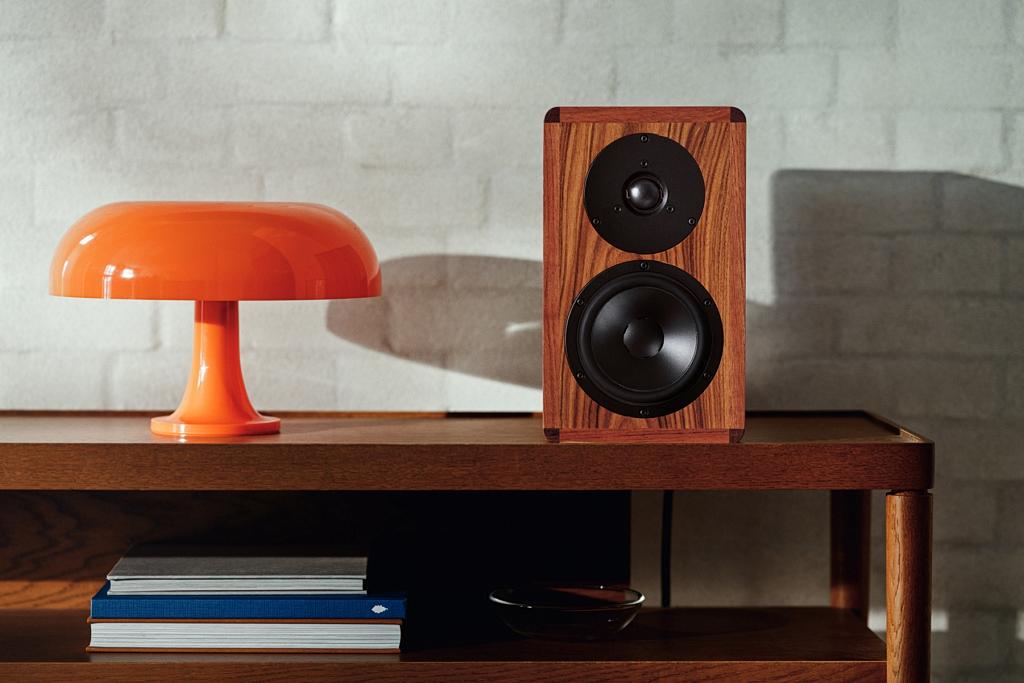
Dynaudio introduced the Legend, a compact high-end standmount loudspeaker positioned outside the company's regular product ranges and conceived as a design-led model that combines reference-grade driver technology with furniture-level craftsmanship. Rather than forming part of an existing series, the Legend follows the tradition of special standalone releases such as the Special Forty, offering a distinctive interpretation of Dynaudio's core engineering philosophy in a compact enclosure intended for flexible placement and relaxed listening environments.
Unlike many anniversary-style loudspeakers, the Legend is not a limited-edition product, although individuality plays a central role in its identity. Each cabinet is finished in rosewood veneer panels complemented by jatoba corner elements, sometimes referred to as Brazilian cherry. These hardwood components receive matching surface treatment and are visually paired by hand to ensure coherent grain alignment within each stereo pair. Because the natural structure of the wood varies from set to set, no two pairs are identical, reinforcing the model's positioning as both a high-end audio component and a decorative object intended for long-term ownership.
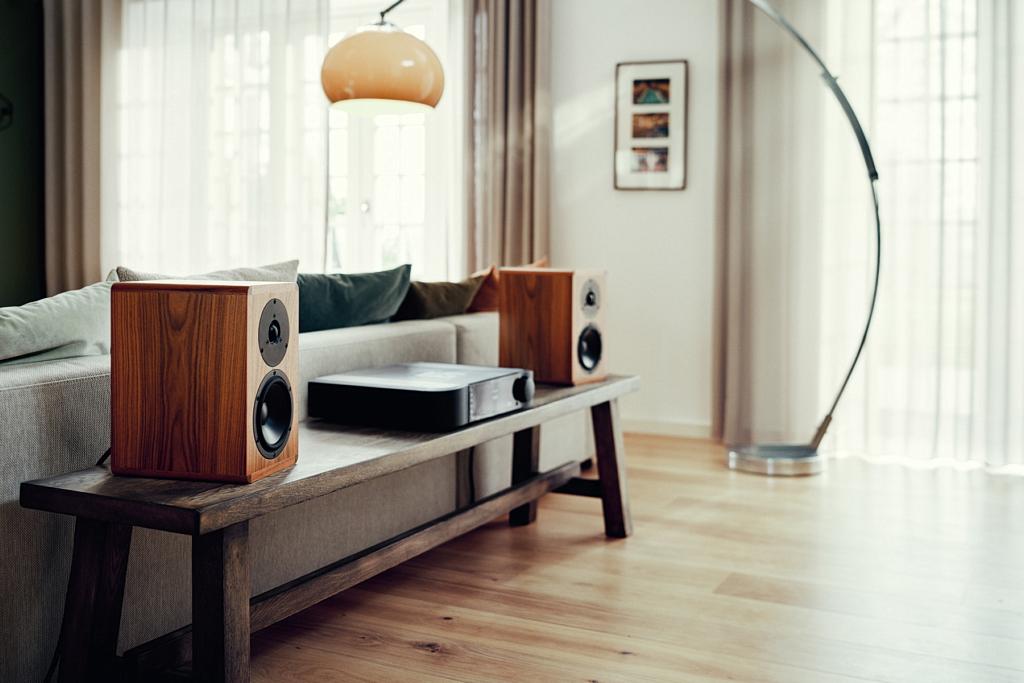
Dynaudio also presents the Legend as a loudspeaker designed for less rigid listening conditions than traditional nearfield stereo setups. Rather than requiring strict positioning on dedicated stands and a fixed listening axis, the speakers are intended to perform convincingly across a wider range of placements, whether positioned upright, inverted, laid horizontally, or installed on shelves, furniture, or stands. This flexibility reflects a broader shift toward systems that combine serious hi-fi performance with everyday usability in living spaces rather than dedicated listening rooms.
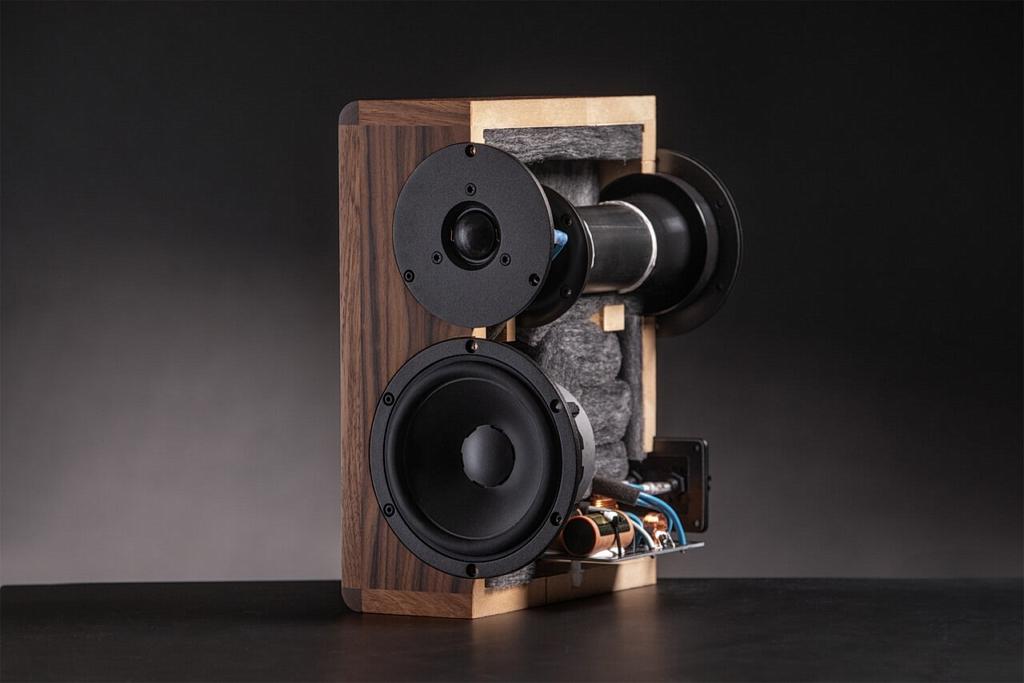
Despite their compact dimensions, the Legend incorporates one of the company's most advanced high-frequency drivers, the Esotar3. This 28 mm soft-dome tweeter, derived from the flagship Confidence series, is paired with Dynaudio's Hexis inner-dome structure, which reduces internal resonances and improves airflow behind the diaphragm. The result is intended to be lower distortion, smoother treble extension, and improved micro-detail retrieval compared with earlier Esotar generations, bringing reference-level high-frequency performance to a smaller loudspeaker platform.
Low and mid frequencies are handled by a 15 cm MSP (Magnesium Silicate Polymer) midwoofer operating up to a crossover point at 3.5 kHz. This driver continues Dynaudio's long-standing use of one-piece MSP diaphragms, a material chosen for its balance of stiffness, damping, and low coloration. The overall frequency response is specified from 60 Hz to 28 kHz, suggesting that while the Legend can operate as a full-range solution in smaller rooms, integration with a subwoofer may be beneficial in larger listening spaces or for users seeking extended low-frequency output.
The enclosure follows a bass-reflex configuration and measures 186 x 311 x 271 mm, with each speaker weighing 6.3 kg. Sensitivity is rated at 83 dB with a nominal impedance of 6 ohms, consistent with Dynaudio's preference for controlled driver behavior over maximum efficiency. Recommended amplifier power is specified at up to 150 watts, indicating that the Legend is intended to be partnered with capable electronics despite its modest physical size. Connection hardware includes high-quality rear terminals designed to support a wide range of cable types and installation scenarios, reinforcing the model's positioning as a serious hi-fi component rather than a lifestyle-oriented compact speaker. With a retail price of €6,000 per pair, the Legend sits firmly in the premium compact loudspeaker category. Info and photos by Dynaudio.